Chile Burns Again as Wind Turns Neighborhoods into Ash Overnight

A wall of fire tore through Biobío as Chile’s summer heat peaked, killing at least 16 and forcing more than 20,000 from their homes. In Penco, the mayor said he was “emotionally destroyed” watching firefighters weep at the command post.
Orange Skies, Empty Streets
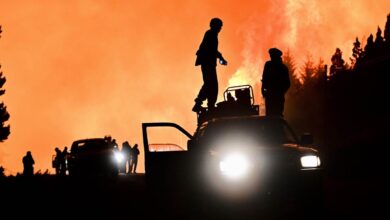
By Sunday, the southern forests and hills of Chile were no longer background scenery; they were an advancing front. Entire neighborhoods in Biobío were reported destroyed, with evacuees streaming toward temporary shelters carrying what they could grab in the minutes before smoke turned the day to dusk. Videos and photographs captured flames leaping across buildings and utility poles, thick smoke swallowing the horizon beneath a bruised orange haze. When the fire passed, it left a quiet that felt unnatural: collapsed structures, streets lined with charred cars, and a landscape that looked sifted through a furnace.
In Penco, a city of about 50,000, roughly 400 kilometers south of Santiago, Mayor Rodrigo Vera described a scene that sounded more like grief than disaster management. “Emotionally, I am destroyed,” he said on Chilean radio, explaining that some firefighters had been trapped and that he had seen others crying on the ground at the command post. Even his plea to the national government came without political varnish, as if the fire had burned away every other language. ”I beg you, please, from the deepest part of my heart. Come and help us,” he said, pleading for help.
The scale of displacement pushed the emergency beyond the obvious images of burning homes. Vera said more than 20,000 people had to abandon their houses, and emergency crews evacuated patients from a hospital threatened by the flames. In a country accustomed to summer fires, the ritual is familiar: sirens, shelters, ash falling like a thin snow, but familiarity doesn’t reduce the shock when entire blocks vanish, and the air itself becomes dangerous to breathe.
A State of Catastrophe
In the early hours of Sunday, President Gabriel Boric declared a “state of catastrophe” for the regions of Ñuble and Biobío, a move that allowed the government to deploy the army to areas where the fire had already consumed more than 8,000 hectares, nearly 20,000 acres. The declaration carried the weight of a constitutional alarm bell, acknowledging that ordinary capacity had been exceeded, that the state needed to bring its most powerful tools into the fight.
Chile’s public security minister, Luis Cordero, confirmed the death toll at 16, while warning that the count could shift as families searched and authorities gathered information. “There are people who still have not been located, but many could be in shelters,” he said. “Some people remain unaccounted for, though many could be in shelters. The information is being compiled progressively,” he added, explaining that details were being assembled gradually as relatives filed reports. In that cautious phrasing is another painful truth of fires: the dead are not always found quickly, and the missing are sometimes scattered, out of phone range, without transport, in a shelter whose list hasn’t yet reached a database.
The Corporación Nacional Forestal de Chile said 24 fires were being actively fought across the country, most in the southern forests, where a heat wave and fierce winds intensified the latest surge. Temperatures were expected to reach 38 degrees Celsius (about 100 degrees Fahrenheit), with winds up to 90 kilometers per hour. Those numbers are not merely meteorology; they are fuel and speed, the difference between a controllable line and a runaway inferno. Heat dries vegetation into tinder. Wind turns sparks into strategy, throwing embers ahead of the main blaze, creating new fires faster than crews can reach them.
Chile battles wildfires every summer, especially in January and February, but official records suggest the season is already running hot. Last summer saw 3,018 fires nationwide. This year, there have already been 2,825, even as the hottest stretch of the season is just beginning. Behind those figures are exhausted crews and communities that have learned to pack bags quickly, to keep phones charged, to scan hillsides for smoke the way older generations once watched for storms.

The Long Memory of Fire
The government announced in November a budget of about $180 million to fight wildfires this summer, a sum that signals preparation but also the grim expectation that the battle will return year after year. Money buys aircraft hours, equipment, logistics, and training. It does not buy back forests in a weekend, or rebuild a neighborhood’s sense of safety, or erase the moment someone realizes the family home is now a glow behind a wall of smoke.
That long memory sharpens because Chile has a recent trauma. Two years ago, the deadliest wildfires in the country’s history tore through the central coast, killing 135 people and destroying or damaging 8,188 homes. Prolonged drought and strong winds helped the flames race across hillsides, leaving devastation that many Chileans still measure in personal terms: the house a cousin lost, the dog that never came back, the street that no longer exists. The south’s current disaster echoes that earlier one, reminding the country that “fire season” is not a phrase; it is a recurring national test.
And the flames are not respecting borders. In recent weeks, wildfires have also spread through Argentine Patagonia, burning nearly 30,000 hectares since mid-December, according to Greenpeace. The report said no human lives were lost there, but native forests burned, homes were destroyed in multiple communities, and wild animals died. For the region, it reads like a shared nightmare with different chapters: two countries, one southern landscape, the same expanding vulnerability.
In Biobío and Ñuble, the immediate work is survival, shelter, water, reunification, the slow accounting of who made it out and who did not. But the deeper question follows close behind the smoke: how many summers can a society endure in which fire is not an exception but a rhythm, returning each year with new speed, new heat, and a widening appetite.
Also Read: Argentina Wildfires Revive Antisemitic Mythology That Never Truly Died