Colombia Gulf Clan Grows Stronger As Washington Calls It Terrorism
This week, Washington labeled Colombia’s Clan del Golfo a terrorist organization, but the group’s real power is measured in quiet rules: who opens a shop, who crosses the Darién Gap, and who dares report extortion in Urabá after dark, unseen.
A New Label, Old War
On Tuesday, December 16, 2025, the U.S. State Department placed Clan del Golfo on two of the world’s hardest lists, naming it both a Foreign Terrorist Organization and a Specially Designated Global Terrorist. U.S. officials described the group as “violent and powerful,” financed by cocaine trafficking and responsible for attacks in Colombia. The intent is to squeeze money and logistics—freezing assets, discouraging third parties, and widening penalties for those who knowingly support its operations. The same shift also carries a shadow of escalation: in U.S. politics, a terrorism frame can widen the menu of tools discussed, even when it does not automatically translate into immediate military action. AP News+1
In Colombia, that label lands on a landscape where the state’s words have never been the only law. Along the Caribbean routes that connect ports, rivers, and jungle corridors, the Gulf Clan is felt in delays, whispers, and the fear of being noticed. People learn that a road can fall silent overnight, that a small business can inherit a “security” fee, that a community leader can be told when to speak and when to disappear. For families, the question is not whether the group fits a U.S. category; it is whether tomorrow’s trip to the clinic, the school, or the market will be permitted.
What, then, is the Clan del Golfo? Calling it a “cartel” captures only a slice of its business and misses its political ecology. The report behind this story portrays a hybrid armed network that holds territory in key corridors, imposes rules through threats and selective violence, and expands by absorbing or subcontracting criminal crews. That is why it can feel like an army in rural zones and like a shadow consortium in cities. Its durability comes from flexibility and a cold understanding that, in areas where institutions arrive late, control is measured less by ideology than by routine compliance.
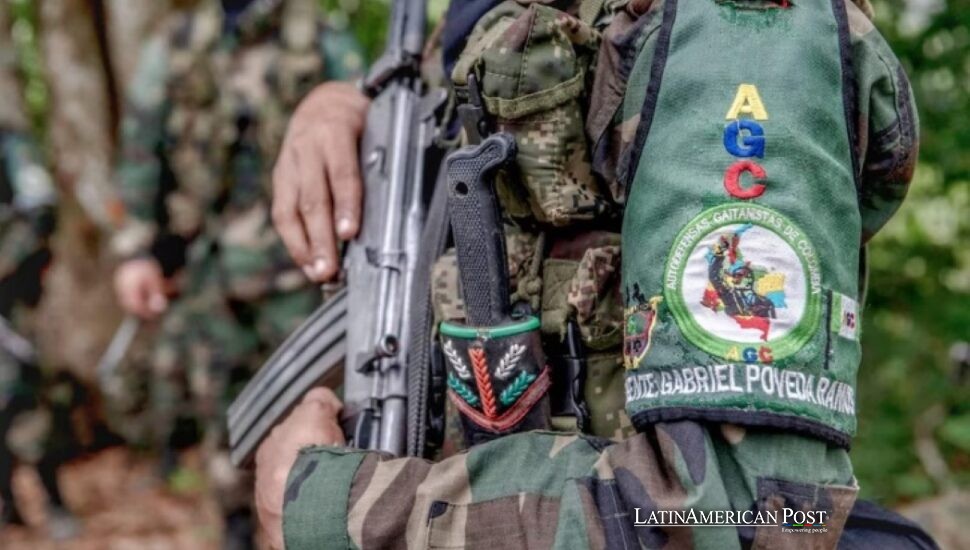
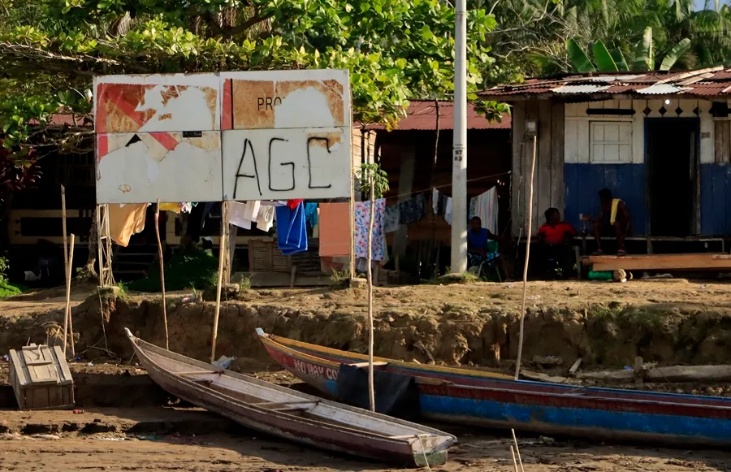
Even its name has been a battlefield. Over time, the organization has moved through labels such as Héroes de Castaño, Autodefensas Gaitanistas de Colombia (AGC), Los Urabeños, Clan Úsuga, and today’s Clan del Golfo. In 2024, it rebranded itself as the Ejército Gaitanista de Colombia (EGC), signaling a desire to be treated more like a political armed actor than a criminal enterprise. Invoking Jorge Eliécer Gaitán, assassinated in 1948, borrows national symbolism in a country where memory is political currency. But the report’s description of extortion, displacement, recruitment, and territorial predation suggests the rebrand is less a transformation than a negotiating posture.
An Army in Blocks and Franchises
The group’s origins sit in one of Colombia’s unfinished endings. After the paramilitary demobilizations of 2003–2006, the AUC fractured, and in regions like Urabá and Córdoba, those fragments reconsolidated, drawing from paramilitary blocks including Élmer Cárdenas, Bananero, and Casa Castaño. The leadership timeline reads like a lesson in institutional survival: Daniel Rendón Herrera, alias Don Mario, was captured on April 14, 2009, in Necoclí, Antioquia; Juan de Dios Úsuga David, alias Giovanni, was killed on January 1, 2012, in Acandí, Chocó; and Dairo Antonio Úsuga David, alias Otoniel, was captured on October 23, 2021, again in Necoclí. The report identifies Jobanis Ávila Villadiego, alias Chiquito Malo, as the current top figure, underscoring a pattern: leaders fall, the structure adapts.
Research portrays persistence as structural. At the top sits an Estado Mayor, beneath it commanders operating through roughly five blocks and about 30–32 fronts, with indications of a potential new block in Magdalena Medio and parts of Antioquia and Caldas. What keeps the organization elastic is the franchise logic: in places where it cannot saturate with its own fighters, it links up with local gangs that operate under its banner, sharing rents and enforcing discipline through the threat of retaliation. The scale is large by Colombian standards. The report cites estimates of 5,000–9,000 members in 2024, with some assessments indicating growth of around 17% and others suggesting expansion of nearly 20% every six months. Its presence is mapped across the hundreds of municipalities—one count cites 316, with continuous presence in 239 and new footholds in 77; another places it in about 348 municipalities across 25 departments during 2023–2024.
Its power is not only economic; it is also martial. Between January 2023 and May 2024, the report cites 152 combats involving the organization, with about 39% against Colombian security forces and roughly the same share against the ELN. Yet the most theatrical demonstration remains the paro armado, the armed shutdown that empties streets without capturing city hall. Between May 5 and May 10, 2022, after Otoniel’s extradition, the group imposed a shutdown that affected 47 municipalities in Antioquia and reached 1,211,599 people. In a country where sovereignty is often negotiated day by day, such stoppages function as a cruel census: a way to measure how much of public life can be turned off with a single order.
The Business Model of Fear
In areas where the Gulf Clan is hegemonic, violence often becomes quieter and more intimate. The report describes a pattern in which large-scale massacres and disappearances may appear less frequently than in earlier paramilitary periods, while selective killings and persistent threats deepen social control. Communities learn unwritten rules about movement, relationships, and speech, enforced not only by gunmen but by “points” embedded in civilian life who watch, recruit, and mediate disputes. Order, under this logic, is not peace; it is obedience at a price.
Where the group is challenged, humanitarian costs surge. Disputes with the ELN in southern Chocó and with dissident FARC structures in places like southern Bolívar and northeastern Antioquia have driven displacement and confinement, including reports of more than 50,000 people affected in the San Juan region of Chocó in August 2024. The same geography of violence is written in personal names: cases linked to the organization include the killings of Plinio José Pulgarín Villadiego in San José de Uré, Córdoba, on January 18, 2018; José Isidro Cuestas Rivas in Carmen del Darién, Chocó, on March 29, 2020; Mary Cruz Petro Villalba in Ciénaga de Oro, Córdoba, on April 25, 2023; Jhon Freddy Rueda Rodríguez in Sincelejo, Sucre, on May 11, 2023; and Narciso Beleño in Santa Rosa del Sur, Bolívar, on April 21, 2024. These are not just data points; they are the human cost of territorial ambition.
Coercion also moves through shame and scarcity. The report cites allegations of sexual abuse involving commanders and girls, followed by pressure on communities to retract complaints, and it documents recruitment that targets adolescents where dignified work is scarce. A testimony describes recruitment at 17 with an offer of 1,200,000 Colombian pesos—money that can sound like a rescue when the formal economy arrives as a rumor. The organization’s reach extends into the humanitarian corridor of the Darién Gap, where the report cites roughly 2,000 migrants crossing per day and reports payments of $200–$500 for passage. Many migrants, it notes, end up stranded for months in towns like Necoclí and Turbo, turning waiting itself into a market.
Money binds the architecture together. One estimate places annual income around $4.4 billion, generated through cocaine trafficking, extortion, illegal mining, and the coercive capture of public resources. In the cocaine economy, the report describes the group as regulating cultivation, controlling chemical inputs, taxing the supply chain, and guarding routes to export markets; one estimate placed exports at around 20 tons of cocaine per month in 2021. In gold, armed power is tied to extraction and territorial fights. The report cites one estimate that in Guainía the organization may be connected to about 25% of gold extraction, worth roughly 17 billion Colombian pesos. Diversification is not just a business tactic here; it is insurance against the state’s next offensive and the world’s next headline.
That is what makes the U.S. designation consequential but not decisive. Colombia has wrestled for years with whether the organization can be pushed into “submission to justice,” negotiated into disarmament, or confronted indefinitely. An earlier effort under President Juan Manuel Santos involved 38 meetings in 2017–2018 and produced a law that did not satisfy the group’s leadership; afterward, it expanded into areas vacated by the demobilized FARC. Under President Gustavo Petro’s Paz Total, the problem sharpened: exclude the biggest armed criminal network, and you leave a vacuum it can fill; bring it to the table, and you risk legitimizing an armed business model. The new U.S. terrorism label adds pressure on financiers and facilitators, but it cannot substitute for the daily work of a state that protects witnesses, funds schools, and keeps roads open. In the end, the Gulf Clan’s power is measured less by what Washington calls it than by what Colombia can offer instead.
Also Read: Chile Swings Right as Crime and Migration Fears Rewrite Hope