Colombia Minimum Wage Fight Turns Courtrooms into Campaign Stages Again
On Jan. 1, Colombia’s new minimum wage landed on pay stubs and spreadsheets alike. Now a court has paused the decree behind it, reopening arguments about inflation, dignity, and power as elections near and workers prepare to march Thursday.
A Raise Arrives Before the Argument Ends
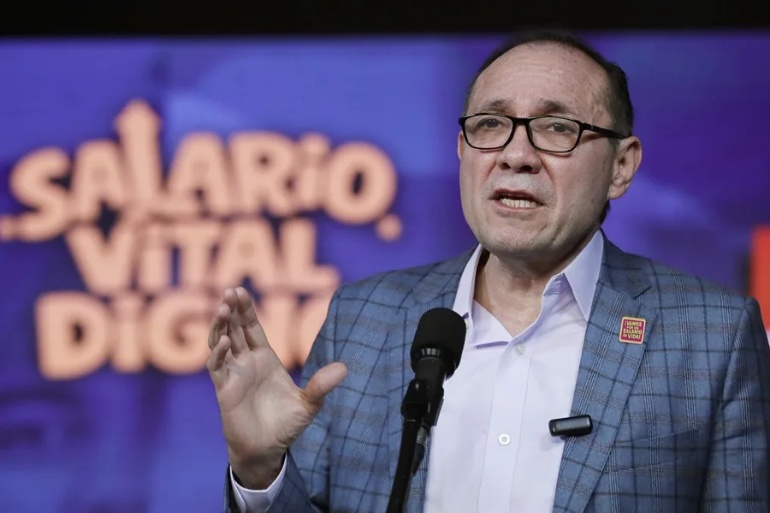
On Sunday night, the country experienced a presidential moment that felt both personal and distant. Gustavo Petro addressed the nation on screen, announcing he would issue a provisional decree to maintain the minimum wage at its current level. He also promised new studies to support the increase and described the policy using his chosen term, “salario vital” (living wage), which goes beyond simple numbers.
The trouble is that the arithmetic is exactly what has returned to center stage.
This year’s minimum wage rose by 23.7 percent to 2 million pesos, about 546 dollars, including the transport subsidy. It is a number that shows up in ordinary places, not just in speeches. In payroll runs. In small business calculators. In a quiet moment, someone checks their phone to see whether the deposit has hit. It is not abstract. It has the weight of rent day and bus fare, and the way a price tag can tilt a household’s week.
But just as the policy settled into daily life, a tribunal’s administrative process pulled it back into dispute. The Council of State, the top court for administrative litigation, provisionally suspended the presidential decree that ordered the increase. The court told the government to issue a transitional decree that determines the percentage increase and the total value, pending a definitive ruling by the judiciary.
So the raise is happening in reality, but it’s also being debated at the same time.
This overlap shows why Colombia’s minimum wage debate isn’t just about labor rights. It’s also about who controls the story: the price pressures people worry about, the dignity workers seek, the limits employers say can’t be crossed, and the political gains at stake.
How Colombia Sets Pay and Why This Time Is Different
Colombia’s minimum wage has a long institutional memory. It was created in nineteen forty-five and began to be applied in nineteen forty-nine. At the beginning, it varied by type of productive activity. It did not become unified until the mid nineteen eighties, a late decision that still echoes in how Colombians talk about fairness across sectors and regions.
In dollar terms, Colombia’s minimum wage has been around the middle compared to other South American countries for the past twenty years. The peso’s devaluation and the usual steady, single-digit increases tied to inflation explain this. But that steady pattern changed in 2022, Iván Duque’s last year, when the wage rose 10.07 percent. Petro continued this trend with increases of 16 percent in 2023, 12.07 percent in 2024, 9.54 percent in 2025, and this year’s surprising 23.7 percent raise.
A key detail sits behind that surprise: the process broke.
Each December, the minimum wage is negotiated in the Permanent Commission for the Coordination of Wage and Labor Policies, a tripartite body that includes the government, labor unions, and business associations. The idea is concertación, coordination, bargaining with institutional guardrails. Workers and employers present proposals, and if they fail to reach consensus, the government sets the wage by decree no later than Dec. 30.
This time, there was no agreement. Workers asked for a sixteen percent increase. Business groups offered 7.21%. Petro’s government set 23.7 percent, exceeding what both sides had put on the table.
This turned a normal end-of-year negotiation into a debate about how the government leads. Is the state just a referee in talks, or is it setting a goal and making the economy follow?
Petro has argued for the second approach, invoking the “salario vital” to calculate a higher wage and, in his words, guarantee better living conditions for workers and their families. The notes make clear that the minimum wage directly benefits about 2.3 million workers, around 10% of Colombia’s salaried workers. The critics’ counterargument is also clear: they say a 23.7% jump in inflation because it affects some tariffs, and they argue it can disadvantage workers who earn above the minimum wage because the raise does not apply to them.
In simple terms, the main disagreement is this: one side says life’s costs are real and wages must keep up. The other says prices react to policy, and that policy can backfire.
Legal challenges soon followed. After the new minimum wage took effect on January 1, opponents filed lawsuits based on economic concerns. The Council of State’s temporary suspension last Friday was the biggest impact so far, forcing the government to find a legal workaround while the wage remains in effect.
Elections in the Background and a March in the Foreground
The political calendar is not subtle here. Colombia will hold legislative elections on March 8 and presidential elections on May 31. In that context, the minimum wage becomes a litmus test, a campaign object, a symbol candidates handle carefully because it can burn them.
The notes describe right-wing candidates who opposed the 23.7% increase and now, wary of its electoral impact, defend keeping it. They propose compensating companies for higher costs by reducing taxes. It is a pivot that tells you something about how quickly economic arguments bend under electoral pressure, and how a policy can become popular simply by appearing on a pay stub.
Petro appears at ease speaking directly to the public. He urged workers to march on Thursday to defend the living wage, calling it a major historic achievement. The hope is that strong public support can protect a disputed policy, that a street protest can back a decree challenged in court, and that politics can achieve what the legal system cannot.
And yet, the uneven truth of the moment is that Colombia is being asked to hold several realities at once. A wage that has already changed. A decree that has been provisionally suspended. A court is demanding a transitional fix while it decides. A business association, ANDI, initially criticized the increase and later acknowledged that, as a fait accompli, society must assume it, and that employers, within their means, should find mechanisms to avoid harming workers.
That phrase, “within their possibilities,” stands as a quiet warning. It’s practical but also cautious.
Because minimum wage debates always end up in the same place: at the edge of what is possible for whom. For the worker whose transport subsidy is folded into the monthly math. For the employer trying to absorb a higher payroll. The government is trying to claim a social victory without triggering the very inflation that can erase it.
It’s easy to see this as just a technical issue or a year-end routine gone wrong. But that misses the human side. The raise is already here. People have felt it or expected it. The court acted afterward.
Right now in Colombia, the minimum wage isn’t just a number decided behind closed doors. It’s a number moving through the country, shaped by law, politics, fear, and hope. It’s repeated, debated, and repeated again.
Also Read: Peru Ousts Jerí as Congress Keeps the Revolving Door Spinning