Brazilian Startup Detects Water Leaks, Saving Billions of Liters and Earning Global Recognition
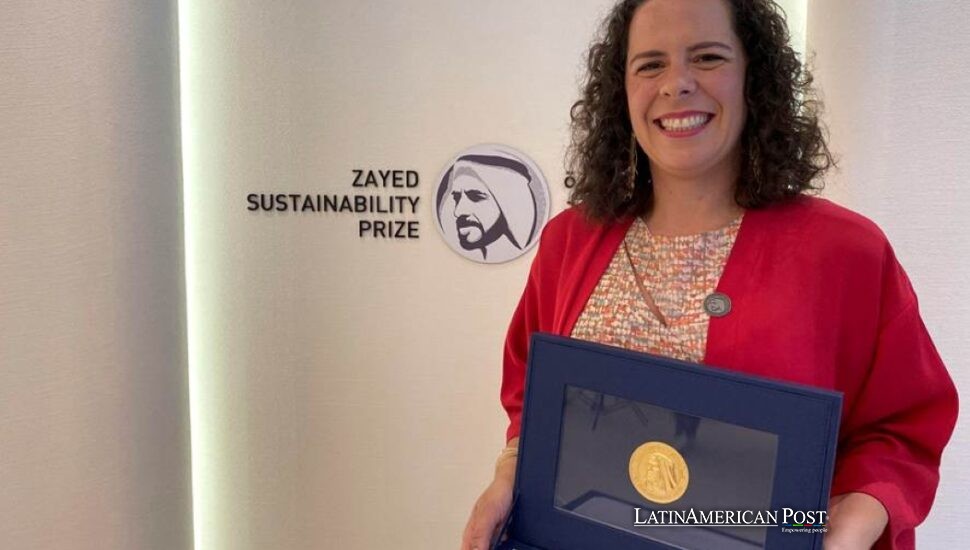
From São Paulo to Abu Dhabi, one young engineer is proving that water can be saved not only with concrete and valves, but with listening. After a US$1 million global prize, her startup aims for Spain and beyond.
A Bionic Ear Beneath the Asphalt
In the first seconds after Marília Lara speaks, you can hear the decade she carries on her shoulders: the persistence of a country that swims in rivers yet still thirsts in neighborhoods, the patience of a scientist translating street noise into public policy, the quiet urgency of someone who has watched a basic right leak away, drop by drop, under the pavement of Brasil. Ten years ago, she began what she now calls the “Shazam” for water leaks: a company that can pinpoint losses in pressurized pipes by analyzing sound and vibration. Today, that same idea has traveled farther than many municipal water plans ever do, landing on a stage in Abu Dhabi with the kind of recognition that changes a small firm’s future overnight.
The name of her company, Stattus4, was announced during the Zayed Sustainability Prize ceremony at Abu Dhabi Sustainability Week (ADSW), an event organized by the Emirati renewable-energy giant Masdar. The prize, worth US$1 million, recognized the project as the best global water initiative. Speaking to EFE after receiving the award—presented by Mohamed bin Zayed, president of the United Arab Emirates (EAU)—Lara framed the moment less as a trophy and more as fuel. “We’ve been developing this project for 10 years,” she told EFE, adding that the goal is to reinvest in the technology and, above all, expand beyond Brazil.
Her explanation feels surprisingly tactile for something so data-driven. She describes the system as an “oído biónico,” a bionic ear. In practical terms, Stattus4 collects pressure readings and acoustic data from pipes—networks that must remain pressurized so water can climb the subtle hills and long blocks of any city. When a rupture occurs, the pipe vibrates differently than when it is intact. That difference, she told EFE, becomes a signature. With the help of artificial intelligence, the software learns to recognize these signatures, flagging not just leaks but inefficiencies in distribution. At one point, Lara asks a simple question through a smile—“Have you used ‘Shazam’?”—and the metaphor lands because it is familiar: the app that identifies a song in seconds. “We are the ‘Shazam’ of water leaks,” she told EFE, making the invisible suddenly easy to picture.
In Latin America, where infrastructure often arrives late and maintenance is even later, metaphors matter. They translate innovation into something that city councils, overstretched utilities, and ordinary residents can grasp. And they cut through the political fog that so often surrounds water—treated as a technical issue until taps run dry, then weaponized as a scandal.
One Million Dollars And The Weight Of Public Trust
The organizers of the Zayed Sustainability Prize credited Stattus4 for combining artificial intelligence (AI) with the Internet of Things (IdC) in a way that allows utilities to detect and repair leaks with speed and precision described as “unprecedented,” according to the prize’s own assessment reported by EFE. The numbers attached to the company’s work are bold enough to sound like fiction, but they are presented as measurable outcomes: monitoring more than 5,000 kilometers of distribution networks, identifying over 22,000 potential leak points, and enabling savings of around 5.560 billion liters of water per day. The organizers said this reinforces water security for more than 4 million people and reshapes the efficiency of urban systems. These are not merely statistics; in a region where a missed repair can mean a neighborhood rationing water for weeks, each figure carries the emotional weight of daily life.
Lara told EFE that the company already serves about eight clients among the ten largest water-distribution companies in Brazil—a telling detail in a sector that is often cautious, bureaucratic, and historically slow to adopt new tools. The leap from pilot projects to major contracts suggests that the technology has done something even more difficult than detecting leaks: it has earned institutional trust.
Now, the ambition is to export that trust across the Atlantic. Lara said Stattus4 already has some projects in Portugal and that, for about a year, the team has studied how to expand into Mediterranean Europe—specifically Spain, Italy, and Portugal—where aging infrastructure, drought pressure, and political scrutiny are reshaping water management. The target is not only technical compatibility but a shared sense of urgency. The Mediterranean is no stranger to scarcity, and Latin America knows the feeling of watching a climate problem become a social one, then a political crisis.
Her language, as reported by EFE, leans toward a kind of pragmatic idealism: working with cities in other countries to help save the “water of the world.” It is the sort of phrase that can sound grand, but in the hands of someone who has spent a decade listening to pipes, it reads less like marketing and more like a working hypothesis: that small, scalable fixes inside cities can have global consequences when repeated thousands of times.
Brazil Has Water, Yet Loses It In Plain Sight
There is a reason this story feels so Latin American: abundance and fragility live side by side. Brazil holds 12% of the planet’s freshwater reserves—about 53% of South America’s water resources—and much of the country’s borders are literally drawn by water, shaped by 83 border and transboundary rivers, along with basins and aquifers. Those figures should make insecurity unthinkable. Yet, in practice, water is not only a matter of how much a country has. It is also about pipes, governance, inequality, and whether the benefits of geography reach the periphery.
That contradiction sharpens when the map changes color. A study released by the MapBiomas network found that Brazil lost 2.2% of its surface water in 2024 compared with 2023, maintaining a trend of decline that began in 2009. The same reporting highlighted that 2024 brought an extreme drought—the worst in six decades—and that the Amazon was hit hard, losing 3.6% of its water surface that year compared to its historical average. In a country where the word “Amazonía” serves as both an ecological symbol and a political battleground, those numbers sound like a warning siren.
And yet Lara is careful about where her technology can—and cannot—go. Stattus4 is built for cities, she told EFE. It is not yet operating in the Brazilian Amazon. Even in Manaus, one of the region’s largest cities, she suggested that foundational issues must be solved before the company’s approach can be fully effective. Distribution has to exist. Homes must be connected to pipes. Water meters must be installed. Only then can the system reliably compare what enters the network with what reaches households. In other words, the bionic ear cannot hear what politics refuses to build.
That candor is part of what makes her argument solid. Too often, innovation is sold as a shortcut around the slow work of public investment. Lara’s approach, as described to EFE, implies the opposite: technology can amplify good systems, but it cannot substitute for them. For Brazil, the lesson is uncomfortable and necessary. The country’s water challenge is not a lack of rivers; it is the modern challenge of making rights real through infrastructure, measurement, and management—especially in places where history has normalized absence.
In the end, the scene in Abu Dhabi is less about glamour than about translation. A Brazilian startup took a problem many people accept as inevitable—water loss through unseen leaks—and turned it into something audible, actionable, and fundable. That is a Latin American kind of ingenuity: born from scarcity inside abundance, shaped by public pressure, and sharpened by the knowledge that when water disappears, it is never just water. It is time, money, dignity, and the fragile trust between a city and its people.
Also Read: The Global Rise of LLCs, But Are They Always Protected?