Guatemalan Arjona Turns Madison Square Garden Into a Borderless Cabaret

Ricardo Arjona arrived in New York with sold-out shows and an old chorus that still stings. Onstage at Madison Square Garden, his nostalgia tour became a live argument about migration, influence, and identity, without turning into a speech.
A Statue of Liberty Wearing Latin America
The micro scene comes early, and it lands with the odd clarity of a visual joke that refuses to stay a joke. Ricardo Arjona sings his nineties song “Si el norte fuera sur.” Behind him, the Statue of Liberty appears on screen, dressed in traditional Latin American clothing. In the room, you can feel the audience clock it at the same time, the quick collective recognition that this is not just decoration. It is a statement made through costumes rather than slogans.
Arjona has called this the biggest and most ambitious tour of his career. In Guatemala, he filled every date of a historic residency. Now he is in Madison Square Garden for two consecutive nights, both sold out. This Wednesday’s show marked the fifth stop of Lo que el seco no dijo, the tour that follows his 2025 album Seco. He performed several songs from that record, but he also traveled through the catalog that made him a fixture, El problema, Historia de taxi, Desnuda, moving across pop rock, flamenco, and salsa, carried by a full band.
He did not give political speeches. The power of his lyrics as social commentary, like “Si el norte fuera sur,” creates a sense of relevance and connection, making the audience feel involved without direct preaching.
More than twenty years later, he sings that same song while images generated with artificial intelligence flash across the screens. The Statue of Liberty becomes a food delivery worker. It becomes Elon Musk. It becomes a superhero. The visuals suggest a paradise of fast food chains waiting for migrants after their journey.
People know what those images do: compress a century of power imbalance into spectacle and highlight ongoing social and political struggles.
What this does is turn a concert into a kind of public forum without anyone having to raise their voice.
Stories Instead of Speeches
Arjona does not only sing. He tells stories. He reaches back to his childhood in Guatemala. He jokes that before influencers, parents were the influencers. He criticizes modern overprotection. He reflects on how the world became a cabaret while standing inside a spectacular set that recreates a Paris street.
Under a fake balcony with the words Cabaret Seco, a powerful-voiced singer performs La vie en rose by Edith Piaf. Then the show pivots into the new song La vida es un cabaret, with Arjona joined by dancers in red bodysuits and feather crowns.
It is theatrical, but not empty. The cabaret metaphor is a way of saying that public life has become performance, that seriousness and parody sit too close together, that the stage and the world are starting to look like mirrors.
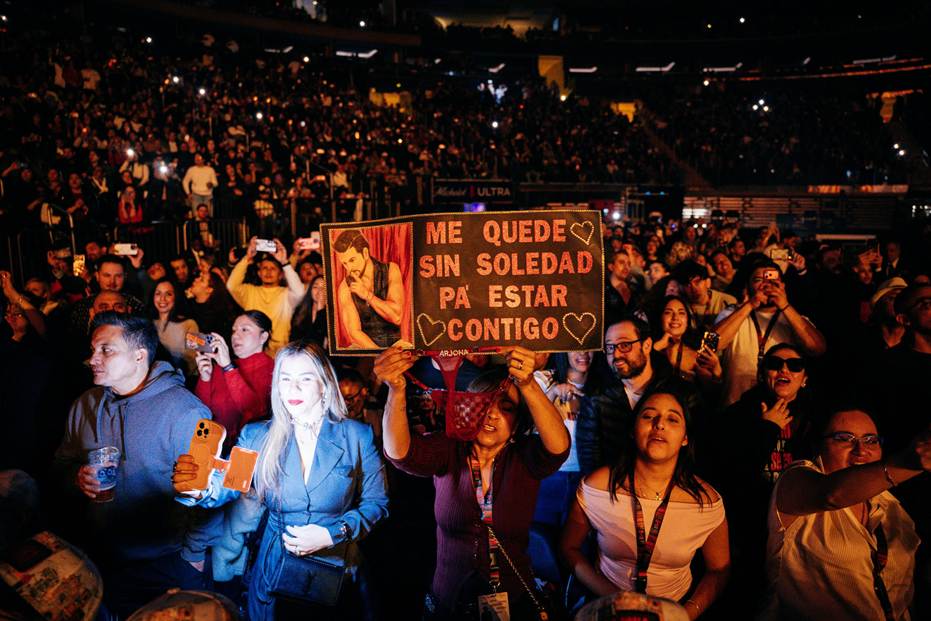
The everyday observation implied by the way he works the crowd is how diaspora audiences carry their passports in their voices. Arjona calls out fans by their countries. Dominicans respond with a roar. He reads signs held up in the stands. He brings a fan onto the stage when she asks. He encourages the room to loosen up, to dance to Latin rhythms.
None of that is policy language. And yet it is about borders, about who is in the room, about who gets named and recognized in a city that can swallow people whole. He repeats a motto, se acabaron las fronteras, as if saying it aloud can push back against the hardening of the world.
The wager here is whether art can still offer a shelter when politics feels like a machine built to grind people down. Arjona’s answer is not a manifesto. It is a sequence of images and songs that insist, over and over, that Latin America is not an accessory to someone else’s story.
Time, Bodies, and the Price of Staying Visible
Midway through the show, the mood narrows. Arjona sings Todo termina alone with his guitar under a single beam of light. It is dedicated to his children. It is about time passing and the need to use life while you have it. The visuals behind him show him moving through life stages, from a baby taking his first steps to an elderly man with white hair.
The contrast is sharp. One moment, Liberty is a superhero, and the world is a cabaret. The next is one man, one guitar, one song about how everything ends. That turn feels lived in, the way real conversations do, when a joke slips into a confession without warning.
Arjona is sixty-two. He took a break in 2023 after back surgery. In this two-hour concert, he shows himself in full form, moving across the stage and, at one point, crossing the arena to stand at the back for a while so the far seats can see him clearly.
His gesture of crossing the arena to stand at the back and asking the audience to come to him fosters a sense of closeness and connection, making everyone feel recognized and included.
Arjona is a Grammy and Latin Grammy winner with over 80 million copies sold. His success and history inspire admiration, reinforcing his authority to speak subtly on social themes.
In Madison Square Garden, he does something both simpler and harder than politics. He builds a room where people from many countries can hear themselves reflected back. He makes the Statue of Liberty put on another outfit. He turns Paris into a set. He turns migration into a song that keeps returning.
And he does it without preaching.
Just stories. Just music. Just the soft pressure of repetition, telling the audience that borders are real, but they are not the only thing that is real.
Also Read: Ecuador Film Finds Humor in Midlife, Family, and What Men Avoid Saying