Mexican Pop Star Turns Nahuatl and Maya Into Mainstream Fire

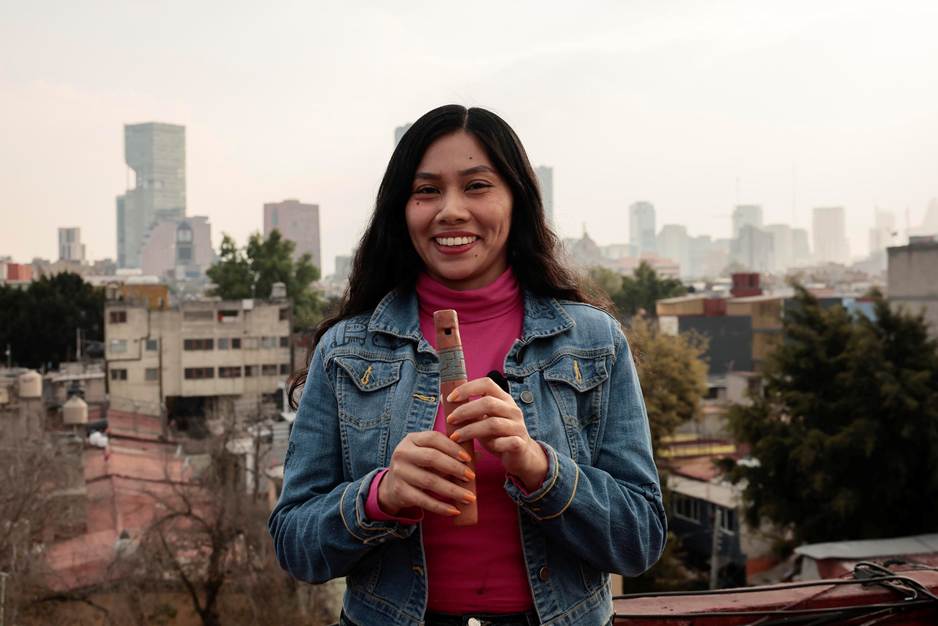
On a Mexico City rooftop, Azalea Báalam lifts a jaina flute and plays nine notes into the open air. What follows is pop built from older languages, newer beats, and a stubborn idea: that the biggest genre on earth can still make room for origin.
A Rooftop Where Nine Notes Cut Through the City
From the rooftop of her home in central Mexico City, Azalea Báalam stands with a small pre-Hispanic flute in her hands and sends nine notes outward. The city is below, crowded and indifferent in the way cities often are, but up here, there is a pocket of attention—a moment where sound leads.
She is thirty-three, a composer and singer from the Yucatán Peninsula, and people tell her the music feels like a ‘revolution.’ This term highlights her effort to challenge norms and can draw readers into her cultural movement.
The trouble is that “revitalization” can become a slogan if you do not keep it tethered to something you can see and hear. Here, the tether is literal. A jaina flute, an instrument with a pre-Hispanic lineage, is held on a rooftop in the capital. Nine notes, repeated because repetition is how songs work and how memory works, too.
Báalam’s music does not stay in one place. It fuses electrifying K-pop rhythms with choreography shaped by Michael Jackson, one of her favorite musicians, alongside Juan Gabriel. It is a blend that refuses to apologize for being a blend. It insists that origin is not the opposite of modern. It can be a method.
“The people who connect with my music really like it and feel proud that not everything is lost, that something is being done in the original languages,” she told EFE.
There is a wager here, and it is not only artistic. It is social. To bring languages that are losing speakers into the world’s most dominant musical format is to gamble that young audiences, in Mexico and beyond, will not treat Indigenous language as museum glass. That they might sing along, fostering hope and curiosity about cultural resilience.
The platform matters because it is where pop now travels at the speed of imitation, where a chorus becomes a caption, and where Indigenous language can reach new audiences quickly, transforming sound into a shared experience.
Learning From Zero and Naming a Genre on Purpose
Báalam’s route into Nahuatl and Maya was not easy. Even with a Maya-speaking father, she says she had to learn both languages from scratch when she was fifteen, after moving to Mexico City. In the capital, she says, Maya was practically not taught in any school.
So she began with “basic Nahuatl,” the most spoken Indigenous language in the city, rooted in the heritage of the Aztec Empire, which dates from 1325 to 1521. That detail matters because it shows how history stays lodged in the everyday. Not as a textbook. As an imbalance. A language present in the capital’s past, yet still treated as peripheral in its present.
In the course of learning, she reached a conclusion that sounds like marketing but is also a strategy of survival: to resist the death of linguistic diversity, she believed she needed a label that would catch the attention of young audiences, both national and international, by intentionally naming her style ‘nahuapop’ and ‘mayapop.’
“It’s a mix of things I like,” she told EFE.
The line lands because it is ordinary and exact. Mole is not a metaphor imported from elsewhere. It is a word that already understands mixture as craft, not dilution. In her version of pop, K-pop is not a colonizer. It is a tool. So are the classical dances of India, especially the mudras, hand gestures used in Bollywood choreography. She borrows with intention, then turns back toward Nahuatl and Maya as the core.
There is an everyday detail in the notes that does more work than it seems. As she talks, her gaze goes to her Hello Kitty socks. It is small, almost too small, but it fits the larger argument of her music. Cute culture, kawaii tenderness in Japanese, paired with an incendiary edge. Softness and critique in the same frame.
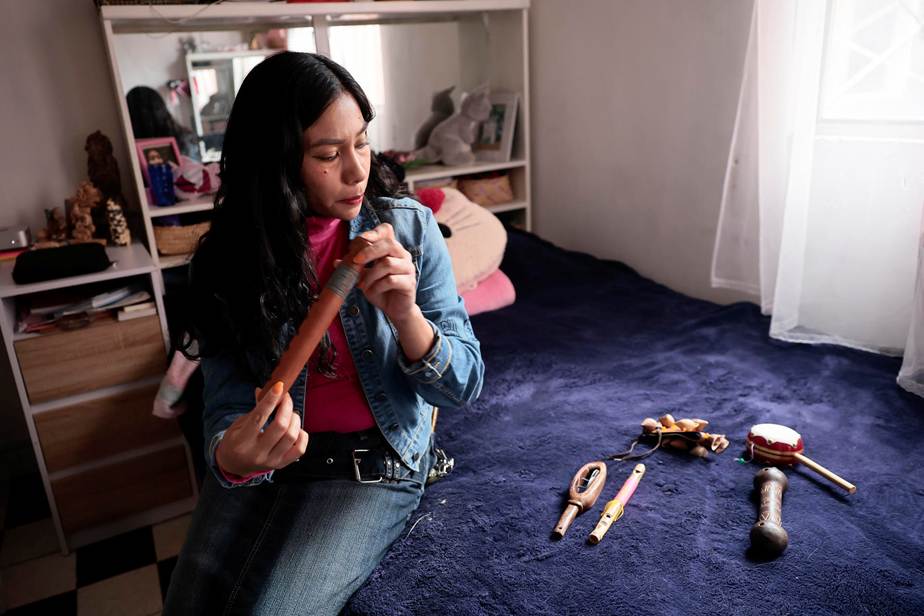
Making music in Indigenous languages, she says, is like jumping from one world to another, playing with the possibilities of words beyond the borders of Spanish. That idea of play matters. Play is how people learn. Play is how people keep returning.
And then there is the way language changes emotion. She notes that in Nahuatl, verbs are more intense, which lets her explore feelings like anger. Anger, she says, is something she wants to analyze from a feminist perspective because when women get angry, it often seems socially unacceptable. This highlights how language can empower individuals to express and challenge societal norms, inspiring a feeling of agency in the audience.
Here, the politics is not abstract. It is grammatical. It is about what a verb can hold, and what a society allows a woman to say.
She even says she would like to use these languages to rethink insult, to answer men who, without knowing what they are saying, criticize her music as poorly made or try to mansplain her own work. The point is not secrecy for its own sake. It is power.
“I can say it, and they won’t cancel me, they won’t say anything because people don’t know the languages, so it’s also playing with that,” she told EFE.
A cheerful grimace accompanies the line in the notes, and it reads like recognition. The world has not learned these languages, so she uses that ignorance as a shield and as a stage. What this does is expose the asymmetry: Spanish and English are treated as universal, while Indigenous languages are treated as niche. She flips that hierarchy in the space of a song.
A Movement With Company and Dreams That Refuse to Shrink
Báalam insists she is not alone. She points to artists like Za Hash and Juan Sant, who rap in Mazahua and Totonaco, making new music from millennia-old expressions and helping it be heard as contemporary sound rather than just cultural heritage.
The multiplication of this talent motivates her, she says, and it shapes her most enormous ambition: to build her own path and found her own record label to push projects like these. She wants an effect on society. She wants a new life for cultures that the industry often treats as background texture.
“Those dreams are too far away, but before I die, I want to feel that I tried everything to achieve them,” she told EFE.
It is an intimate line and also a political one. Because when Indigenous languages lose speakers year after year, the question is not only what the state does. It is also what culture rewards. What gets distributed. What gets repeated.
Back on the rooftop, those nine notes do not solve anything by themselves. But they make a claim. That pop is not only the sound of the global present. It can be a container for the languages that survived conquest, schooling, shame, and neglect. A container that travels. A container that sings back.
Also Read: Ciudad Juárez Reckons with Femicide in a Film That Refuses Silence