How Latin America’s families faced fearful Thanksgivings in Trump’s United States
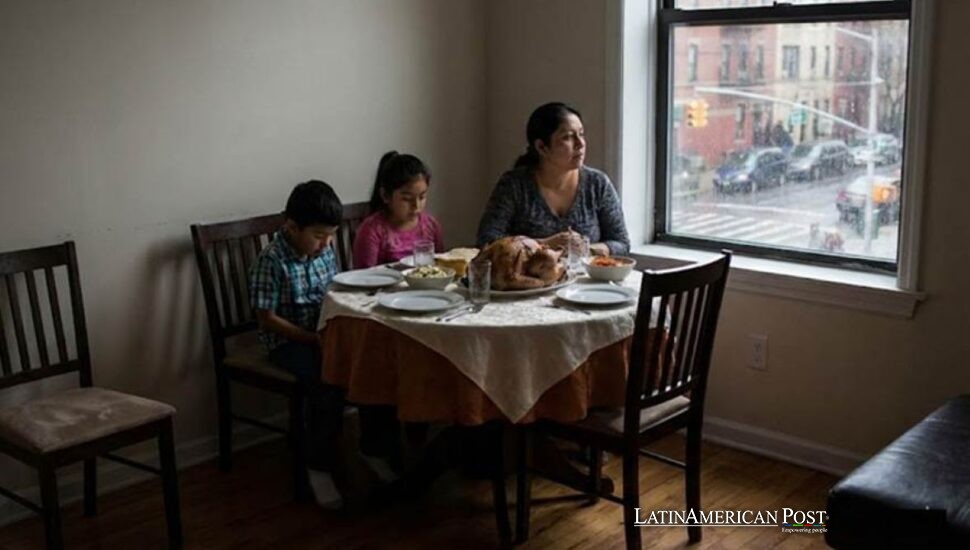
As millions of Americans carved turkey this Thanksgiving, many Latin American immigrant families in the United States spent the holiday behind closed curtains, navigating fear of ICE raids, missing relatives, and rising prices instead of the gratitude the ritual imagined.
A Holiday Of Turkeys, Raids And Empty Chairs
In Latino neighborhoods of Charlotte, Chicago, Los Ángeles, Houston, Miami, and beyond, the familiar scent of roasted turkey traveled down apartment corridors and across duplex patios. But this year, that smell mingled with something more corrosive: the unease provoked by immigration raids intensified under the administration of Donald Trump, and the empty chairs left behind by deportations, detentions, and forced returns.
For Eugenia Blanco, a sports coach in West Palm Beach, Florida, the script of Thanksgiving had been quietly rewritten. “During the last four years we were 18 at dinner,” she recalled, describing how her family embraced the holiday as a way of honoring a country they felt had received them. Her story, shared with reporters [EFE], suddenly changed when her parents decided to return to Venezuela after the removal of Temporary Protected Status (TPS), the fragile legal shield that had allowed them to remain.
Her relatives were part of the roughly 600,000 Venezuelans who, according to her account, lost temporary protection this year after legal challenges failed and the Trump administration’s decision to end that status took effect. Some went back; others simply decided to stay inside. Her uncles and cousins, she said, then left home only to work, too scared to risk a supermarket run or a visit to friends. The turkey that once symbolized gratitude became, in her words, a bitter dish.
Research published in the Journal of Ethnic and Migration Studies documented how policy shifts around programs like TPS produced what scholars called “precarious legality,” a condition in which families technically tied to legal forms of entry still lived as if every knock on the door could be the last. The psychological fallout was not an abstraction. It was there in the drawn blinds, the cancelled trips, and the way a holiday once adopted with enthusiasm began to feel like a reminder that belonging was always provisional.
More than 5,000 kilometers to the northwest, in Seattle, Washington, the fear took another shape. Food pantries that had prepared for lines of families seeking help with Thanksgiving dinners instead found themselves staring at stacks of untouched turkey. Van Cuno, executive director of NorthWest, explained that fewer people were coming to the organization’s community pantries since ICE intensified operations in the area. A spike in detentions early in the week meant that almost no one showed up to pick up donated turkeys. Excess food became a measure of how deeply raids could empty public space.
Studies in Latino Studies and in the Journal of Urban Affairs underscored this “chilling effect” of enforcement campaigns: when immigration authorities appeared more visible, entire neighborhoods reorganized their lives around avoidance. Parents kept children home from school, patients skipped medical appointments, and even charity became suspect because walking into a church basement or community hall might attract attention. Thanksgiving, in this climate, stopped being a communal event and became a risk assessment.
When Fear Turned Everyday Errands Into Calculated Risks
In North Carolina, that atmosphere of panic acquired an operational name. The ICE operation dubbed “Charlotte’s Web” brought with it a wave of absences: missing students in classrooms, “temporarily closed” signs on Latino-owned businesses, and cancelled family gatherings. Web was the right metaphor. The raids tangled not just those targeted, but also the people who loved them, worked with them, and sat next to them in church.
For Juan de Dios Rodríguez, a 38-year-old Mexican American waiter at a Mexican restaurant near Greensboro, the operation already reshaped daily life. Two of his relatives were in ICE detention centers. He feared being mistaken for an undocumented migrant and spent three weeks without work. The restaurant owners closed the doors because clients stopped coming. They promised to reopen next week, but even he doubted they would. This Thanksgiving, he said, would be sad. With three cousins likely to be deported and prices soaring, his family could not afford the special dinner they once tried to prepare. With only his wife’s income, basic bills were barely covered.
To generate some money, Rodríguez joined a gardening crew. But even that work came laced with anxiety. He and his co-workers knew that if you were not white, you were more vulnerable. They had seen cases of people born in the United States detained for days and mistreated. That fear spoke to what scholars writing in Latino Studies described as the “racialization of citizenship,” a process through which brown bodies were treated as suspect regardless of legal status, particularly in the U.S. South. The line between “immigrant” and “citizen” blurred when uniformed agents and neighbors alike treated Spanish accents and darker skin as shorthand for illegality.
In Chicago, the response to this climate took a more pastoral form. The parish of Our Lady of Mount Carmel decided to revive the home-delivery system it improvised in 2020, during the COVID-19 lockdowns. This year, instead of inviting families into crowded halls for Thanksgiving meals, volunteers once again knocked on doors with boxed dinners. For the parish priest Leandro Fossá, who had long worked with migrants in the United States, the mood felt different. Many parishioners found themselves in unstable situations, worried about both their legal status and food prices. For the first time in his ministry, he said, people no longer had the confidence to dream about a better future. His reflection, also shared with reporters [EFE], captured something that numbers alone could not measure: the shrinking horizon of hope.
Academic work in the American Journal of Sociology suggested that deportation regimes did not simply remove people; they also compressed the ambitions of those who remained. Children adjusted their aspirations downward, adults abandoned plans to start businesses or return to school, and neighborhoods began to expect less from the future. When a parish resurrected pandemic-era delivery not because of a virus but because of ICE, it was a sign that enforcement had become another kind of public health emergency, one measured in stress and sleeplessness rather than infection rates.
Thanksgiving Myths, Deportation Numbers, And Latin American Memories
The tension between national myth and everyday reality was not lost on those living it. On social media, Julissa Arce, a Mexican American activist, wrote that when someone bought food out of fear, a celebration stopped being one. Her message went viral on X, shared thousands of times by people who recognized themselves in the simple truth of the observation. Thanksgiving was supposed to be about abundance and hospitality; fear at the checkout line turned it into a test of survival.
Other viral messages went further, poking at the historical irony. Sarah Jumping Eagle, an Indigenous activist, used X to point out that the country celebrated a dinner built on the myth of welcoming newcomers while deporting those who sustained its economy. Another post circulating widely contrasted descendants of people who arrived on ships, celebrating that their ancestors were received, with the persecution of those who then crossed deserts and rivers. The critique echoed what historians in the Journal of American History long examined: Thanksgiving as a myth-making device that smoothed over conquest, displacement, and exclusion in favor of a comforting narrative of mutual generosity.
In Los Ángeles, the dissonance became intimate. During a public hearing on the impact of raids, a Central American mother summed up her wish for the holiday in a single line: Thanksgiving was a day to give thanks; she would simply ask that her husband come home. No feast, no decorations, just reunion. It was a modest request that felt enormous when weighed against the machinery of the state.
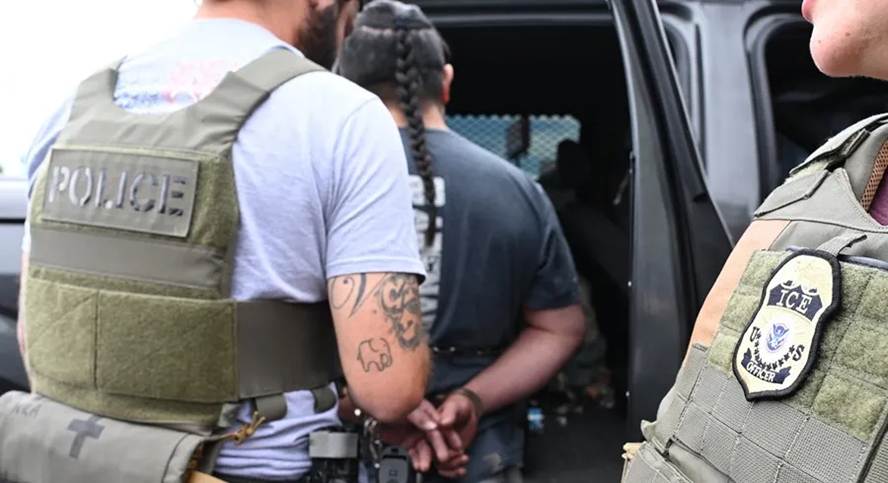
Behind these personal stories stood the raw numbers. According to the Department of Homeland Security (DHS), the United States expelled close to 400,000 migrants in the first 250 days of Trump’s second administration. It projected around 600,000 removals in the first year alone. Scholars writing in the American Journal of Sociology argued that such figures were best understood not as isolated statistics but as part of a long-term “deportation regime” that reshaped labor markets, family structures, and transnational communities stretching deep into Latin America. Every removal reverberated through small towns in Mexico, Central America, and Venezuela, where remittances stopped arriving, and empty chairs appeared at other tables, thousands of kilometers away.
Seen from a Latin American perspective, this year’s Thanksgiving in immigrant neighborhoods felt less like an uncomplicated national ritual and more like a mirror of hemispheric inequalities. The same day that celebrated harvest and hospitality also exposed who was allowed to feel safe enough to celebrate. In apartments with closed curtains and in churches sending out boxed dinners, families with roots south of the Rio Grande were living a different version of the holiday, one where gratitude had to coexist with fear, and where the simple act of sitting down together was never fully guaranteed.
The turkey still went into the oven. Children still waited for pie. But outside, patrol cars circled, and inside, phones stayed on the table, face up, in case there was news from a detention center or a border crossing. Between the official story of Thanksgiving and these quieter scenes lies the distance between myth and lived experience, a distance measured in 400,000 expulsions and in the whispered hope that, next year, everyone at least would be home.
Also Read: Latin American Films Storm Oscars With Grit, Memory, And Magic