Venezuelan Herrera Show Turns Women’s Art Power Into Wearable Politics
In a Meatpacking District room, the surprise was not a hemline but who wore it. Carolina Herrera’s new fall-winter collection put women artists on the runway, turning fashion into a debate about patronage, visibility, and cultural power in uncertain times.
Artists Step Out From the Walls
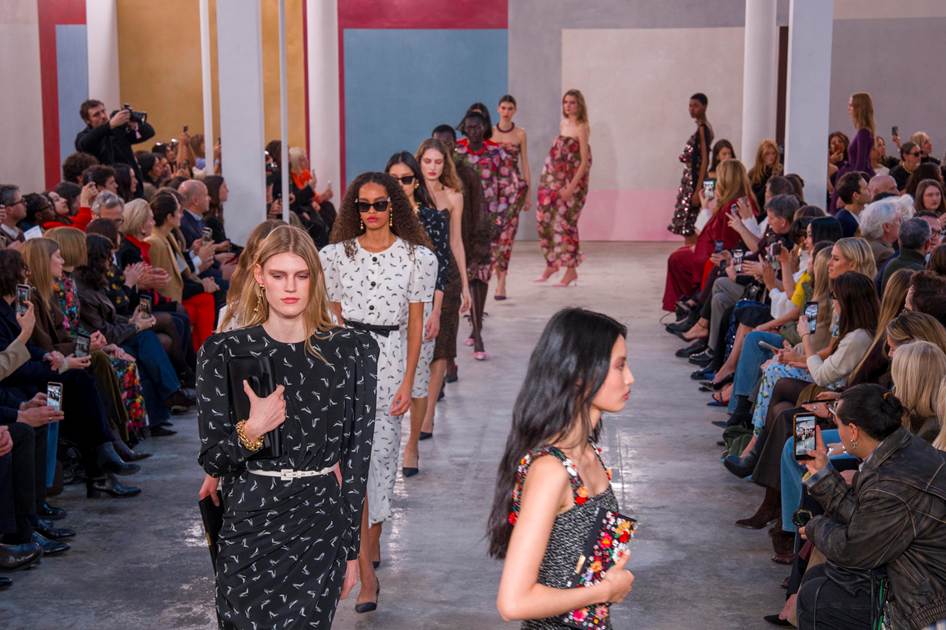
There is a particular kind of hush that settles right before a runway look comes into full view, a pause that feels like everyone is holding the same breath. In the industrial space in the Meatpacking District, it carried a different charge this time, because the faces were not only model faces. Among the women walking were figures known for making art, collecting it, defending it, selling it, shaping the gaze around it. This highlights the power and influence women hold in the arts, inspiring pride and admiration in the audience.
The new Carolina Herrera collection was framed as an ode to the creative power of women artists, patrons, gallerists, collectors, and muses. The brand of the Venezuelan designer, now led creatively by Wes Gordon since 2018, gathered around two hundred people, including fashion and music figures such as Hiba Abouk, Emilia Mernes, Lauryn Hill, Lux Pascal, Tabita Von Fustenberg, and Olivia Palermo.
Then the reveal inside the casting itself. The painter Amy Sherald, known for her portrait of Michelle Obama, and Ming Smith, the first African American photographer purchased by MoMA, were not just honored guests. They moved through the light, inhabiting the silhouettes, embodying the show’s celebration of women artists shaping cultural power.
What this does is shift the room’s hierarchy. In the standard fashion script, art is often the reference point, the mood board fuel, the name dropped in press notes. Here, the women who make and steward art were brought forward as part of the show’s body. Not decoration. Presence. And the trouble is, once you see that, you cannot unsee the question underneath it: who usually gets to be visible, and who is expected to stay behind the work.
“My mood board filled up with incredible images of them, and it felt like a natural extension and a fun opportunity, especially because fashion has to be fun, talk about stories and personality, to invite seven fabulous women to the show,” Gordon told EFE backstage.
He said that fashion must be fun. That word can sound light, but in a moment defined by global uncertainty, fun becomes a statement about what people are allowed to want.
A Patron’s Eccentricity, a House’s Discipline
Gordon’s collection drew inspiration from the eclectic style of patron and collector Peggy Guggenheim, with romantic layers inspired by her wardrobe. The way the idea lands in practice is a mix of theatrical reference and sharp tailoring, the push and pull that keeps an old house alive.
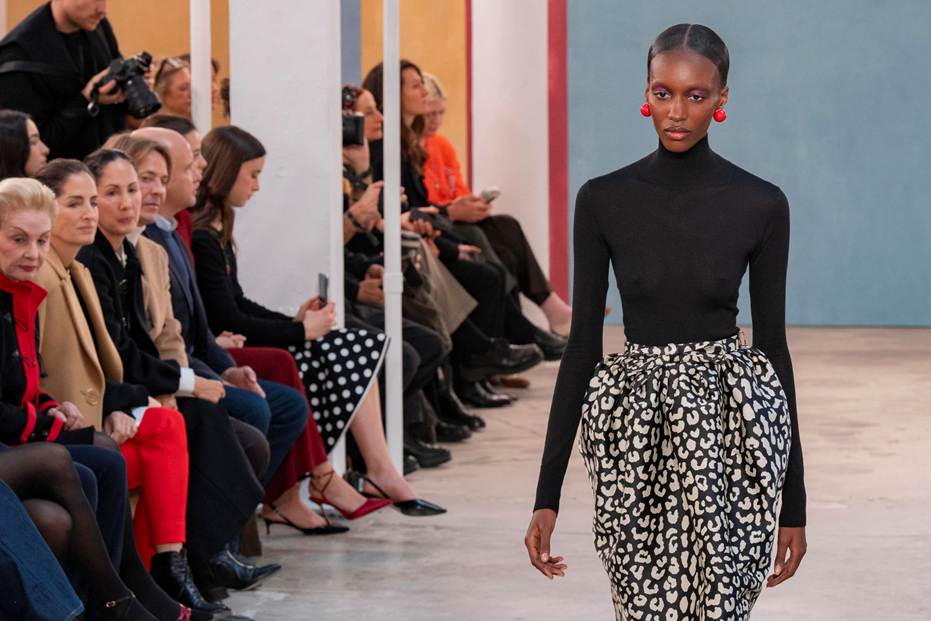
There were simple but elegant pencil skirt sets paired with blazers with puffed shoulders. There were dresses tight through the torso, with exaggerated hips. There were warm jackets crowded with bows, and then the counterpoint: tunic dresses, and top-and-pants sets that emphasized the feminine silhouette with a thin belt at the waist.
The palette moved through neutral tones in white, black, and red, with leopard and floral prints cutting through the restraint. Shoes with high heels echoed the iconic logo and bottle of the Good Girl perfume, which turns ten years old. The everyday observation implied by that detail is how a brand is not only fabric and stitching. It is memory. It is a perfume bottle you recognize instantly, and the way that recognition gets translated back into a print or a heel.
For the night, the embellishment took over. Dresses covered in sequins, forming poppies in color. Golden sequins, inspired by Agnes Martin’s work Friendship, according to the brand’s notes. Calla lilies reappeared as buttons and golden brooches on several looks.
It is a collection that speaks in symbols, but it does not abandon the body. Volume is a statement on the hip, on the shoulder, challenging traditional notions of elegance. It insists that loud, expressive fashion can still embody grace without shouting.
Beauty as Strategy in an Uncertain Economy
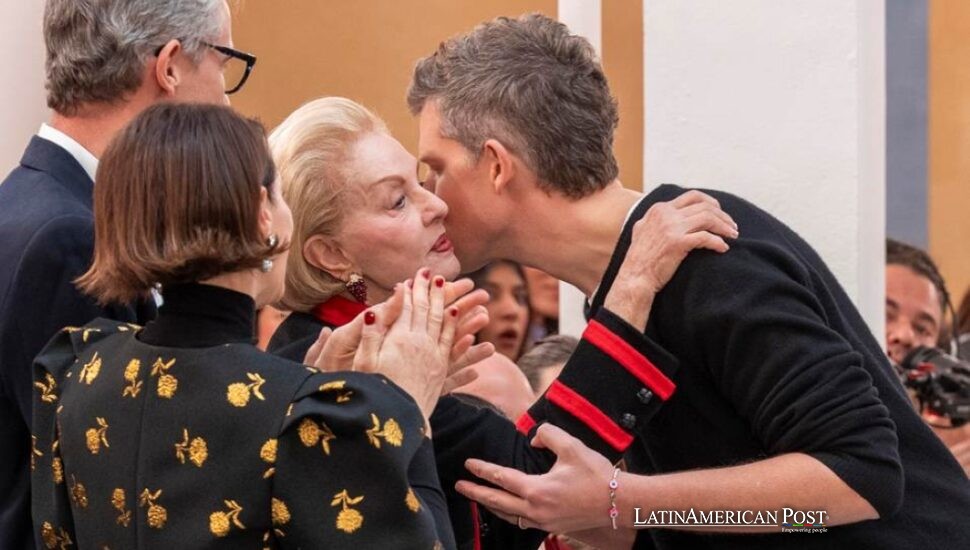
After the artists walked among the mannequins in the industrial space, they closed the show to applause. Gordon came out at the end to a broad ovation, then stopped to greet the Venezuelan designer herself, seated in the front row beside her daughter, Carolina Herrera Jr.
Gordon described the moment with the kind of nervous honesty that makes a backstage quote feel human instead of polished. “The first time she sees a collection is at the show, like today. So I always like to look at her face to see her reactions, because even after eight years, it makes me nervous. And today she stood up and gave me a hug, something precious,” he told EFE, adding that they are close friends.
That embrace sits at the heart of the brand’s own story, as told in the show notes. Herrera began designing because another woman believed in her: Diana Vreeland, the legendary Vogue editor who recognized Herrera’s instinct and encouraged her to follow it.
That line matters because it turns the runway concept into a policy argument about cultural ecosystems. Not government policy in the narrow sense, but the deeper policy of who gets supported, who gets introduced, who gets the first yes. The show’s stated celebration of women patrons, gallerists, and collectors is really a statement about networks of power, and about how women have built them anyway, often without being credited as architects. This encourages the audience to feel motivated to support structural change for women in the arts.
Asked about how fashion responds to the current moment of global uncertainty, including tariff policy, Gordon framed beauty as a necessity rather than an indulgence. “When times are dark is when we need beauty, color, and joy,” he told EFE. He defended fashion’s capacity for personal expression. “Fashion is about creating something beautiful, creating something with our own hands and our minds, and it is the highest expression of who we are as a people and as persons,” he told EFE.
The trouble is that beauty is never only beauty. In a world of tariffs, supply chains, and economic pressure, insisting on color and joy is also insisting on labor, craft, and the right to make something that is not purely functional. It is a claim that culture is not a luxury add-on. It is part of how people stay legible to themselves.
The brand also used the day to highlight a platform called Carolina Herrera for Women in the Arts, which collaborates with institutions to promote women’s talent in fashion through scholarships and to support exhibitions of women artists, among other efforts.
Seen through the lived reality of the runway, that initiative reads less like a slogan and more like a map of what the show is trying to argue. If women’s art power is the theme, then support has to be more than applause. It has to be structured.
In that Meatpacking room, you could feel the logic click into place. The artists did not just inspire the clothes. They wore them. And for a moment, the distance between muse and maker, between patron and runway, got smaller. Not erased. Smaller.
Sometimes that is the whole fight.
Also Read: Puerto Rican Halftime Heat Tests Who Gets Policed on TV