Ecuador Uses Technology to Trace the Hands Behind Toquilla Hats

Inside a small museum in Montecristi, visitors lift virtual reality goggles and step into rural weaving communities. Ecuador is betting that technology can protect heritage, expand markets, and return visibility to artisans whose work has long traveled the world without their names attached.
Five Minutes Inside a Living Craft
The room is quiet before the goggles go on. Then the soundscape changes. Fields appear. Hands move. Fibers cross and tighten. In five minutes, visitors travel through rural communities where the toquilla straw hat is born, learning techniques, places, and family histories that rarely fit on a price tag.
This is Explora Toquilla, a new immersive digital experience inside the Toquilla Straw Hat Museum in Montecristi. It opened this week as a collaboration led by the municipality, with funding from the Organization of Ibero-American States for Education, Science and Culture (OEI). The premise is simple. Use virtual reality to show what cannot be carried out of a museum in a shopping bag.
Visitors explore historical sites, observe weaving techniques, and encounter the cultural legacy of artisan families. They also see Montecristi itself, framed as a destination rather than just a name stitched into labels abroad. The experience lasts minutes, but it compresses centuries.
The everyday observation is almost mundane. People adjust the headset straps the way they would sunglasses. Someone wipes a lens with a sleeve. Then the past appears, rendered in pixels.
The OEI said the project “marks a milestone in the digital transformation of culture in the country,” a phrase that can sound abstract until you watch someone slowly remove the goggles, as if stepping back across a threshold.
The trouble is that heritage has often been treated as something frozen in time. This project insists it is not.

From Ancestral Knowledge to Digital Traceability
The initiative is called Montecristi Creativa, a digital transformation of the toquilla straw weaving tradition. It was selected regionally as the only Ecuadorian proposal to receive support from the OEI’s competitive fund for digital transformation. That distinction matters because it frames culture as infrastructure rather than decoration.
The initiative aims to safeguard ancestral art using advanced tools like artificial intelligence and augmented reality, but crucially, it also enhances artisans’ livelihoods by providing traceability and market access, making their work more valued and recognized.
One of the most consequential innovations is a certification system using QR codes. For the first time, buyers will be able to scan a hat and learn the identity of the artisan who made it. The code confirms authenticity and shields the craft from international competitors who mimic the product without its history.
More than 1,200 artisans benefit directly from this system, strengthening their connections to new markets and making their work feel valued and respected.
The toquilla straw hat is already recognized as an intangible cultural heritage of humanity. That recognition came in 2012, when the traditional weaving of Ecuador’s toquilla straw hat was inscribed on UNESCO’s Representative List of the Intangible Cultural Heritage of Humanity. The title matters, but it does not pay school fees or stabilize demand.
What this digital turn attempts is a bridge between recognition and livelihood. Not a replacement for hands, but a system that makes hands visible.
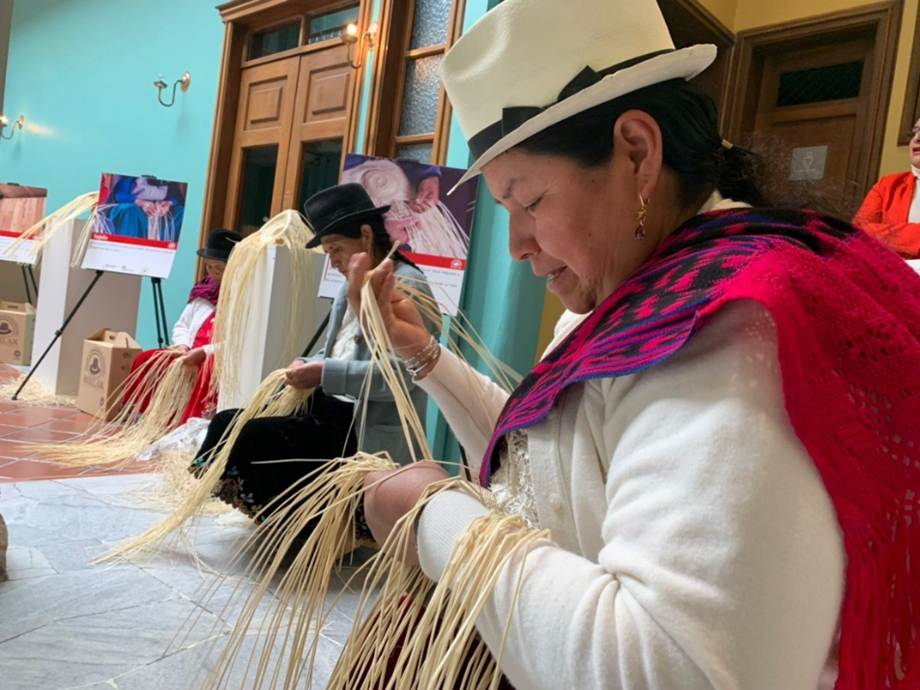
Historically, the craft originated in Manabí. In the seventeenth century, indigenous knowledge merged local fiber with European hat forms. Weavers in Montecristi and Jipijapa specialized. In the nineteenth century, the trade spread and intensified, especially in the southern highlands. Exports surged. For a time, toquilla hats surpassed cacao as an export product, traveling through Guayaquil to Europe and the United States, showcased at international exhibitions and worn by canal workers and political figures alike.
Then industrial change arrived. Demand shifted. The global market moved on. In Ecuador, the weaving stayed.
The craft remains in families and communities, passing routines from one generation to the next, emphasizing its living, ongoing nature that deserves support.
Recognition Without Monumentalism
The UNESCO recognition of the traditional weaving of the Ecuadorian toquilla straw hat was meant to shift how heritage is understood, not as a monument, not as an object sealed behind glass, but as a living set of knowledge, practices, and techniques with social meaning.
That shift carries obligations. Visibility must translate into respect. Respect must translate into conditions that allow transmission to continue. Otherwise, heritage becomes a certificate pinned to something already fading.
The National Institute of Cultural Heritage led the technical dossier that supported the UNESCO nomination, working through national ministries and diplomatic channels. The recognition aligned with the government’s broader cultural objectives at the time, but its long-term value depends on what happens afterward.
Technology enters as a policy tool that empowers artisans by explaining, authenticating, and connecting, fostering a sense of agency and progress.
The sensory detail that lingers is tactile even inside a digital space. Viewers notice the rhythm of hands weaving straw, the patience embedded in repetition. That rhythm contrasts with the speed of scanning a QR code or slipping on a headset. Old time and new time sharing a frame.
A memorable line emerges almost accidentally. A hat that once traveled the world without its maker’s name now carries one, if you bother to look.
Ecuador’s experiment sits inside a broader Latin American debate about how to protect cultural heritage without trapping it in nostalgia. Tourism alone is not enough. Declarations alone are not enough. The question is whether digital tools can redistribute value toward those who sustain the tradition daily.
In Montecristi, the answer is tentative but tangible. Five minutes inside a headset. A code stitched into a product. A policy choice to treat artisans not as background, but as protagonists.
It is not a revolution. It is something quieter—a recalibration, done carefully, with straw, light, and technology sharing the same space.
Also Read: Plus Ultra Flight: 100 Years of the Historic Air Journey Linking Spain and Buenos Aires