Cuba Eyes Rugby Dreams as Football Fields Host a New Scramble
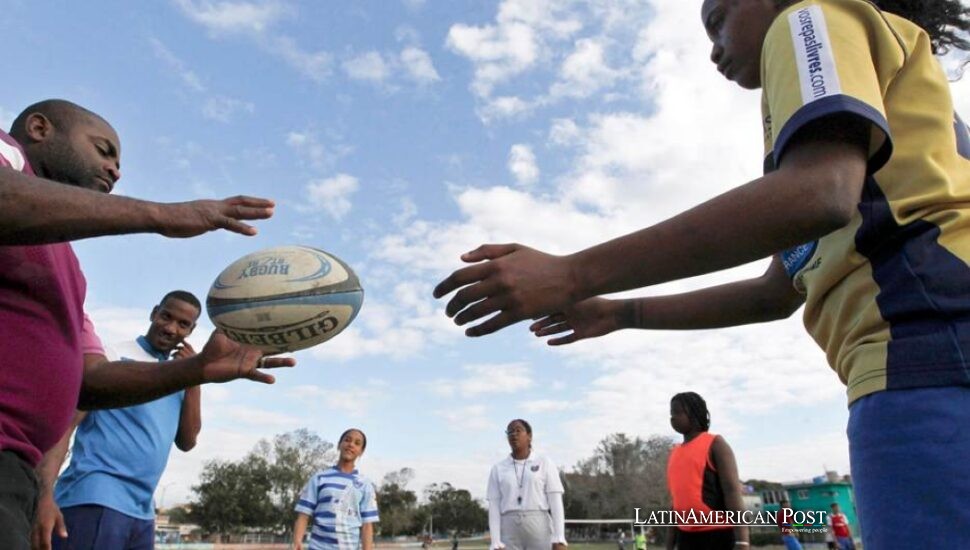
On a Havana football pitch, Cuban kids pile onto a rugby ball while baseball continues nearby. A French-backed program and a Cuban coach with European experience want continuity, inclusion, and girls’ participation, hoping Cuba can build rugby from scratch.
A Tackle Drill Beside a Baseball Diamond
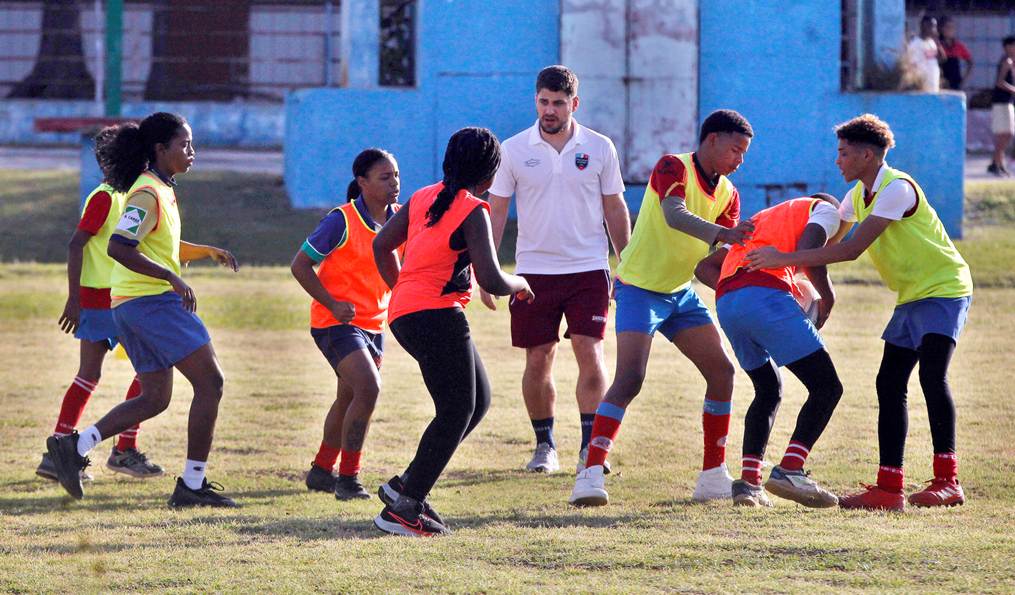
In the middle of a wide football field in Havana, children scramble around a rugby ball with determined effort, arms and legs crossing in a lively, improvised contest that embodies both seriousness and spontaneity. Nearby, another group plays baseball, illustrating the coexistence of two sports that reflect Havana’s diverse sporting culture, sharing the same air and dust in a scene that captures the island’s sporting duality.
Joel Guillén watches the rugby knot form and reform. He is thirty, the first Cuban to play professionally in Europe, and now a coach of a second-division team in France. He does not talk like someone selling a fantasy. He talks like someone who has been inside systems that either grow or fade depending on whether they repeat themselves.
He does not think it is a utopia for the island to become a rugby country one day. “It can be done. You just need to dedicate time and continuity,” Guillén told EFE.
The trouble is, time and continuity are not motivational phrases in Cuba. They are resources. They are also a policy choice, because every hour given to one program is an hour not given to another, and every new sport competes with traditions that are not just athletic but also cultural. Still, the scene on the field carries its own argument. Children do not pile onto a rugby ball because of geopolitics. They do it because the game gives them something immediate: contact, teamwork, the weird satisfaction of learning how to fall and get up again.
Guillén’s presence at Havana’s Eduardo Saborit stadium is tied to an international project that aims to have the island, sooner rather than later, form a national rugby team at a fundamental level. This week, he has led practices and talks with Cuban youth and local coaches who want to learn the sport. It is training, yes. It is also persuasion, conducted through drills.
A French Partnership and a Cuban State Structure
The program is part of a cooperation agreement between the French embassy in Cuba and Inder, Cuba’s National Institute of Sports, Physical Education, and Recreation. That pairing matters. One side brings international partnerships and a well-established rugby development model. The other side is the Cuban sports system, historically centralized, proud of its athletes, and shaped by the idea that sport is not only a pastime but also a national projection.
That can be an advantage. It can also be a constraint. The wager here is that a new sport can find a place within a system built around legacy disciplines and global expectations.
The program aims to create an academy for boys and girls from six to sixteen, focusing on inclusion and gender equality, to make participation feel welcoming and normal for everyone,’ Benassi told EFE.
That sentence carries a quiet challenge. Rugby is a contact sport, and contact sports often carry gender assumptions that harden into habits. If the program wants girls involved from the start, it is trying to shape culture as much as technique, to make participation feel normal before it becomes exceptional.
There is another goal, too, one that speaks to how international sports pathways are built. The project also aims to identify talent and develop it in France. In a country without a rugby tradition, the initial pipeline will come from young people who already trained in other sports, especially handball. That detail is not incidental. It suggests an approach based on transferable skills, bodies already accustomed to movement patterns, speed, and contact, athletes who can be redirected rather than invented from nothing.
What this does is underline an old truth about sport in the Global South: talent often exists before the pathway does. The path is what countries fight over, fund, and sometimes lose.
Continuity, Not Utopia, in a Country That Loves Sport
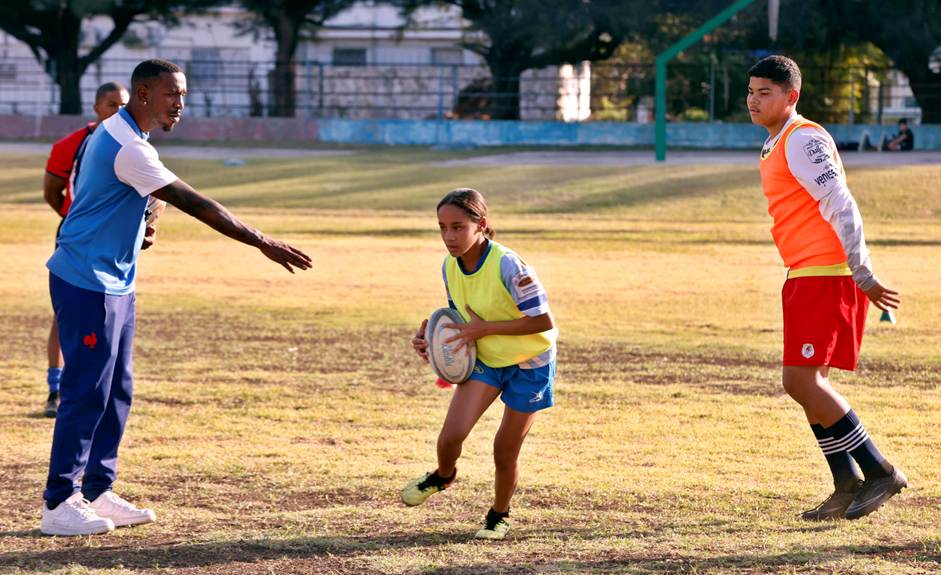
Guillén argues that Cuba’s athletic culture is an asset, even if rugby itself is unfamiliar. “Cuba is a country that historically has high-level athletes. We have that culture of sport here, and when we see even the kids or young people who come to train, you can see potential,” Guillén told EFE.
His own story is a reminder that pathways can begin in accidents. He emigrated to Spain as a child. He found rugby almost by chance, and then stayed with it by choice. He describes being drawn to contact sports, then receiving a nudge from a teacher. “I’ve always been very curious about contact sports. And once a teacher called me and said, ‘Why don’t you try judo or rugby?’ At that moment, honestly, it was an unknown sport for me. I started researching and watching matches, and I fell in love,” Guillén told EFE.
That kind of origin story matters in Cuba because it mirrors what the program is trying to create. A first encounter. A moment of curiosity. Something that catches.
The scene in the Havana field makes it real. A child does not need a national tradition to enjoy a tackle drill. But a national team requires more than enjoyment. It requires repetition, coaching depth, competition structures, and enough institutional patience to accept that early years look messy.
With 75 players aged 6 to 16, including 36 girls, the French and Cuban authorities see this as the start of a community. ‘Building community is the foundation for sustainable growth in sport,’ they believe.
The everyday observation, implied by the field itself, is that space is shared. Rugby is born beside baseball, not in isolation. That matters because it frames the project not as a replacement, but as an addition, an expansion of what Cuban sport can mean.
And yet the program’s success will be measured less by the novelty of a rugby ball on a Havana pitch than by whether those children come back next week, and the week after that. Continuity. Continuity. Because in the end, the difference between a fleeting curiosity and a national sport is not inspiration. It is what happens when nobody is watching, and the drills still start on time.
Also Read: Trinidad and Tobago and Jamaica Put Caribbean Grit on Olympic Ice