Vinícius, Benfica, And Latin America’s Unfinished War on Stadium Racism
In Lisbon, Vinícius Junior’s celebration, a paused Champions League match, and a UEFA investigation revived football’s oldest debate: is racism truly punished or just managed? For Real Madrid’s Brazilian star, this moment reflects years of abuse and avoidance in Spain.
A Corner Flag, a Covered Mouth
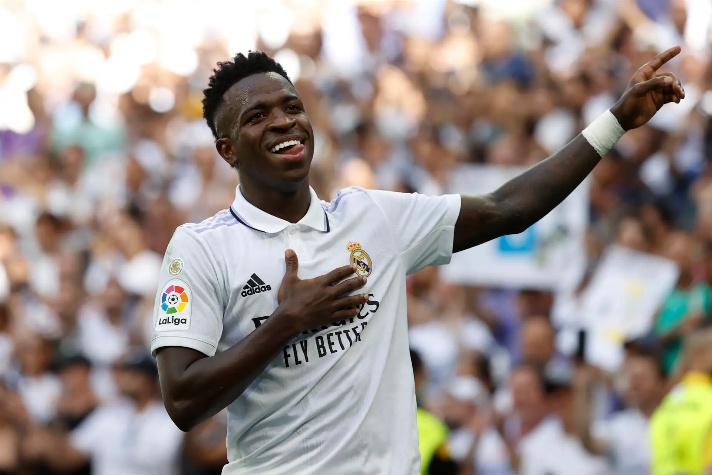
The ball had just hit the net when Vinícius Junior turned to the corner flag and danced, close enough to make the celebration feel personal. Four minutes into the second half, Real Madrid was leading Benfica, and the Estadio da Luz was filled with a tense silence as thousands held their breath.
Then everything changed.
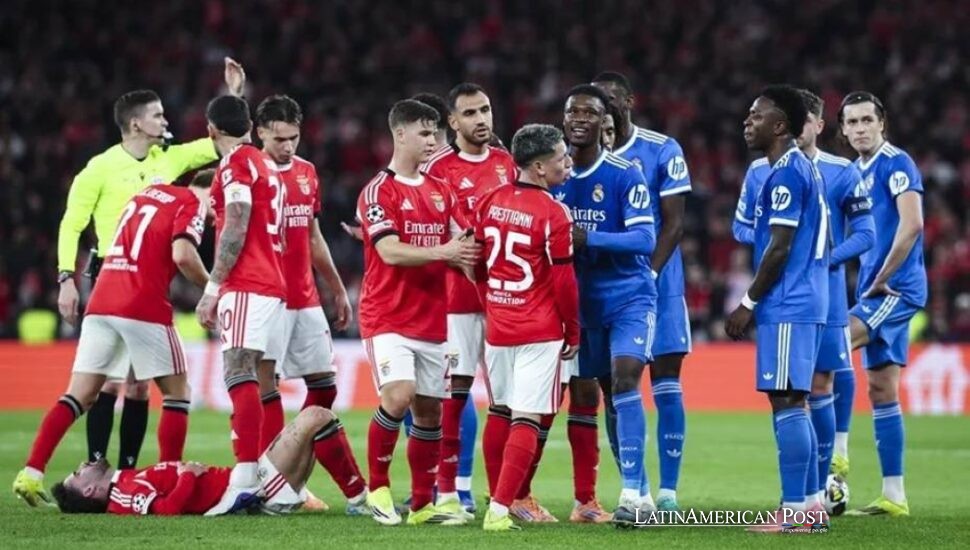
Benfica players converged. Words came fast. Gianluca Prestianni, their winger, pulled his shirt up to cover his mouth as he spoke, a familiar habit in modern football, private speech in public. Vinícius told referee Francois Letexier he had been racially insulted, The Athletic reported, and Prestianni later denied it.
Letexier activated UEFA’s anti racism protocol. The match stopped, The Athletic reported, and for a stretch it looked as if it might not restart. Vinicius left the pitch and sat on the bench before he and his teammates returned. It stops. It restarts. That rhythm is part of the policy now, and it is also part of the problem.
Real Madrid’s account is based on more than feelings—it’s backed by evidence. The club confirmed on Thursday that it gave UEFA all available proof about Tuesday’s incidents and the alleged racist insult. It said it has been actively cooperating with UEFA’s investigation into what it called “unacceptable episodes of racism.” The club also shared images it says show fans making monkey gestures from the stands.
UEFA, as reported by Real Madrid, is investigating and has appointed an ethics and disciplinary inspector to conduct the procedure.
The problem is how blurry the line is between following protocol and facing real consequences when the key moment is spoken, hidden, and disputed. Real Madrid said that neither Letexier nor any official heard the alleged insult, so the match continued under protocol instead of punishment. According to IFAB’s Laws of the Game, rule twelve calls for a direct red card if the referee hears a racist insult. But in this case, the crucial sound was missing, even as the stadium made its own noise.
Real Madrid reported that objects were thrown from the stands onto the field and that the game was halted for about eight minutes amid threats by Vinícius and other Madrid players, including Kylian Mbappe, to leave the pitch. Mbappe’s account, as cited by Real Madrid and also reported by The Athletic, was blunt: “The number twenty-five said five times to Vini that he is a monkey.”
Prestianni responded later on social media, denying the claims, as reported by Real Madrid and The Athletic. “At no time did I direct racist insults to Vini Jr,” he wrote. He added that Vinicius “misunderstood what he thought he heard” and said he had received threats from Real Madrid players. Vinícius responded like someone who knows how these nights unfold. “Racists are, above all, cowards,” he wrote on Instagram after the match, as reported by Real Madrid and The Athletic. “They need to put their shirts over their mouths.”
Deja Vu and the Politics of Denial
The Athletic described Tuesday’s allegation as a painful sense of deja vu, and it’s more than just a feeling. It’s a repeated pattern backed by records.
In figures cited by The Athletic, La Liga has recorded twenty-six incidents of racist abuse directed at Vinícius Jr at ten different football grounds in Spain since October two thousand twenty one. Those numbers are more than a tally. They are a map of repetition, a route traced by chants, gestures, and the slow work of institutions deciding what they can prove.
The story The Athletic shares from recent seasons is sadly familiar: racist chants before, during, and after an Atletico Madrid match in September 2022; a mannequin made to look like Vinícius Jr hung from a bridge near Real Madrid’s training ground the next January; and later, suspended prison sentences for members of Frente Atletico involved in that act, in June 2025.
And then there is Valencia, where the conflict became global and also local in the sharpest sense. The Athletic described “dramatic scenes” at Mestalla in May two thousand twenty three, when Vinícius confronted a group of home fans behind one of the goals during a break in play. A Spanish football federation report later detailed the language he faced, The Athletic reported, and three supporters were found guilty of a hate crime. Yet The Athletic also reported that many around Valencia came to believe they were the ones wronged, turning a racist incident into a civic grievance.
Moha Gerehou, a Spanish writer and anti-racism activist, explained this reversal to The Athletic with clear insight. “There was a choice between protecting a victim of racism or protecting the interests of their football team,” he said. “They had no problem downplaying what Vinicius Jr went through.” active. The Athletic reported that Spanish media wrongly characterized Vinícius’s court testimony, that Valencia demanded an apology, that a newspaper depicted him as Pinocchio, and that Valencia later filed a lawsuit against Netflix over alleged inaccuracies in a documentary about his battles against racism. Each step is different. The direction is the same.
The Athletic also highlighted an argument that follows Vinícius across Spain: it’s not about whether racism happened, but whether he provoked it. Alberto Edjogo Owono, a former Equatorial Guinea international and Spanish TV pundit, said in a conversation reported by The Athletic: if you’re against Real Madrid, “often the conversation isn’t about the racist abuse but whether he provokes it.” Football, he added, is emotional, and that emotion “brings out the most primitive.”
Benfica: It’s A “Defamation Campaign”
Vinícius has been pushing back for years, often in cultural terms that link his Latin American identity closely to the debate. When a Spanish football agents association president criticized his celebrations in 2022, Vinícius defended dance as “cultural diversity,” in a post reported by The Athletic. He mentioned samba and Brazilian funk alongside reggaeton and Black American dances, showing that the real issue is always about who gets to be joyful, and how.
Gerehou described a similar divide with words that stick: “It’s more about who is the ‘good’ Black person and who is the ‘bad’ Black person,” he told The Athletic. The incident, as described by The Athletic, fit the older script. After the final whistle, manager Jose Mourinho appeared to blame Vinícius for provoking the moment, The Athletic reported, and he spoke in terms that redirected the debate from racism to etiquette. “When you score a goal like that, you celebrate in a respectful way,” Mourinho told Amazon Prime, in comments quoted by The Athletic.
He went on. He pointed out that Benfica’s greatest player, Eusebio, was Black, and insisted the club was “the last thing that it is” racist, The Athletic reported. He also hinted at a pattern that feels like an accusation itself: “There is something wrong because it happens in every stadium,” he said, as reported by The Athletic. “Always.”
Benfica later called it a “defamation campaign” against Prestianni and promised to cooperate with UEFA, according to Real Madrid’s report. The club also posted on social media saying it would have been impossible for Madrid players to hear what was said because they were too far away, The Athletic reported. Mbappe’s reply was straightforward: he said he heard it.
This shows how modern anti-racism efforts can get stuck in arguments about angles and distances while the main issue remains unresolved. UEFA’s protocol can stop a game and force a pause. But a pause isn’t punishment, and a restart isn’t accountability.
Real Madrid’s statement on Thursday focused on the consequences. The club said it would keep working “in collaboration with all institutions” to fight racism, violence, and hate in sport and society, Real Madrid reported. It also said Vinícius had received “unanimous support” from all parts of world football. The longer arc noted the unevenness of institutional support around Vinícius over time, from Bernabeu tributes and public slogans to moments when critics suggested his anti-racism commitment was a distraction. That tension matters because Latin America’s export stars do not just carry goals and sponsorships into Europe. They carry the contradictions of being celebrated for talent while being policed for presence. The same celebration that sells a sport can be framed as provocation when the player is Black, Brazilian, and unapologetically visible.
UEFA’s investigation now hangs over the second leg at the Bernabeu on Wednesday, a football event that will also test governance. The process will either lead to visible sanctions or another familiar restart. The crowd will roar. The paperwork will move. And Vinícius will once again have to decide how much of himself he must give up just to play.
Also Read: Argentina and Uruguay Haunt United as Ratcliffe Targets Immigrants Loudly