Panama Finds Room for Faith After Earthquake Leaves Historic Churches in Ruins
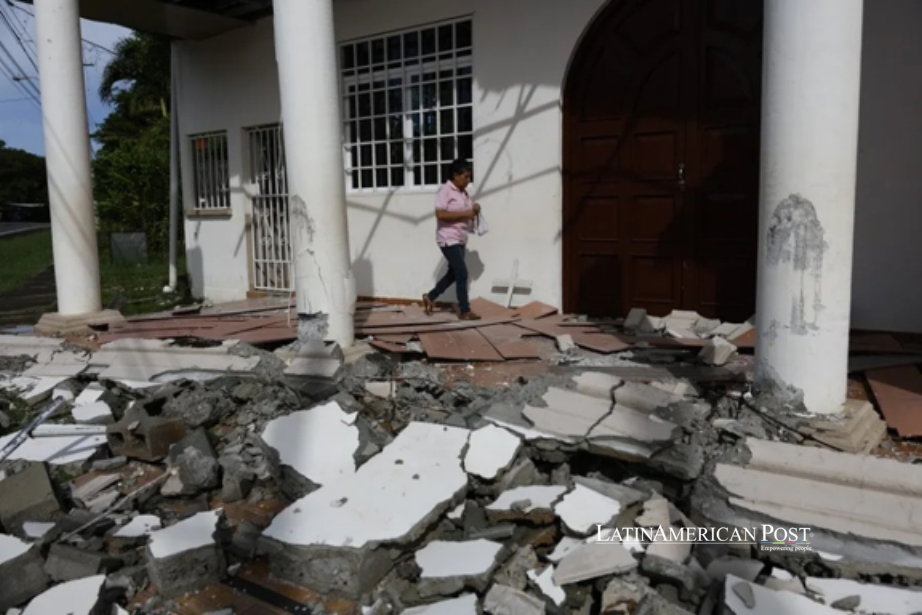
Panama’s earthquake has damaged 13 churches, leaving rural communities to mourn familiar sanctuaries while practicing their faith. Across the Azuero Peninsula, outdoor Masses reveal how the loss of historic buildings deepens a disaster already reaching into homes, livelihoods, and memory.
A Cross Among the Debris
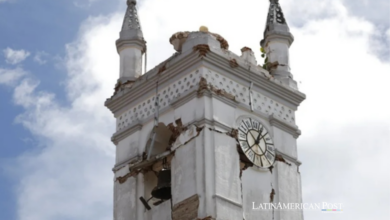
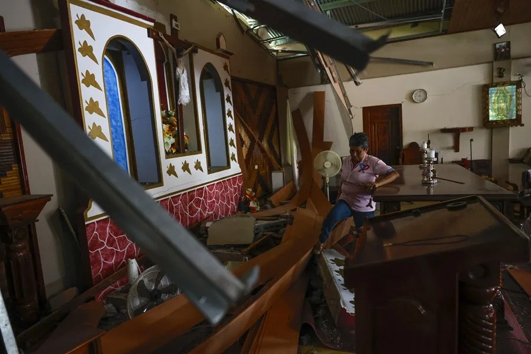
The cross from the altar lies fallen inside Santa Rosa de Lima chapel. One tower has collapsed. Cracks cut through the building, the suspended ceiling is shattered, and religious images bear damage of their own. In Llano de Piedra, a familiar place of shelter has become another place to fear.
Yet the congregation has not disappeared with the building’s security. Father Álvaro Sáez, who oversees the area, describes a community grieving its homes and the chapel where neighbors gathered each Sunday.
“They are very afraid, but they have a lot of hope,” he told EFE.
The magnitude 7.7 earthquake struck Panama at 12:56 p.m. on October 9. Across Azuero, whose villages depend on agriculture and cattle raising, damaged churches stand as stark reminders of how quickly an ordinary gathering place can become unusable.
The Archdiocese of Panama counts 13 damaged places of worship. The Culture Ministry is assessing heritage losses, including the chapel at Llano de Piedra, built more than a century ago, and the church at La Villa de Los Santos, founded in the sixteenth century.
Thirteen is a building count, but each entry represents a separate interruption in community life. It says nothing about repair costs or how long congregations will remain displaced. Nor does it distinguish a damaged interior from a collapsed tower. Those differences will determine what can reopen and what requires prolonged restoration.
Neighbors in several villages told EFE that their churches had recently undergone renovations. That makes the destruction particularly painful: work intended to preserve familiar spaces has itself become part of the loss. Renovation alone, however, does not establish whether a building received structural reinforcement.
Four in Five Buildings Hit
About 60 miles from Llano de Piedra, Fulvia Pérez opens the doors of San Sebastián chapel with trembling hands. She heads the Catholic committee in La Colorada, where EFE reported that the earthquake devastated 80 percent of homes and local government buildings.
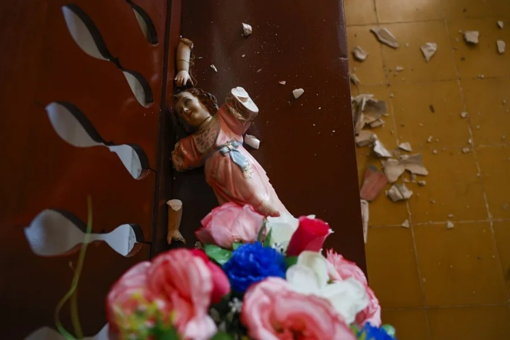
Inside, the patron saint’s image has lost its head. Debris obstructs passage, and sections of ceiling hang loose. Yet objects used for worship still shine on the central table. In the sacristy, a green priest’s vestment remains intact.
“Our patron saint has been destroyed,” Pérez told EFE. “Nobody has come here to look at the structures.”
Her account describes the situation when she spoke and captures the gap between knowing a building is damaged and knowing what can be saved. Visible ruin supplies no timetable. Someone must assess the structure before a community can plan its return.
The reported 80 percent means roughly four out of every five buildings in those categories were affected. It is a measure of concentrated destruction, not a finding that the remaining fifth is safe. With homes and government premises damaged, recovery must address both private shelter and the places where public assistance is organized.
For farming and ranching households, rebuilding a chapel also competes with rebuilding domestic life. Money, labor, and time cannot be spent twice. Even when residents want their church restored immediately, that wish must coexist with the urgent need to secure housing.
That is why historic preservation belongs inside the recovery discussion. Restoring these churches can recover shared space and cultural memory, but decisions must account for the same families’ housing needs. Their devotion cannot reasonably be treated as an unlimited source of reconstruction labor or donations.
The Church Goes Walking
Sáez had returned to his native Panama after studying in Rome barely 15 days before speaking with EFE. His arrival has become an introduction to ministry among people whose homes and churches have been damaged. He jokes that the church is becoming mobile, carrying what he needs between houses, parks, and fields.
The humor offers a little breathing room. The work continues.
He spoke amid his chapel’s ruins after conducting a funeral at a neighbor’s house. The person had died of natural causes. Even as earthquake recovery consumes attention, ordinary bereavement continues, demanding somewhere for people to gather.
No earthquake deaths had been reported, an outcome authorities described as a miracle. That relief is immense. It does not cancel the fear Sáez describes or restore the houses and sacred spaces people depended on. A disaster can spare lives while profoundly disrupting the arrangements that make those lives familiar.
An October 11 health report recorded 27 people with minor or moderate injuries. Set beside the absence of reported deaths, that number describes survival with consequences. Neither figure measures how many households lost usable shelter, how many livelihoods were interrupted, or how many residents now hesitate before entering a familiar building.
The outdoor services offer continuity without requiring a return to damaged sanctuaries. They also make visible the relationships that had always sustained worship inside them.
“The walls gave us shelter, but this has helped us understand what it means to be a church,” Sáez told EFE.
Now they celebrate faith in fields, on porches, and inside homes. The priest calls it a living community. Beside him, his assistant reaches into a cloth bag and takes out the chalice.