Colombia’s Kollin Castro Shatters Records With Triple Gold at Paraguay World Skate Games
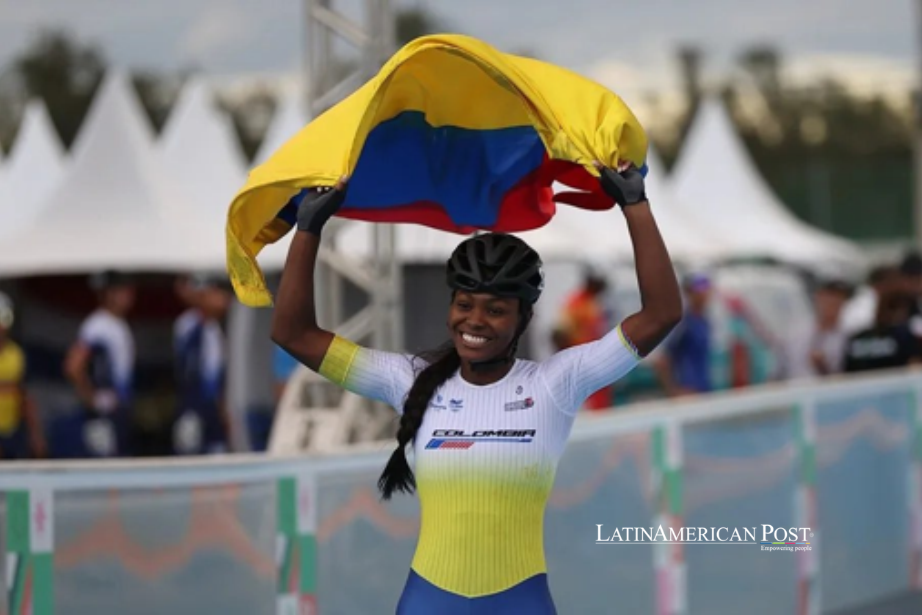
Colombian skater Kollin Castro won three gold medals and rewrote the 1,000-meter world record in Paraguay, leading a championship story that stretched beyond the podium to reveal Latin America’s strength, the uneven representation of women, and the unforgiving arithmetic of elite international sport.
Four Thousandths Between Gold and Silver
Four thousandths of a second separated Kollin Castro from her Colombian teammate Geiny Pájaro in the 200 meters. Castro finished in 18.425 seconds; Pájaro in 18.429. The difference was so small it was almost too small to say aloud. The results sheet separated the first two places.
For Castro, from Valle del Cauca, that victory began a performance crowned by three titles at the fifth World Skate Games in Paraguay. Across 17 days, from October 2 through 18, the event brought together 5,600 athletes from 91 countries across 11 sports and 40 disciplines, according to organizers’ figures reported by EFE.
Her defining performance came in the 1,000 meters, where she recorded 1:24.751 during qualifying. That distinction matters: the world record and the gold medal came in different races. She later won the final in 1:27.882, ahead of American Corinne Stoddard and Chilean Catalina Lorca.
Taiwan’s Yang Ho-Chen held the previous record, 1:26.172, which had stood since the 2021 world championships in Ibagué, Colombia. Castro removed 1.421 seconds, a reduction of approximately 1.65 percent. Over the kilometer, she averaged about 26.4 miles per hour.
That improvement was substantial against a standard that had survived five years. Her slower final also shows why racing cannot be reduced to a single stopwatch comparison. A qualifying record captures an exceptional performance; a final requires beating the people sharing that particular race. Castro accomplished both.
She then joined Yicel Camila Giraldo, Gabriela Rueda, and María Alzate to win gold in the 3,000-meter relay, then added silver in the circuit lap event. Individual speed became a shared result, with three other women carrying the same Colombian ambition.
A Tradition Bigger Than One Champion
Castro arrived with 10 previous world titles, according to Colombia’s skating federation. Her success therefore reflects accumulated experience rather than a sudden discovery. The federation identifies her with the Semillas Valle club and the Valle del Cauca league, institutions that give a national achievement a local address. The national speed team drew 28 skaters from 17 clubs across six regional leagues, evidence of a sporting network extending well beyond any single champion or training group.
Colombia’s strength was visible beyond its leading woman. Santiago Vásquez set a men’s 200-meter world record of 17.108 seconds. At the end of the track competitions, Colombia won 13 golds, eight silvers, and four bronzes, according to the Colombian Olympic Committee. That was the track tally, not the final medal table for every sport.
Thirteen of those 25 medals were gold, a 52 percent conversion rate. The figure measures how often Colombian podium appearances ended on the highest step. Together with success in individual races and relays, it points to depth across competitors and formats.
Elsewhere in Latin America, El Salvador’s Ivonne Nóchez supplied another lesson in the difference between records and championships. She set the women’s 200-meter mark of 18.389 seconds in qualifying, then took bronze in the final, which Castro won. EFE also reported her gold in the circuit lap event.
Spain’s Jhoan “Chevi” Guzmán, born in Venezuela, carried the region’s sporting connections into another national delegation. He won three golds and two silvers, including a 100-meter world record of 9.467 seconds. He won his Spanish relay title alongside Francisco Peula and Manuel Taibo.
His birthplace and competitive allegiance complicate a simple national accounting of talent. The medals belong to Spain; his sporting biography also belongs within Latin America’s story. Paraguay provided a meeting ground for athletes whose routes to the podium crossed borders and finish lines.
Women Lead Headlines, Numbers Lag
Women numbered 2,004 of the 5,600 competitors, approximately 35.8 percent. That left them outnumbered by nearly 1.8 to one. Their prominence among the champions should not obscure that broader imbalance. Repeated wins and equal participation measure a sport’s reach in different ways.
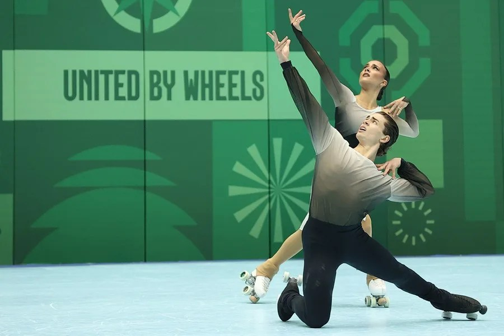
Italy’s Roberta Sasso demonstrated the first with a solo dance gold and the second alongside Gherardo Altieri. Since 2021, across junior and senior competition, she has won five individual world titles and five in partnered dance, always with Altieri. Continuity was part of the achievement.
Her compatriot Sofia Paola Chiumiento, 18, collected three junior speed titles and two silvers, while Ludovica Rimondi earned two senior skate cross golds. Their results show women succeeding across different competitive demands, even within a field where women remained little more than one third of participants.
Other records required a different reading altogether. Spain’s Guillermo Gómez, 19, won on his senior debut with 275.76 points overall, including a record 100.18 in the short program. Portugal’s Madalena Costa reached 264.69 points in artistic free skating. Such scores cannot be ranked against sprint times.
American Jack Walsh’s 188.60 in street scootering and Russian Veronika Zherelnikova’s 142-centimeter skating high jump further widened the championship’s range. Spain’s Egoitz Bijueska added another world title in skateboarding park. One festival contained several distinct definitions of excellence.
For Castro, the achievement remained concrete: three world titles and a new 1,000-meter benchmark, taken from a record established in her own country. Paraguay confirmed her place among the best. The relay ensured she wasn’t there alone.