Caribbean Reparations Vote Pushes Latin America Toward Its Unfinished Reckoning
A UN vote backed by Caribbean and African states has reopened Latin America’s oldest wound, forcing the region to confront slavery’s afterlife not as distant history, but as a living political argument about race, inequality, apology, debt, and democratic memory today.
A Moral Demand Moves Into Global Politics
The United Nations General Assembly vote declaring the transatlantic slave trade “the gravest crime against humanity” may not bind any government to pay a cent, but it has already done something politically serious for Latin America and the Caribbean. It has shifted the argument. What was too often treated as a historical grievance, a ceremonial lament, or a morally safe museum subject has been returned to the realm of active international politics. That matters in this region, where the wealth of empires and later republics was built not around an abstraction called labour, but around captive bodies, racial hierarchy, and generations of silence.
As the BBC reported, the resolution was backed by African and Caribbean countries and adopted by 123 votes to three, with 52 abstentions. The United States, Argentina, and Israel voted against it. The United Kingdom and EU member states abstained. That voting map tells its own story. The countries and regions that lived closest to the wound pushed the issue forward. Many of the powers historically tied to slavery, colonial rule, or the architecture of that trade resisted direct alignment with the language now being used.
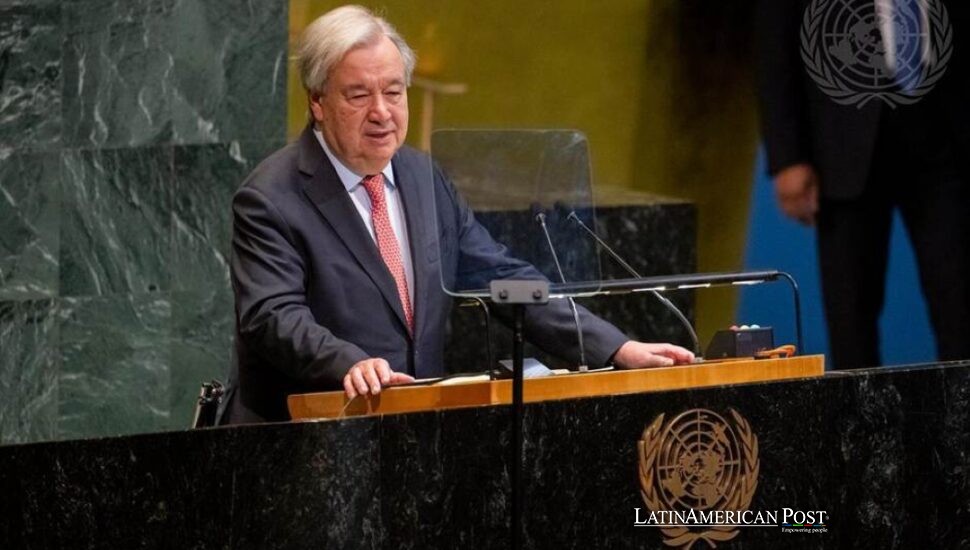
For Latin America, especially the Caribbean, this is not just about diplomatic theatre in New York. It is about who gets to name reality. For centuries, descendants of enslaved people have had to argue that the wealth extracted from African lives did not disappear with abolition. It hardened into land ownership, state formation, business fortunes, racial inequality, and the very social order many countries still inhabit. When UN Secretary General Antonio Guterres said, in remarks cited by the BBC, that the wealth of many Western nations was “built on stolen lives and stolen labour,” he was describing not only a past crime but a present structure.
That is why this vote lands differently in this hemisphere. Latin America knows what it is to live among ruins that still pay dividends to someone.
The Caribbean Has Forced the Region to Speak Plainly
The strongest political pulse in this story comes from the Caribbean. For years, Caribbean governments and campaigners have been among the clearest voices insisting that slavery is not a closed chapter and that reparations are not a fringe fantasy. In the BBC’s notes, Caricom’s ten-point plan appears not as a slogan but as an organized political framework, spanning debt cancellation to education and public health. In 2023, the bloc presented a study claiming its 15 nations owed at least $33 trillion to former colonial powers.
That number is so large it can sound unreal, and critics seize on that unreality fast. But the Caribbean case has never been only about a cheque. It has also been about forcing the world to stop pretending that an apology without repair is enough, or that regret without responsibility counts as justice. Verene Shepherd of the Caricom Reparations Commission told the BBC that “the healing process for the victims and their descendants requires that European governments issue sincere formal apologies.” That is not the language of mere symbolism. It is the language of political recognition.
Latin America should pay attention to that. The Caribbean has often borne the region’s clearest vocabulary on race, empire, and reparatory justice. It has done so while larger Latin American nations have frequently preferred ambiguity, especially where national myths depend on softening the brutality of slavery or diluting black political demands into a general story about mixture and harmony. The UN vote disrupts that comfort.
Brazil sits at the center of this discomfort. The BBC notes that it was the largest recipient of enslaved Africans, with 4.9 million people trafficked there, mostly while it was a Portuguese colony. It also notes that black Brazilians are twice as likely to live in poverty as whites, according to IBGE. That single comparison is devastating because it closes the distance between plantation history and present inequality. The point of reparations, as the BBC lays it out, is not to reverse history. It is to address the consequences that still persist in housing, schooling, wealth, health, and political power.
For Latin America more broadly, that is the hard truth inside the Caribbean push. Reparations are not only a demand aimed outward at Europe or the United States. They also raise questions inward, for republics in this region that benefited from slave labour after independence and still distribute dignity unequally.
Symbolic Victories Can Reshape Real Power
There is a temptation, especially among political elites, to dismiss this UN resolution because it is not legally binding. Even some supporters quoted by the BBC are cautious. Dr. Esther Xosei called it a victory but “only a declaration of intent.” Almaz Teffera of Human Rights Watch described it as a “huge and significant step in political terms,” even if it carries more symbolic value. That caution is fair. No resolution, by itself, can compel states to repent or pay.
But symbolism is nothing in Latin America. In this region, symbolic language has often been the battlefield before law moves, before archives open, before schoolbooks change, before public money follows moral acknowledgment. The words used in international forums matter because they alter what can be said domestically without sounding extreme. Once the General Assembly adopts language this severe, governments that keep dodging the legacy of slavery look less prudent and more evasive.
The politics of apology show why. The BBC notes that one reason states avoid formal apologies is that they may imply legal responsibility and, therefore, financial cost. That fear alone reveals the stakes. Governments know words are not free. Words create pathways. They build claims. They make denial harder to sustain. In that sense, the Caribbean and African-backed resolution is already doing political work even before any settlement exists.
For Latin America, the deeper meaning may be cultural as much as legal. The region is being asked, again, whether it wants a remembrance culture that cherry-picks the past or one that faces it whole. Sara Hamood of OHCHR told the BBC that the financial side is only part of restorative justice and that “formal apologies, truth-telling and education are all part of a wide range of measures.” That may be the most important lesson here. Repair is not one thing. It is a long argument about memory, dignity, and the shape of democracy itself.
So the Caribbean victory at the UN is not small because it is unfinished. It is important precisely because it has forced unfinished history back onto the table. Latin America now has less room to hide behind politeness and less room to pretend that slavery belongs safely to the past. The region has heard the claim in full view of the world. The question now is whether it answers with caution or with courage.
Also Read: Mexico Debates Dignity as Samara Martínez Brings Death into Public Discourse