Brazil Turns Sugarcane Into a Geopolitical Shield Against Oil Panic
Brazil’s sugarcane ethanol model is mitigating the impact of oil shocks resulting from the conflict in Iran, demonstrating to Latin America that energy sovereignty can be achieved not only through oil extraction but also through sustained public investment, adaptable technology, and a fuel system integrated into daily transportation.
A Buffer Built Long Before the Crisis
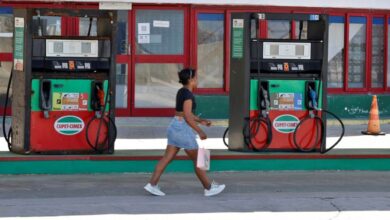
According to the Associated Press, Brazil is navigating the current global oil crisis with a level of protection unavailable to most Latin American countries. While the conflict in Iran destabilizes energy markets and prompts defensive measures elsewhere, tens of millions of Brazilian drivers can still choose between pure sugarcane ethanol and gasoline blended with biofuel at fuel stations. Although this choice may appear technical from an external perspective, within Brazil it carries significant political implications. It enables the country to absorb external shocks without immediately transferring the full burden of global conflict to households.
This context extends the relevance of Brazil’s experience beyond its borders. Throughout Latin America, fuel is closely linked to inflation, transportation logistics, food prices, electoral stability, and public anxiety during supply disruptions. When oil markets experience volatility, the region is reminded of the vulnerability inherent in dependence on imported energy. Brazil has partially alleviated this vulnerability, not by withdrawing from global markets or achieving complete self-sufficiency, but by developing an alternative fuel system over the course of decades and integrating it into everyday life.
The ethanol program was initiated in 1975 under military rule and has persisted through Brazil’s transition to democracy, a continuity notable in the Latin American context. Many state-led initiatives in the region either dissolve with regime changes or become largely symbolic. In contrast, Brazil’s ethanol system adapted and evolved, resulting in a dual-fuel vehicle fleet of unprecedented scale. This achievement now serves as a national asset, particularly as global conflicts continue to disrupt local economies.
The Associated Press reports that gasoline prices in Brazil increased by only 5% in March, compared to a 30% rise in the United States. Analysts attribute this relative stability in part to Brazil’s established domestic biofuels industry. While Brazil remains affected by global market fluctuations and continues to import refined fuels and petroleum from countries such as the United States, Saudi Arabia, Russia, and Guyana, the presence of a viable alternative reduces its vulnerability. In the Latin American context, this distinction can mean the difference between inconvenience and crisis.
What Latin America Sees in Brazil’s Tank
The broader lesson for the region is not that Brazil’s model can be replicated immediately by other countries. The Associated Press notes that India and Mexico are considering the Brazilian approach as a potential blueprint for energy security, a logical development. However, their focus extends beyond sugarcane itself to include political continuity, research infrastructure, and the capacity to transform a state-supported initiative into widespread social practice.
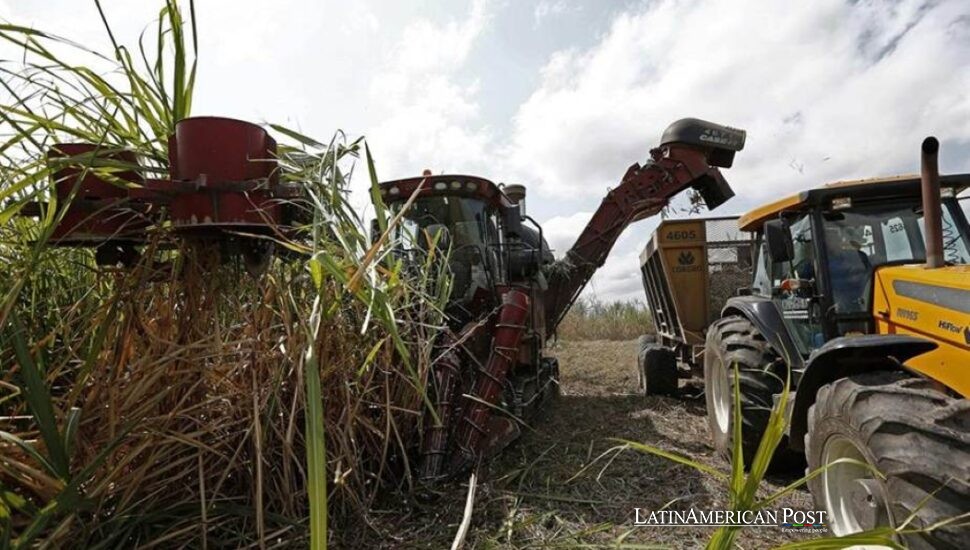
Brazil’s advantage in this area is the result of cumulative developments over time. The upcoming harvest is projected to yield a record 30 billion liters of ethanol, up 4 billion liters from the previous year. According to UNICA president Evandro Gussi, this increase alone matches the total volume of gasoline imported by Brazil last year. Furthermore, ethanol is already deeply integrated into daily life, with projected consumption reaching 37.1 billion liters in 2025, according to the state-run Energy Research Company.
These figures are politically significant because they illustrate a level of policy depth that is often difficult to maintain in Latin America. Rather than representing a temporary subsidy or a brief patriotic initiative, Brazil’s ethanol sector functions as an integrated ecosystem. The Associated Press describes a production model encompassing both advanced large-scale farms and smaller family-run operations, such as Bom Retiro, established in 1958, where several dozen workers cultivate forty square kilometers of land. The model also benefits from years of state-sponsored research, including efforts at the Science Development Center for Ethanol at Unicamp in Campinas.
The research infrastructure supporting Brazil’s ethanol sector may be its most critical component. According to Luis Cortez, coordinator of the Science Development Center for Ethanol, Brazil possesses flexibility in ethanol production, vehicle engine compatibility, and federal regulation of ethanol blend percentages. This multi-level flexibility signifies that the state has not merely subsidized a crop, but has facilitated the development of an integrated system in which agricultural production, engine technology, and regulatory frameworks operate in concert. In a region where energy policy often oscillates between resource extraction and consumer dissatisfaction, this represents a rare instance of industrial policy with tangible effects at the consumer level.
There is also a significant cultural dimension to Brazil’s approach. While the ethanol buffer is cost-effective and more environmentally sustainable, it also provides psychological stability. The Associated Press observes that the widespread availability of ethanol at fuel stations offers Brazilians both economic and psychological security. This aspect is noteworthy, as political stability depends not only on governmental crisis management but also on citizens’ confidence in available alternatives. The existence of another fuel option can fundamentally alter public responses to potential shortages.

The Diesel Warning Beneath the Success
However, the Brazilian model is not without limitations, as highlighted by Associated Press reporting. While ethanol represents a notable success, diesel presents a significant vulnerability. Although gasoline prices have remained relatively stable, diesel prices increased by more than 20% in March. This is primarily due to diesel’s continued reliance on imported crude oil and its lower biofuel content. Currently, biodiesel, predominantly derived from soybeans, accounts for only 14% of the diesel blend, and projections suggest it may not reach 30% until 2030, contingent on advancements in research and technology.
This vulnerability has direct political implications. Government estimates indicate that Brazil must import between 20% and 30% of its diesel supply each month, primarily from Russia, amounting to nearly 17 billion liters in the previous year. For President Luiz Inácio Lula da Silva, who is seeking reelection in October, stabilizing diesel prices is a matter of social stability rather than a purely technical concern. Diesel is essential for transportation and food distribution, and food inflation can destabilize governments. The risk of truck driver strikes remains a persistent concern in Brazil, underscoring that, despite resilience in some areas, dependence on imports persists.
This reality underscores the relevance of the Brazilian experience for Latin America. Rather than representing an unattainable ideal of complete independence, Brazil’s approach offers a model of partial insulation from external shocks. While the country remains affected by the conflict in Iran and continues to rely on imported diesel, it has successfully limited the impact on a significant segment of its fuel economy. In a region where energy security has traditionally been associated with oil extraction and transportation infrastructure, Brazil demonstrates that sovereignty can also be cultivated through agricultural innovation, scientific research, and technological integration.
According to Gussi, several heads of state have consulted him since the recent conflict in Iran to discuss Brazil’s biofuels industry, including Mexican President Claudia Sheinbaum, who has expressed interest in Petrobras technology for producing ethanol from agave. This development suggests a broader political significance for Brazil’s approach. The country is not only protecting its own economy, but is also emerging as a regional reference point. In an increasingly volatile global environment, Brazil’s longstanding investment in sugarcane-based biofuels is now regarded as a viable and serious solution for Latin America.
Also Read: Venezuelan Hope Meets Empty Pipes and a Harder Post-Maduro Economy