Argentine Long Shot Turns Lima Playoff Into Three Major Passes
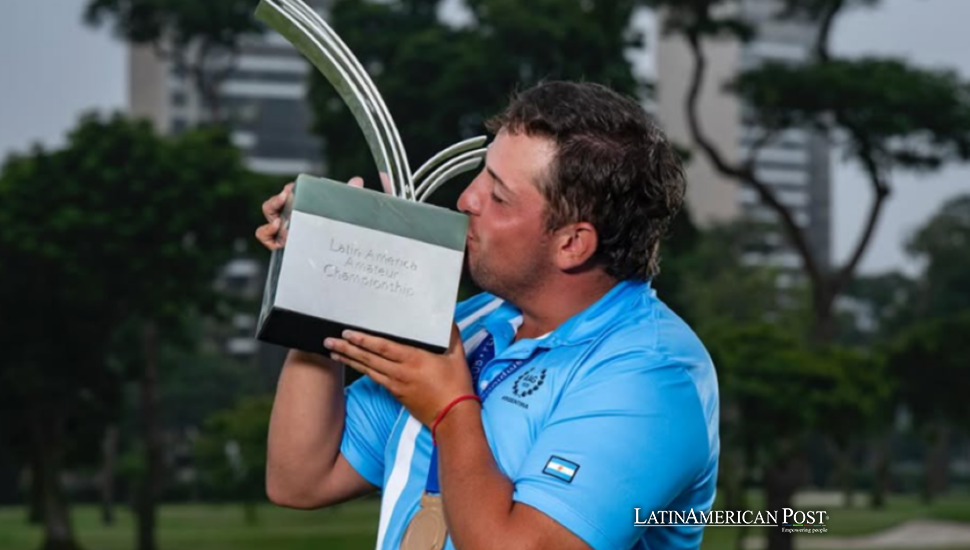
On a tense afternoon at Lima Golf Club in Peru, Mateo Pulcini, an Argentine amateur of twenty-five, survived a sudden-death playoff to win the Latin American Amateur Championship and claim invitations to the Masters, U.S. Open, and British Open.
Two Holes, One Doorway
For a sport that often moves with polite silence, the Latin American Amateur Championship can feel like a public heartbeat. One swing, one bounce, one putt—and suddenly a player from the far edge of golf’s map is standing at the gates of its most guarded cathedrals. That was the scene for Mateo Pulcini at Lima Golf Club, where the air carried the particular weight of Latin American sport: talent sharpened by scarcity, ambition constantly negotiating travel, funding, and distance, and the knowledge that a single week can decide whether a career becomes visible to the world.
The finish arrived as a sudden-death playoff against Venezuela’s Virgilio Paz, with the kind of reward that makes even seasoned players blink twice: a place in the Masters, the U.S. Open, and the British Open. Those names aren’t just tournaments in this region; they’re symbols of entry into an elite circuit that Latin American golfers have had to approach like a locked room—sometimes invited, often ignored, always forced to prove they belong.
Pulcini’s first playoff tee shot suggested nerves, or maybe the honest friction of the moment. He hit an iron into the right rough—an ordinary miss that becomes enormous when the margin for error disappears. From there, he tried to muscle a second shot toward the green, the kind of decision players make when they can practically hear the future clicking shut behind them. The contact looked wrong immediately. The ball came out low, the kind of flight that usually ends in a blunt lesson.
Instead, it did something almost unreasonable: it skimmed under a tree sitting directly in his line, slipping through a narrow corridor of air and luck, and came to rest roughly forty feet from the hole. It wasn’t applause-worthy artistry; it was survival. And in sudden death, survival is its own skill. Pulcini chipped closer—about twenty feet—and then made the par putt to stay alive, the sort of putt that doesn’t only save a hole, but steadies a body that’s trying not to shake.

College Detours, Continental Dreams
On the second extra hole, the tension shifted. Paz made bogey after chipping to roughly forty feet on his third shot and missing the par putt. In golf, that’s how heartbreak arrives: not with a crash, but with a small failure that feels, to the person living it, like a door closing softly and permanently.
Pulcini didn’t respond with fireworks. He responded with control. From off the green, he putted to about three feet and tapped in for a winning par. The final act was almost modest, yet that’s part of what made it so human. In a region where so many athletic triumphs are loud because they have to be—because attention is scarce and fleeting—this one landed like a simple sentence spoken clearly. He had won. He had crossed the line.
Afterward, Pulcini reached for words and found the kind that don’t sound rehearsed because they aren’t. “We dream to play and to win this,” he said. “I have no words right now. I’m so happy and so grateful for the people around me.” In Latin America, the phrase “the people around me” can carry an entire economy inside it: family sacrifices, coaches working extra hours, the friend who drives you to practice, the network that forms when institutions aren’t designed to catch you.
His path also explains why this moment hit with such force. Pulcini first played collegiately at Division II Oklahoma Christian, becoming a three-time All-American in four years—a record of steady excellence that rarely makes headlines outside campus sports pages. He later transferred to Arkansas, then finished the 2023–24 season with just five starts and two top-twenty finishes. Those numbers tell a familiar story: the climb isn’t linear, and progress is often invisible right up until it isn’t.
In golf’s amateur world, twenty-five is not young in the way fans imagine youth. It can be the age where people start treating you like a question mark—good, but maybe late; promising, but maybe already passed. Which is why the detail that followed mattered: Pulcini is now the oldest winner of the Latin American Amateur Championship since its inception ten years ago. It reads like trivia until you recognize the deeper meaning. He stayed in the fight long enough for the fight to finally reward him.
A Regional Tournament with Global
The playoff also offered a second human truth, one that is easy to miss if you only watch trophies. Virgilio Paz didn’t leave the course performing tragedy. He spoke like someone who understood that a loss can still be a chapter worth keeping. “It was a fun fight, a long day,” he said. “I’m proud of myself for what I did. I go back to school happy.” There is dignity in that—especially in a region where athletes are often asked to carry not only their own hopes, but national projections, political frustrations, and the constant comparison to richer systems elsewhere.
Pulcini’s win matters because it shows how thin the line can be between the overlooked and the unforgettable. One low shot that should have failed found a path under a tree. One par putt held steady. One tap-in finished the job. And suddenly an Argentine golfer who spent years grinding through college golf in the United States is headed to the Masters, the U.S. Open, and the British Open, carrying with him the quiet insistence that Latin American talent is not a novelty—it’s a fact, waiting for the world to stop pretending it’s surprised.
Also Read: Venezuelan Dominican Dreamers Finally Shift the Giants’ Latin Pipeline