Latin American Couples Weigh Marriage and Children Against the Rent

In Latin America and the Caribbean, women have an average of 1.8 children. A United Nations report finds nearly four in five adults ages 25 to 39 who have a partner but live apart would like to get married or move in together.
Who Counts as Married?
One good payday might cover the first month’s rent. The harder question for two people thinking of moving in together is what happens in a slow month. In its 2026 State of World Population report, presented Thursday in Costa Rica, the United Nations Population Fund points to expensive housing and unsteady work as reasons couples who want a place together keep separate addresses.
At ages 35 to 39, just 28.6 percent of women and 26.2 percent of men in Latin America and the Caribbean are formally married, the lowest shares in the UN report. In the Arab states, 67.4 percent of women and 63.4 percent of men that age are married. Among women that age in Asia and the Pacific, the share is 64.8 percent, more than double the figure for Latin America and the Caribbean.
A civil registry can tell you who signed the papers. It says less about who comes home to whom. In a region where couples have long made homes together without a wedding, two people who have shared a kitchen for a decade are still counted as unmarried. So are two people who have picked out a neighborhood and are still doing the arithmetic from their respective parents’ kitchen tables.
The UN researchers asked a question that gets at the difference. Among adults ages 25 to 39 who had a partner living elsewhere, nearly 80 percent wanted to marry or move in together. Some of those couples could get exactly what they wanted, a key for each partner and one front door, without moving the region’s marriage figure a decimal point.
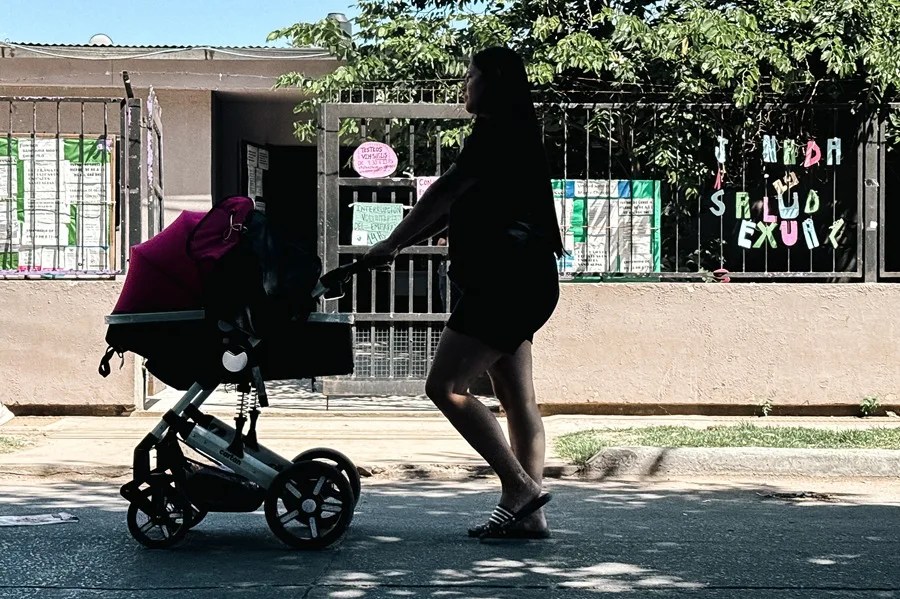
What a Paycheck Makes Possible
A place of one’s own looks different depending on whose name goes on the paycheck. Among men ages 20 to 24, 56.3 percent are working. Women reach a comparable employment level in the next age group, 25 to 29, at 57.6 percent. Those figures show how much earlier paid work becomes common among men. Whether the job offers enough hours next month to cover a share of the bills is another question.
Consider what that gap can mean for a young woman deciding whether she can afford to leave home. An apartment within reach on her partner’s income might be one she could never afford to keep on her own. Having a child changes the arithmetic again. The hours either parent gives up to care for a baby can eat into the very paycheck that made the rent look manageable.
Regional fertility stands at 1.8 children per woman, compared with 2.2 worldwide and 1.5 in regions the UN classifies as more developed. The approximate replacement level of 2.1 offers a benchmark for the size of successive generations. It tells a government little about how many women chose to stop at one child, or how many wanted a second and kept waiting for a better year.
There is a cost to treating 2.1 as a policy goal. A program that helps teenage girls avoid unintended pregnancies could bring the region’s fertility rate down further. For a girl who wants to finish school before becoming a mother, that same program may deliver precisely what she hoped for.

Uruguay Kept a Place in Class
Between 2000 and 2023, the region’s adolescent fertility rate fell by roughly 40 to 50 percent. For 2026, the UN estimates 48 births per 1,000 girls ages 15 to 19, compared with 37 globally. That leaves the regional rate nearly 30 percent above the world average after more than two decades of decline. Afrodescendant adolescents face a further disadvantage. Their risk of pregnancy is 50 percent higher than that of their peers, according to the report.
Ask women who makes decisions about their reproductive lives and the answer changes with the question. Some 91 percent say they decide about contraception, 90 percent about having sex and 86 percent about their own health care. Only 72 percent report being able to decide across all three areas. A woman who can choose a method of birth control may still have little say about whether she can see a health worker when she needs one.
Uruguay took that broader view of choice into its schools. Between 2016 and 2020, the country paired sex education with measures to help pregnant students and teenage parents stay in school and find work. A student who had already given birth still had an education to finish. The program also included young fathers, whose prospects are easy to overlook in a statistic expressed per thousand girls.
During those years, Uruguay’s adolescent birthrate fell to half the regional average, according to the UN. That comparison alone cannot establish how much the program contributed to the decline. For a school, another question is worth asking alongside how many students got pregnant that year. How many who wanted to come back after giving birth made it to graduation?
At the Costa Rica launch, Kadry Thomas Mackenzie, a Costa Rican Afro-Indigenous leader whose testimony appears in the report, asked authorities to listen to young people and give youth organizations more freedom to run development projects. A young mother who missed a semester can tell officials what kept her out of class. Giving her organization a say over the budget would let her help decide what it takes to bring the next student back.