Mexico Survived Trump Tariffs and Now Sells America’s Future Faster
Mexico braced for President Trump’s new tariffs, expecting factories to stall and exports to sink. Instead, shipments to the U.S. climbed, powered by USMCA rules, nearshoring bets, and a widening gap with China, a trade war twist reshaping North America.
Exports That Refused to Fall
In 2025, as President Trump raised tariffs, officials and economists feared Mexico’s export-led economy would take a devastating hit. The early numbers told a different story. Even with steep duties on autos, steel, and aluminum bound for the U.S., Mexican manufacturing exports to America rose almost 9% from January to November, compared with the first 11 months of 2024. Auto exports fell close to 6%, while other manufactured goods surged 17%.
Trade ties kept swelling: goods trade between the U.S. and Mexico is on track for nearly $900 billion this year. Mexico’s central bank projects 0.3% growth in 2025, not the 1% contraction once expected, said Kathryn Exum of Gramercy Funds Management, which manages about $7 billion. The Penn Wharton Budget Model estimates Mexico’s effective tariff rate at 4.7%, compared with 37.1% for China and around 10% globally. Despite “zombie” fears, almost 85% of Mexico’s exports remain tariff-free under the USMCA.
Liberation Day and The Ringing Phone
Nearshore Co. helps foreign manufacturers produce U.S.-bound goods in Mexico through 18 industrial plants, mostly along the U.S.-Mexico border. Co-chief executive Jorge Gonzalez Henrichsen said many investment plans were put on ice until tariff levels became clear. Then April 2 arrived—“Liberation Day,” as Trump calls it. Outside the White House, he unveiled new rates for almost every country—excluding Mexico. Calls flooded in from companies eager to restart paused projects. “In fact, it was Liberation Day for us,” Gonzalez Henrichsen said.
The scramble shows how Mexico dodged a bullet: it didn’t win immunity, it won a better relative deal. Producers still cite the old advantages—proximity to U.S. markets, lower-cost manufacturing, and a free-trade agreement that is battered but intact. Higher duties on China let Mexico fill some of the gap in everything from electronics to industrial inputs. It also softened talk of a “zombie” U.S.-Mexico-Canada Agreement by showing that the rules still matter when the world becomes unpredictable.
A Pact Too Costly to Kill
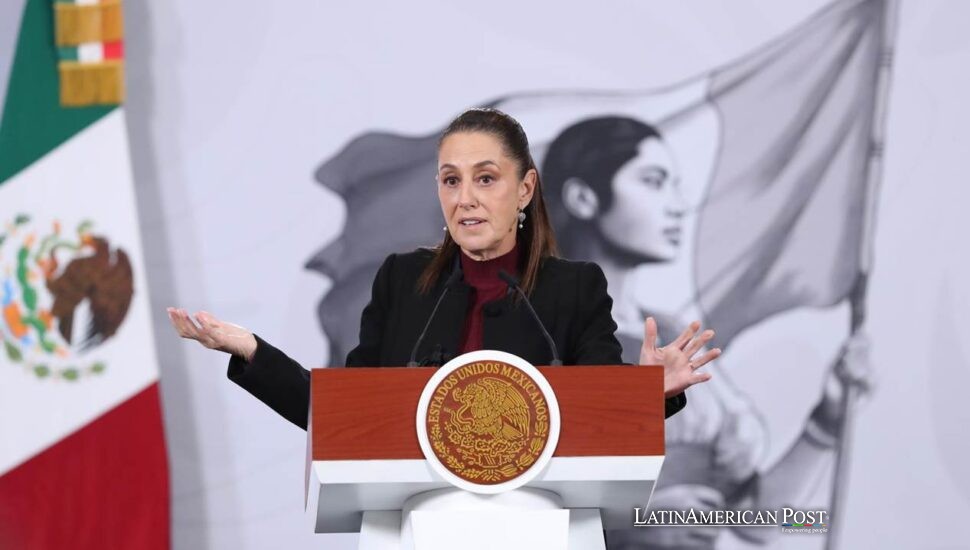
Keeping that advantage has required political choreography. Mexican President Claudia Sheinbaum engaged Trump, tightened drug enforcement along the border, expelled imprisoned cartel bosses wanted by the U.S., and imposed 50% tariffs on Chinese-made vehicles and other goods. “Mexico has approached the relationship with the U.S. quite constructively,” Exum said. Still, Mexico faces the highest tariffs in a generation: 25% on non-U.S. content in autos, up to 50% on aluminum and steel, and 25% on non-USMCA-compliant exports tied to U.S. claims about drug flows.
In testimony in mid-December, U.S. Trade Representative Jamieson Greer said Mexico captured about 25% of the reduction in the U.S. trade deficit with China, citing “the important role that Mexico plays in U.S. supply-chain resilience efforts.” Mexico overtook China as the top foreign-goods supplier to the U.S. in 2023 and is now its largest buyer, in part because many U.S. imports are intermediate goods that return north as exports. “The level of integration is such that the cost of eliminating the USMCA would be monumental,” said Luis de la Calle, a Mexican negotiator of NAFTA more than three decades ago.
Next comes 2026, when the USMCA is up for review. Antonio Ortiz-Mena of AOM Advisors expects uncertainty to persist but says Mexico and Canada should keep lower average tariffs than the rest of the world. “While it won’t be a perfect agreement, we are heading in that direction,” he said. Mexican shipments of data-processing equipment more than doubled this year, tied to U.S. data centers and artificial intelligence. Jorge Gonzalez Henrichsen said a U.S. customer expanded in Mexico from one plant and 18 employees in 2019 to four plants and 600 workers, with 1,000 more expected next year. “We haven’t had any clients close down and pack up to the U.S.,” he said. In Mexico, improvisation is an old economic reflex. This feature draws on The Wall Street Journal reporting, interviews, and quotations by Santiago Pérez and Anthony Harrup.
Also Read: Venezuela Grounded: How Sanctions Turn Holiday Flights into Heartbreak Economics