Latin America Bids a Bittersweet Farewell As Sabina Departs from Stages for Good
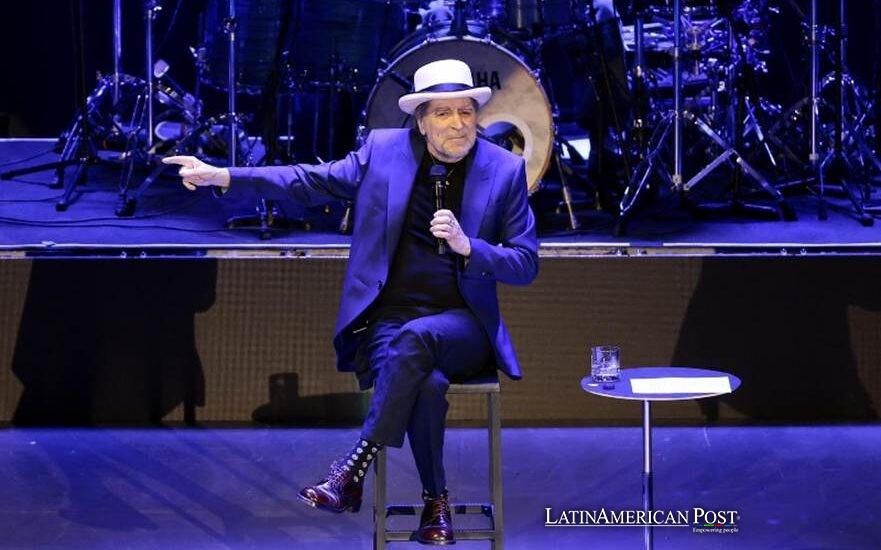
As Joaquín Sabina closed his Hola y adiós tour in Madrid, 12,000 fans watched a generation’s soundtrack turn into a farewell ritual that resonated far beyond Spain, echoing through Latin America’s bars, bedrooms, and border-crossing buses, late into the night.
A last bow in the city that raised him
“This concert in Madrid is the last of my life and therefore the most important,” Joaquín Sabina told the crowd last Sunday, his voice frayed but steady, in the Movistar Arena that had once been the WiZink Center. At 76 years old, the singer-songwriter from Úbeda (Jaén) stood before some 12,000 people and called this show the one he will remember “with most emotion” in the years to come.
The set marked the end of Hola y adiós, a farewell tour that had also been, by his own words, a goodbye to primary stages. He described the night as “an enormously grateful farewell” for having watched his songs grow, somehow sneaking into the “sentimental memory of several generations.” For anyone raised between dictatorship and democracy in Spain, or between military regimes and fragile transitions in Latin America, it was not hyperbole. His lyrics have floated through student marches, smoky bars, and long-distance buses from Buenos Aires to Mexico City, turning personal misadventures into shared mythology.
The room itself testified to his reach. In the audience sat politicians like Alberto Núñez Feijóo and Borja Sémper, and artists including Víctor Manuel, Ana Belén, Dani Martín, Ara Malikian, Fernando León de Aranoa, Manuel Carrasco, David Trueba, Clara Lago, Alejo Stivel, and Vanesa Martín, according to the organizers. They were not just celebrities paying respect; they were representatives of the cultural and political ecosystem that Sabina has accompanied, teased, and sometimes wounded since the late 1970s.
Before he appeared, a video rolled across the screens that encircled the stage, set to “Un último vals.” Then, only nine minutes after the scheduled 8:30 P.M. start, he walked out. For more than two hours, he moved between songs and stories, occasionally wiping away tears he did not bother to hide. His band, likewise emotional, sometimes sang for him: the evening’s 23 songs included four interpreted by members of his group, a reminder that even in farewell, the show is a shared craft.
Music scholars writing in the Journal of Spanish Cultural Studies have examined how singer-songwriters like Sabina helped craft a narrative bridge from dictatorship to democracy, mixing irony with confession and street language with literary references. Watching him in Madrid, it was hard not to see this last concert as an extension of that role: a man from Jaén telling the country, and a wider Spanish-speaking world, how to age without abandoning the stubborn dignity of the “canalla,” the lovable rogue.
A Catalogue Of Wounds, Waltzes, And Broken Dreams
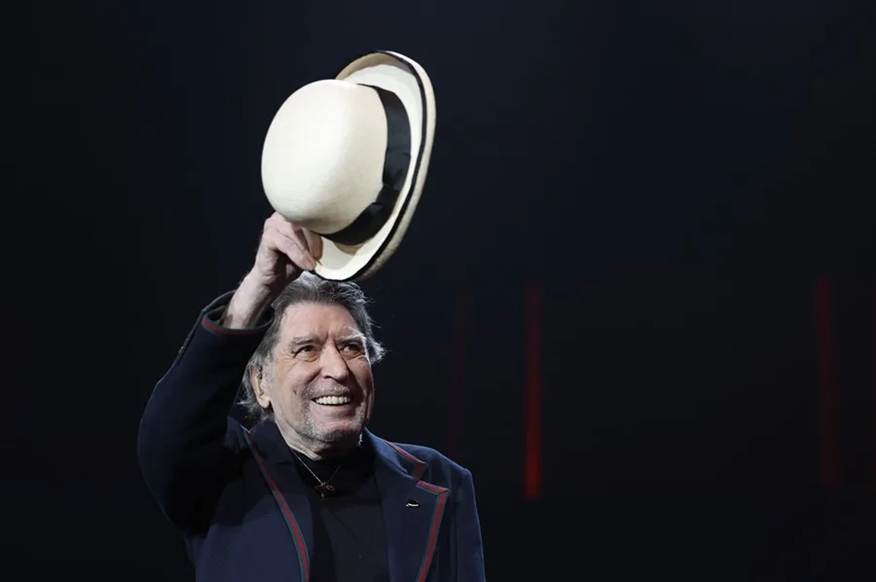
The setlist worked as a compressed autobiography. From “Yo me bajo en Atocha” (from “Enemigos íntimos,” 1998) to “Princesa” (“Juez y Parte,” 1985), the final song, he traced a path through many of the 17 albums he has released since those first records in the late 1970s, when he began his career as a cantautor. The audience sang along to “Calle Melancolía” (“Malas compañías,” 1980), a song he reminded them was only the second he ever wrote, more than 40 years ago. He confessed that he had pulled it from “the trunk of old, rusty and half-forgotten songs” to indulge himself on this last tour. Judging by the roar of recognition, the indulgence was mutual.
One of the most charged moments arrived when he recounted the origin story of another classic. He explained that Chavela Vargas had told him she lived on the “Boulevard of Broken Dreams,” and he had felt she was giving him a marvelous line that deserved its own song. That phrase became “Bulevar de los sueños rotos,” included on his 1994 album “Esta boca es mía.” He described how he began writing it in the small notebook he always carries, and how he had the honor of singing it first to Chavela herself, just the two of them, as he looked into her eyes. Only then did he begin the song, as the crowd rose to its feet.
The night also leaned heavily on the album that exploded his fame beyond Spain. From “19 días y 500 noches” (1999), he performed the title track and a cluster of songs that have become shared hymns: “Ahora que…”, “De purísima y oro”, “Una canción para la Magdalena”, and “Noches de boda.” Each one arrived already half-sung by the crowd, their choruses learned in kitchens and taxis over a quarter century.
From “Yo, mi, me, contigo” (1996) came other pillars: “Y sin embargo,” “Tan joven y tan viejo,” “Contigo.” They alternated with anthems like “Y nos dieron las diez” from “Física y química” (1992), songs that have been used to toast new loves and drown out heartbreak in equal measure on both sides of the Atlantic. Research published in Popular Music and Society has underscored how such repertoires become “emotional archives,” storing private memories in public melodies. In Sabina’s case, that archive belongs as much to Latin America as to Spain, the result of decades of tours where his raspy voice filled arenas from Buenos Aires to Mexico City.
The man delivering those songs now carries the weight of time more visibly. He announced in July 2024, in a public statement, his intention to say goodbye to the primary stages. Within less than 24 hours, more than 200,000 tickets had been sold just for the Spain leg of the tour. The shows had begun earlier that year, in February, in America, a final circuit through the continent where his “musical canallismo” made him an icon as much as in his homeland.
His body has not come through unscathed. A cerebral infarction in 2001 forced him to reconsider the hard-living persona that fueled many of his most beloved lyrics. More recent health scares occurred in public: in 2020, at this very arena, when it still carried the WiZink Center name, he fell from nearly two meters into the pit, suffering several traumas, a stay in the ICU, and two surgeries. All of that history was present, tacitly, each time he moved carefully across the stage or gripped the microphone stand. Studies in Popular Music and Society have noted how farewell tours for aging rock and pop figures can function as rituals of collective adjustment to mortality, not only for the artist but for audiences confronting their own passage of time.
Not An Ending, But A Hard-Earned Pause
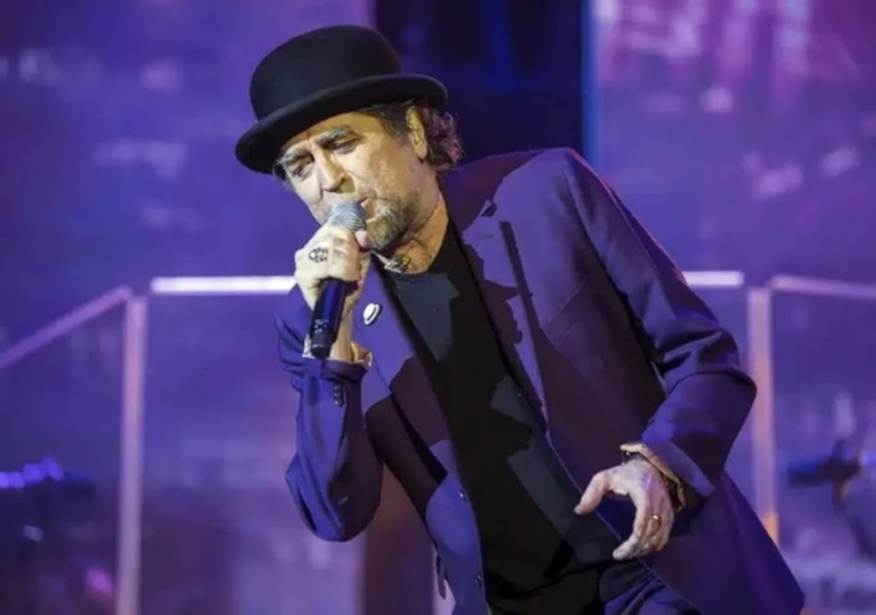
For all the pain of goodbye, Sabina and his circle insist this is not the end of his artistic life. As the tour’s title suggests, “Hola y adiós” was designed as a hinge, not a tombstone. He is stepping away from the physical demands of big arenas, not from writing, drawing, or thinking in verse. In literary and music studies alike, from journals such as the Latin American Music Review, researchers have described how older artists often shift from performance to composition, preserving their presence in culture even when their bodies can no longer withstand the same routines.
In that sense, Sunday’s show in Madrid was less a funeral than a point-and-apart. The ovations that closed the night, as he and his musicians embraced each other through tears, felt like acknowledgments of that complexity: gratitude for what he has already given, and a quiet demand that he continue speaking from whatever room he chooses to write in next.
From a Latin American perspective, the farewell at Movistar Arena also underscored the strange geography of Spanish-language music. A man born in Úbeda, who sang about Atocha and Calle Melancolía, became, over the decades, the house poet of countless listeners in Mexico, Argentina, Chile, and Colombia, people who never saw the streets he named but recognized themselves in his defeated heroes and sharp-tongued narrators. When he says his songs have slipped mysteriously into the sentimental memory of several generations, he is describing not only a Spanish phenomenon but a transatlantic one.
As the last chords of “Princesa” faded and the house lights rose, the 12,000 people in Madrid lingered, as audiences do when they know they have seen something finite. Outside, the city carried on a typical Sunday night; inside, an era had edged closer to its conclusion. The man who once turned the “boulevard of broken dreams” into a shared address has left the big stage. But his catalogue—those 23 songs under the arena roof, and the many more in the “trunk” of old, rusted pieces—will keep traveling through Spanish and Latin American lives, filling that mysterious memory he thanked so tenderly. The concert was, as he said, the last one. The story, like one of his long, winding verses, still hangs open at the end of the line.
Also Read: The Day Dominican Republic Bachata Royals Conquered New York With A Secret Album