
How People Meet in Latin America Now — and Why It Feels a Little Different From the U.S.

People still love to imagine Latin America as this grand, romantic place where nobody needs an app because everyone somehow meets through friends, music, family parties, or a perfectly timed night out. And yes, that version of life still exists. People do meet that way. They meet in cafés, at university, at work, through cousins and mutual friends and birthday dinners that start late and end even later.
But that is only half the story now.
The other half is much more modern, and honestly, much more familiar than people like to admit. People across Latin America are meeting online all the time. Not in a sad, last-resort way. Not as a substitute for “real life.” Just as part of real life. A match starts on an app, the chat moves to WhatsApp, then maybe to Instagram, and then, if the energy still feels right, to an actual meeting. Coffee first. Drinks if the conversation is easy. Dinner if nobody wants to go home yet.
That rhythm is probably the most interesting part.
In the U.S., online dating already feels very institutional. It is normal, yes, but it can also feel strangely procedural. People talk about filters, intentions, exclusivity timelines, premium features, and whether they are “looking for something serious.” It is efficient, sometimes almost too efficient. In much of Latin America, the same technology exists, but the emotional tone can feel softer around the edges. Less like a system. More like a door opening into the rest of your social life.
And I think that is what makes the comparison so interesting.
Because people in both places are meeting online now. That part is no longer up for debate. The difference is often in what happens next. In the U.S., the dating app may stay central for longer. The conversation remains inside it, the early chemistry is tested there, and only later does it spill over into real life. In Latin America, that transition can happen faster. The app is the introduction, not the whole stage. The real early connection often unfolds in a messaging space people already use every day.
That changes the mood completely.
A dating app can feel like an interview room if everything stays inside it for too long. But once the conversation starts living somewhere more natural, it often becomes less performative. A little warmer. A little messier, in a good way. It begins to resemble actual social life instead of a digital waiting room full of profile photos and careful replies.
That is part of why online dating feels so normal now across the region. It does not sit apart from life in some separate category. It folds right into the way people already communicate.
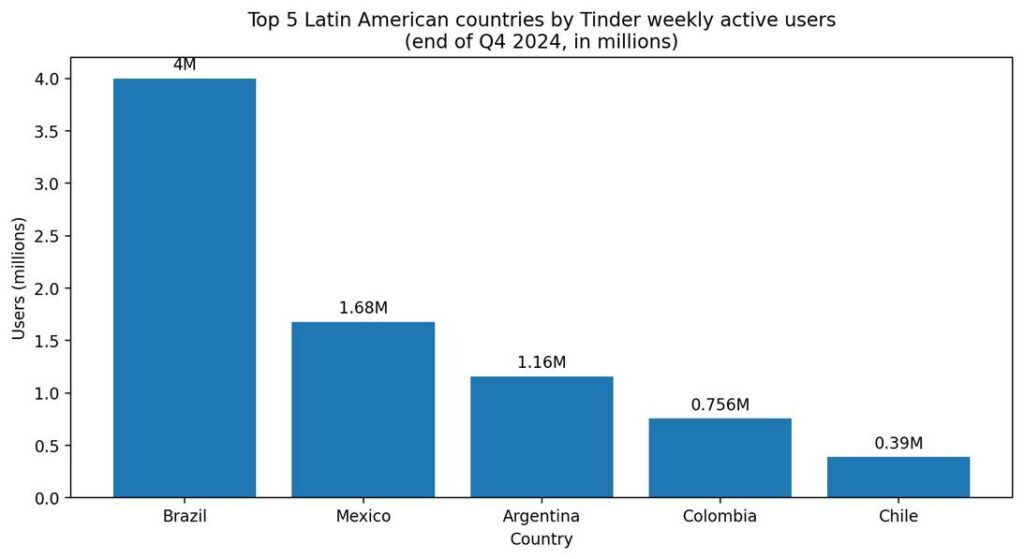
Brazil is the clearest example of that scale. If you look at the public numbers we used for the chart, Brazil sits far ahead of the rest of the region, with the biggest visible audience for app-based dating by a wide margin. Mexico comes after that, then Argentina, then Colombia and Chile. Even without pretending those numbers explain every detail, they tell you something important: online dating in Latin America is no longer fringe behavior. It is too large, too regular, too ordinary for that.
Here’s the same country snapshot in a cleaner, more human way:
| Country | What stands out | Overall dating feel |
| Brazil | Big enough to feel fully mainstream Fast-moving, social, and completely normalised online | |
| Mexico | Large user base, strong crossover into messaging | App introductions often become more personal quickly |
| Argentina | Strong mix of wit, conversation, and chemistry | People often seem to value the quality of the chat before meeting |
| Colombia | Dating and social discovery overlap more naturally | Conversation tends to matter just as much as the match itself |
| Chile | Smaller market, but still active and established | More compact, but not niche or unusual |
And this is where the old clichés start to fall apart.
People sometimes talk as if Latin America is somehow too warm, too social, too human for dating apps — as if those things are opposites. But they are not opposites at all. In fact, that warmth may be one reason digital introductions work so well there. People do not necessarily treat the app as the full experience. They treat it as the first bridge. After that, the connection becomes more conversational, more fluid, more embedded in everyday communication.
You can almost picture the scene. Two people match. They exchange a few lines that are better than average. Nothing dramatic. No fireworks yet. Then one of them suggests moving to WhatsApp. Suddenly the whole thing feels less staged. The tone changes. Voice notes appear. A joke lands better there. The conversation gets looser, more natural. By the time they actually meet, they no longer feel like complete strangers performing “first date.”
That is not a small shift. That is the difference between a system and a social habit.
In the U.S., dating often sounds like a strategy discussion. People want clarity, and that is not a bad thing. But it can make the whole process feel a little more managed. In Latin America, the same search for connection may feel less formal even when the goals are just as serious. People still want affection, stability, attraction, and love. They are not necessarily less intentional. The style is simply different. Slightly more conversational. Slightly less boxed in.
And I think that is why the region’s dating culture feels so alive right now.
It is not because people have rejected modern dating. It is because they have absorbed it into the rest of life instead of letting it become its own little artificial universe. The online part matters, yes, but it is not the whole story. It is the first sentence, not the entire book.
That is also why a good online dating site for relationships can feel genuinely useful in this landscape. Not because technology somehow manufactures chemistry. It doesn’t. But because it increases the number of chances for chemistry to happen. And when people are open to meeting not only locally, but across cities, countries, or even cultures, that kind of platform becomes less about swiping and more about possibility.
That idea matters more than people think.
For years, online dating was treated as if it were a compromise. As if meeting someone on an app meant your story was somehow less romantic, less elegant, less real. But real life has already moved on from that argument. In both Latin America and the U.S., people are now building genuine relationships through digital introductions. The details differ. The cultural feel differs. The pacing differs. But the emotional truth is the same: meeting online no longer makes a relationship less authentic.
If anything, it often makes it more intentional.
And maybe that is the most hopeful part. People are not using apps because they have stopped believing in connection. They are using them because they still believe in it enough to keep looking. They want to meet someone good. Someone interesting. Someone who feels right in person, not just on a screen. The app simply gets them to the starting line a little faster.
So how do people meet in Latin America now?
They meet the old way, and the new way, and very often somewhere in between. Through friends, yes. At bars, of course. At work, at school, through cousins, through social media, through a dating app, through a message that turns into a voice note that turns into a plan.
That is what modern dating looks like there now. Not less romantic. Just more blended. More fluid. More reflective of the way people actually live.
And honestly, that makes sense. Love stories have always adapted to their time. This is simply what adaptation looks like now.
