An Indigenous Teen Takes Her Place: A 16-Year-Old Votes as Brazil Goes to the Polls
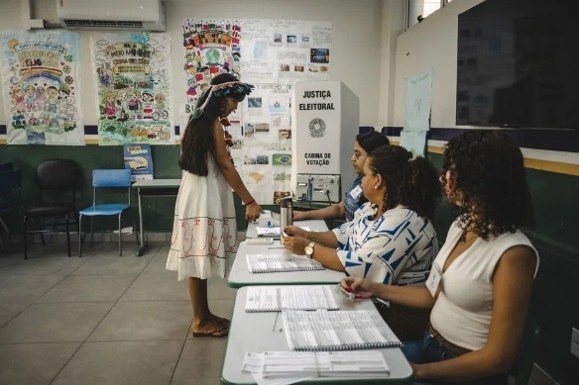
In Manaus, 16-year-old Lauryane Kokama voted in Brazil’s elections with her mother. Among 3.5 million registered voters under 18, she wants Indigenous youth heard, raising a question that outlasts election day: how does participation become a share of power?
A First Vote in Manaus
Lauryane Kokama had company for her first election. Her mother accompanied her to the Senador Artur Virgílio school in eastern Manaus, where the student joined the line to vote on Sunday. She had chosen to be there. Brazil makes voting voluntary at her age.
“My vote is important in politics. And I’m very happy,” she told EFE. The two thoughts belonged together. She was celebrating a personal milestone while making a claim about the place of young Indigenous people in Brazilian public life.
Lauryane, whose Indigenous name is Rutsatsetsa, is also a K-pop fan. At the polling place, she spoke about young people entering politics and the particular weight that participation carries for Indigenous communities.
“Especially when you are Indigenous, your voice within Indigenous movements is important,” she said in the EFE interview.
She connected the ballot to those movements, placing voting within a broader political commitment. She urged other Indigenous teenagers to register to vote and participate when they turn 16, bringing their concerns into institutions that will make decisions long after the polling stations close.
The setting made that appeal concrete. Here, a Kokama teenager exercised citizenship in Manaus, the Amazon’s largest city. An election account centered on her begins with the region as a place where people live, organize, and choose governments, with young Indigenous residents helping define its political future.

The Arithmetic of Being Heard
Across Brazil, about 3.5 million people aged 16 and 17 registered to vote voluntarily. Against an electorate of nearly 158 million, they represented approximately 2.2 percent, or one eligible voter in every 45. That is a modest national share with potentially meaningful weight in a close contest.
Registration measures the opportunity to participate. Its electoral effect depends on how many people actually vote, where they live, and which candidates they support. The total covers young Brazilians generally, with no separate figure for Indigenous teenagers.
Their influence would be uneven. A national percentage spreads voters across a country electing different governors and legislatures. A teenager’s ballot could carry particular weight in a competitive state race even while the youngest voters remain a small fraction of Brazil’s overall electorate. Their choices can also diverge.
For Lauryane, the important number was 16: the age at which she could turn an opinion into a vote. Her insistence that teenagers matter asks political parties to take citizens seriously while they are still deciding whether to enter electoral life.
“Our vote makes a difference for young people aged 16, 17 and 18,” she told EFE.
For campaigns, voluntary voting raises a practical question: what would make a teenager register, show up and return? Lauryane supplied one answer. She understood participation as a way to defend Indigenous interests. A campaign hoping to earn that vote would need to address the concerns that made participation worthwhile.
The next presidential term will carry Lauryane from adolescence into her twenties. Whoever wins will govern through years that matter enormously to a teenager becoming an adult. Registering at 16 gives her a say in choosing that administration before it begins. Her appeal to other Indigenous teenagers puts the timing plainly: their interests are already at stake. Decisions made over those four years will reach them whether they enter the polling station or choose to stay home.

Who Listens After Election Day
Sunday’s election placed several layers of authority before voters: the presidency for the next four years, 27 governorships, 513 seats in the Chamber of Deputies, two-thirds of the Senate, and regional legislative seats. The scale matters because decisions affecting communities pass through governors and lawmakers as well as the president.
Executives need legislatures to turn priorities into laws and budgets. For a voter seeking a stronger Indigenous voice, representation therefore involves institutions as well as personalities. Attention to a community during a campaign acquires practical value when it influences what governments fund and what legislators approve.
That is where representation’s economic significance lies. Public priorities become spending choices, and those choices determine whose needs receive resources. Lauryane’s appeal asks young Indigenous citizens to enter the process through which such decisions gain democratic authority. The next test is whether their concerns receive sustained attention afterward.
She was already thinking about another trip to the polls. Lauryane said she wanted to return if a runoff became necessary for president or governor of Amazonas. Each contest would require a second round if no candidate won a majority in the first.
It will be necessary. Brazilian Senator Flavio Bolsonaro, a prominent figure on the political right, will face left-wing President Luiz Inácio Lula da Silva in a presidential runoff later this month after narrowly outperforming the incumbent in Sunday’s first round and surpassing pre-election expectations.
Bolsonaro captured about 47 percent of the first-round vote, compared with roughly 45 percent for Lula. The result represented a notable departure from private polling before the election, which had generally shown Lula leading by approximately three percentage points.
Bolsonaro’s unexpectedly strong showing could give his runoff campaign fresh momentum. It may also reinforce recent gains in Brazilian financial markets, where the currency and equities have strengthened amid investor expectations that a Bolsonaro victory could bring a more business-friendly economic agenda.
“I won’t deprive society of my vote, because the voice of young people in politics is very important,” she told EFE.
The wording gives her enthusiasm a sharper edge. She described her vote as something society would lose if she withheld it. That also puts an obligation on candidates. Young people who participate voluntarily have reasons for coming, and elected officials have every reason to keep listening once campaign appeals end.
At 16, Lauryane had shown up for Brazil’s democracy. The people elected to represent her would now owe her something more durable than congratulations on a first vote: a hearing.