Panama Banana Jobs Return, but Bocas del Toro Still Trembles
Chiquita's gradual return to Panama's Caribbean banana belt has brought wages back to some households. Still, the reopening also exposes how fragile work, union power, and daily survival remain in a province where one industry still carries almost everything.
A Comeback Built on Need
In Bocas del Toro, relief has arrived wearing work boots, mud, and the familiar rhythm of banana plants being cleaned back into order. But it has not arrived at stability. Not yet.
José Artola, known to those around him as Loncho, says it plainly while working at finca 15 among banana plants that had been abandoned the year before. “La pasamos mal de verdad, no había donde sostenerse,” he tells EFE. In English, the feeling is unmistakable. They went through it badly. There was nothing to lean on. That line lands hard because it sounds less like a complaint than a memory still close to the skin.
Artola is one of the 2,300 workers who have gone back to work since late 2025, after Chiquita resumed an operation it had abandoned in the middle of that year. The multinational had reported $75 million in losses and dismissed 5,500 workers during a union strike tied not to the company's own labor terms, but to already enacted social security reforms. In a province where the banana business sustains more than 80 percent of the economy, that kind of shutdown does not stay inside payroll sheets. It spills into kitchens, transport, neighborhood stores, school routines, and the whole emotional structure of daily life.
That is what makes this reopening feel so significant and so incomplete at the same time. Bocas del Toro is lush, beautiful, and economically narrow. It covers 4,654 square kilometers and has a population of around 160,000 people, most of them Indigenous and living in poverty. Chiquita has dominated the banana industry there for more than a century. That history matters because it explains why the return to work can feel like a rescue and a form of dependence at once. The company comes back, and the province breathes again. The company leaves, and the province buckles.
This is not only a labor story. It is a story about the old plantation logic still echoing in modern Panama, where one export crop continues to function like a regional lifeline, and where the workers most essential to that system remain the ones least insulated from its collapse.

The Province That Lives by the Banana
Artola had worked for more than 30 years at Finca 15 before the union, under the leadership of Francisco Smith, ordered the stoppage, which now faces criminal proceedings. When he speaks to EFE, his satisfaction is humble and immediate. They suffered until work began again, he says, and now they are moving the farm forward. The farm has started to regain strength, and he is happy for that, because they are finally beginning to work again.
That tone, modest but grateful, tells you everything about the hierarchy of need. In Bocas del Toro, work does not have to be ideal to feel lifesaving. It only has to return.
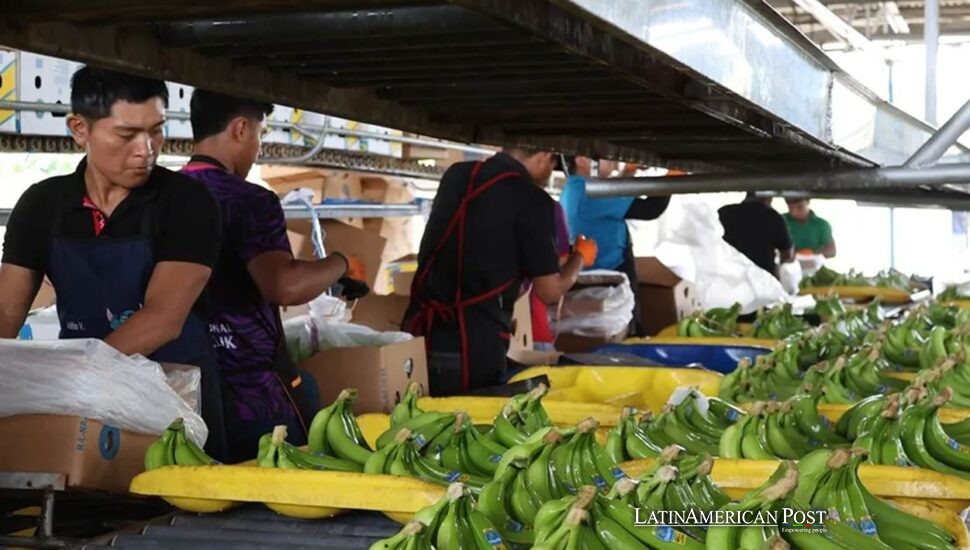
Anaica Batista, a packing plant worker at Finca 15, makes the same point from a different angle. Even if it is only three or four days a week, she tells EFE, there is now a process, meaning work, and they can take something home. That something matters because the crisis has affected more than 5,500 workers, leaving them without income. Her words do not present reopening as triumph. They present it as partial oxygen.
The details she gives also show how careful and limited this recovery has been. First came work in the fields, she explains, beginning with the cleaning of banana areas and growth zones. Only later did the packing areas begin their own restart. That sequence matters because it shows the reactivation is not a sudden restoration of the old economic order. It is staged, cautious, and conditional, with the company feeling its way back through the wreckage of a labor and business collapse.
Not everyone endured the shutdown in the same way. Alvin Garay, another worker with more than a decade of experience at Finca 15, says he managed to get by thanks to small savings. But many coworkers, he adds, did not have that luck. “Hay compañeros que la han pasado feo, feo,” he tells EFE. Some compañeros had it very badly. Again, what stands out is the plainness. There is no abstraction here about labor adjustment or temporary disruption. There are only people measuring the crisis by what they can or cannot still buy, save, or bring home.
That is where the wider Latin American reality comes into view. Across the region, export agriculture often presents itself through numbers, shipments, hectares, and international brands. But underneath it sits a much older social truth. Entire communities remain organized around a single crop, a single employer, a single chain of command between global capital and local survival. When that chain snaps, poverty does not arrive as a new condition. It deepens what was already there.

A Recovery That Revives and Restrains
Chiquita's representative in Panama, Alexander Gabarrete, tells EFE that the reactivation in Bocas del Toro is unfolding under a sharecropping-style model, in which several companies manage labor. At the same time, Chiquita continues to provide technical assistance, supervision, and commercialization. As more hiring increases, he says, the economic movement will become more visible.
That may be true, but it also hints at the kind of recovery now being built. Chiquita is back, yet not exactly as before. The company is producing small quantities of bananas to test how the fruit and the remodeled packing plants behave. All of this early production is being directed to the local market, which allows the company to estimate conditions for a near export return. The language is cautious, technical, and managerial. Observe the packing plants. Observe the harvested fruit. Estimate. Prepare.
From the company's perspective, that makes sense. After losses and a major shutdown, reentry is being handled like a controlled experiment. But from the workers' side, the meaning is different. Their lives have resumed under a model still feeling provisional, still tied to testing, still not fully back in the export cycle that made the region economically legible in the first place.
Chiquita plans to reactivate around 5,000 hectares of banana out of roughly 5,200 dedicated to the crop. As part of its commitments to the Panamanian government, it has established a plan to invest around $30 million to reactivate banana activity in Bocas del Toro. Those are substantial figures. Yet they also underline the central contradiction. A region can receive millions in reactivation money and remain frighteningly vulnerable if almost all of its economic muscle continues to depend on the same monoculture and the same corporate actor.
That is why this reopening carries both hope and warning. The jobs returning are real. The relief is real. The workers' gratitude is real. So is the underlying fragility. Bocas del Toro has not escaped the old equation. It has reentered it.
In that sense, the banana plants at Finca 15 tell a larger story about Panama's Caribbean west. They were abandoned. They are being cleaned. They are showing strength again. So are the workers. But strength is not the same thing as security. What EFE's reporting makes clear is that people are once again carrying something home, and that matters enormously. It also makes clear that the region is still waiting for an economic life that does not rise and fall so completely with the fate of one company and one fruit. Until that changes, every recovery in Bocas del Toro will feel both necessary and uneasy, like a province returning to the very system that keeps rescuing it and cornering it at the same time.
Also Read: Mexico Weighs Mental Health at Work as Stress Stops Hiding