Ueno Bank Won Over Paraguay. Now Teachers Want Their Pension Money Back
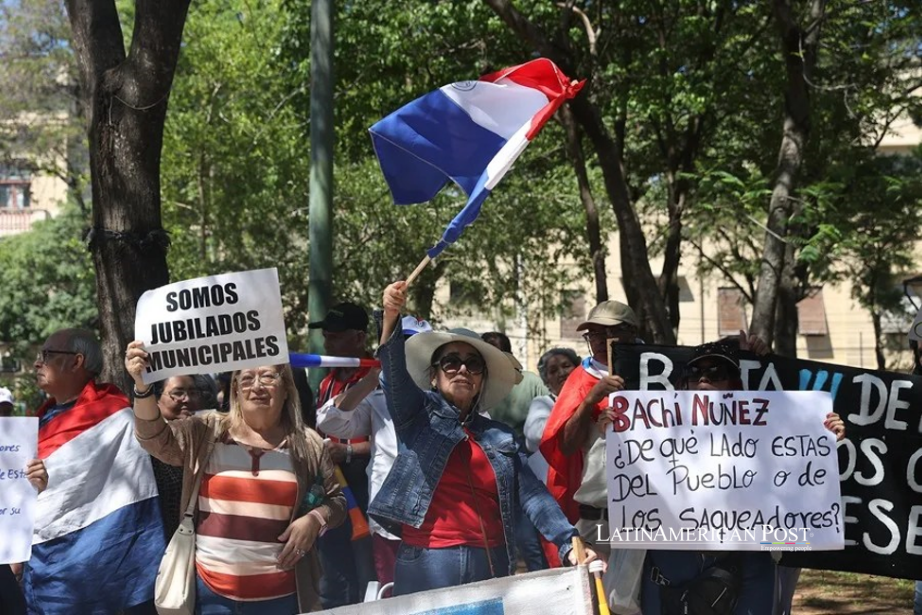
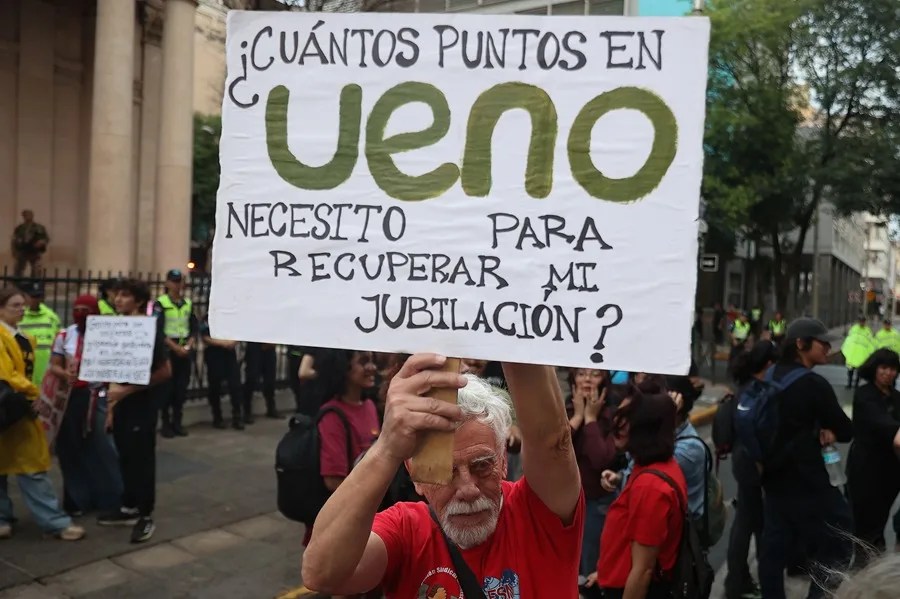
A Paraguayan teacher could spend a career banking elsewhere and still have retirement money frozen at Ueno Bank. In Asunción, educators carrying flags and drums want to know how their contributions got there and when the government can recover them.
A Fifth of the Fund
Rita Duarte, a retiree, stood before teachers in Asunción’s Plaza de Armas on Monday to speak about the money they had put away. Some in the square still saw a pension deduction on every paycheck. Others now counted on the monthly payment. Their unions wanted more than $60 million returned to the Caja Fiscal, Paraguay’s retirement system for public employees.
Silvio Piris, president of the Paraguayan Federation of Educators, put the share of the fund tied up at Ueno at one dollar in five. It had taken workers “years, decades” to accumulate that money, he told EFE. On Friday, Pedro Alliana, formerly Santiago Peña’s vice president, took office promising full compensation. After meeting him at the Palacio de López on Monday, union leader Rubén Irala said Alliana had agreed to work on recovering the pension money.
Public institutions had an estimated $800 million at Ueno. The national electricity utility, ANDE, kept money there, as did Itaipú, the hydroelectric dam Paraguay shares with Brazil. Prosecutors say that by August 2025, Ueno held nearly a quarter of all the U.S. dollars Paraguayan public agencies had on deposit, more than any other bank in the country.
The Social Security Institute, known as IPS, runs a separate pension system and provides health care to workers and their families. It initially put its Ueno investments at $355 million, about 9 percent of its portfolio. On Monday, its investment director, Hugo Díaz, gave the Paraguayan daily ABC Color a fuller accounting. Including operating accounts, IPS had about $516 million tied up. Roughly $158 million sat in accounts the institute uses to collect worker and employer contributions and to meet its own payroll.
Both Sides of the Counter
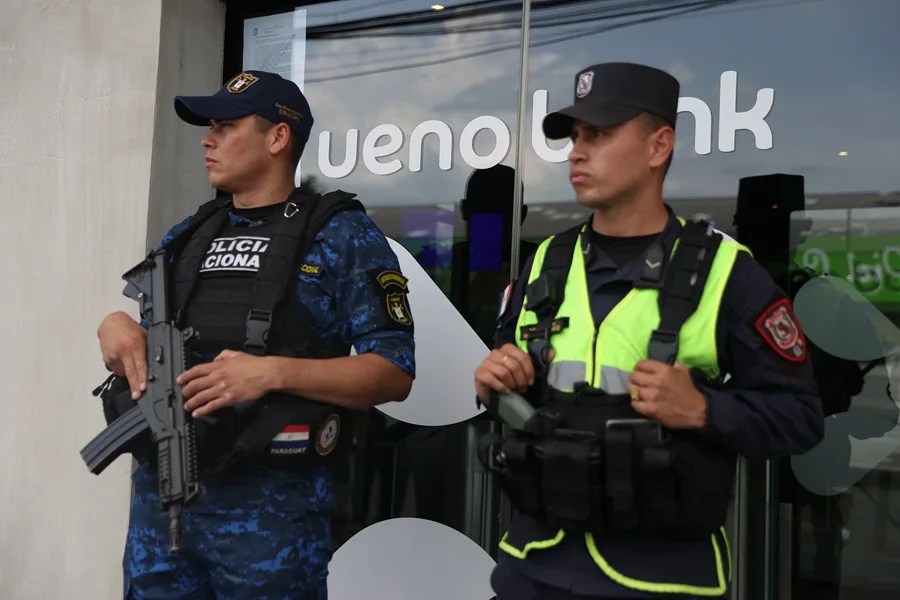
Ueno became a bank in November 2023, three months into Peña’s presidency. It absorbed Visión Banco the following year and by June 2026 claimed 2.9 million customers in a country of 6.1 million people. Even Paraguayans who had never opened the app could see its name on the Defensores del Chaco soccer stadium in Asunción.
On November 3, the central bank announced Ueno’s closure. A review of its books had put its solvency ratio below half the required minimum. Ueno had too little capital to absorb losses. Branches closed and transfers stopped. The next day, the Paraguayan soccer association took down Ueno’s signs at the stadium. Several national team players disclosed that they had kept their savings at the bank.
Ueno advertised that two out of three Paraguayans used its services. The association of importers and merchants had its own way of counting. It estimated that two out of three electronic transactions passed through Ueno accounts. A shopkeeper who banked elsewhere could still lose a sale if the customer at the counter could no longer send a transfer. A few days of that could leave the shopkeeper short when the wholesaler came to collect.
Deposit insurance covered up to 228.3 million guaraníes, about $38,000, per eligible depositor across all their Ueno accounts. The first round paid people with balances of 10 million guaraníes or less who owed Ueno nothing and had another account to receive the transfer. By Monday, the central bank said about 1.74 million depositors had received an advance, 93 percent of those eligible. A saver paid in full and one paid in part each counted once. The guarantee also left out the bank bonds IPS had bought with workers’ contributions.
Two Loans for One House
Peña held shares in Ueno Holding, part of Grupo Vázquez, the conglomerate that owned the bank, until March 2025. Prosecutors allege that in May 2024 the bank made him two loans totaling about $577,000 to build his summer house in San Bernardino, some 30 miles from the capital. They set the monthly installments at nearly $39,000, six times his presidential salary. Peña has denied wrongdoing. His lawyers told the Senate that the central bank and IPS made decisions outside the president’s control.
At IPS, the technical staff chose where to place funds using figures published by the central bank, finance manager Gladys Vera said. The man running the central bank, Carlos Carvallo, had previously headed the finance company that became Ueno. He resigned when regulators intervened. Peña tendered his resignation two days later. Congress lacked a quorum to consider it, and on November 6 the Senate removed him from office. Both men are in pretrial detention.
On Monday, the Senate approved Jorge Luis Schreiner to succeed Carvallo. Prosecutors searched the homes of Peña and Carvallo in Asunción. Investigators have seized a yacht and two small planes in Paraguay and sought help tracing assets in Argentina, Luxembourg and the United States.
Piris believes selling the bank’s assets could recover the pension money. Much depends on what a buyer would pay for its loans. Prosecutors are examining the transfer of a loan portfolio valued at roughly $74 million to a company they suspect bought it with money that came indirectly from Ueno itself. A sale on those terms could take loans off the books without bringing a fresh dollar into the group.
November 17 is still payday for the roughly 32,000 IPS retirees who collected through Ueno. Current contributions from workers and employers finance those payments. IPS is assigning the retirees to other banks and will text them where to collect their pensions and year-end bonus, the aguinaldo. The teachers who went to the palace have no date yet for the return of the Caja Fiscal’s $60 million.