In Bogotá’s Oldest Photograph, the República de la Nueva Granada Still Stands
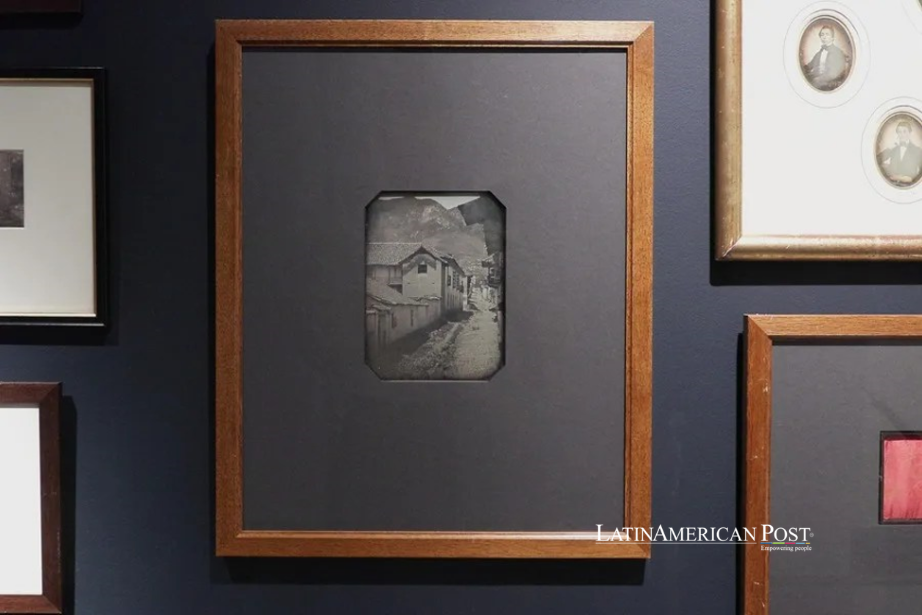
Christie’s expects Bogotá’s oldest surviving photograph to fetch €60,000 to €80,000 in Paris. It took 47 seconds to make in 1842, long enough for someone to cross the cobblestones and leave less of a trace than a single roof tile.
Eleven O’Clock on Calle del Observatorio
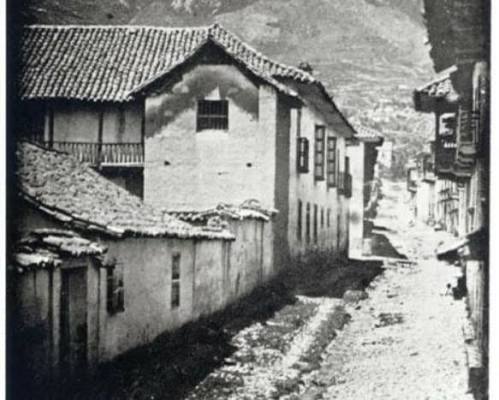
The corner house has a wooden balcony with rails a carpenter could count. Below it, patches of plaster have fallen away beside the door. Tiled roofs run up the block toward the eastern hills. At eleven in the morning, two blocks off Bogotá’s main square, the Calle del Observatorio looks remarkably quiet. Who lived upstairs?
The hour comes from a label in brown ink on the back. Baron Jean-Baptiste Louis Gros, a French diplomat and landscape painter, recorded the year and the exposure time. Beside Bogotá he wrote “nvlle Grenade,” shorthand for New Granada. He noted the mirror he used to correct the usual reversal of left and right. Anyone who knew the neighborhood would find the corner house on the proper side. The street is now called Calle 9.
A portrait photographer could ask a customer to sit still. Gros had no such arrangement with the neighborhood. Someone who spent one second passing a patch of wall left the other 46 seconds to the wall. The camera also had to contend with shade under the eaves and daylight bright enough to wash out the mountains. Gros got both into a view measuring less than eight inches along its longer edge.
Christie’s counts Gros’s daguerreotype, an image made on polished metal, among the earliest surviving street photographs made outside Europe and the United States. Working outdoors was a gamble, Élodie Morel-Bazin, the specialist overseeing the auction, told EFE. She described a race to make pictures nobody had attempted. Bogotá’s El Observador carried news of the invention in September 1839. A reader could pass the news to a neighbor for nothing. A lens, chemicals, and polished plates cost more than most households could afford.
The Country on the Label
Bogotá had photographers of its own. In 1841, a local painter named Luis García Hevia entered two experimental daguerreotypes in the city’s industrial exhibition. He also showed a painting of a brawl between country people and a bust of General Juan José Neira. The exhibition record identifies the general and tells us what the painting depicted. It gives no subjects for the two camera studies. García Hevia won third prize for his entry. The plates themselves have yet to turn up.
The observatory that gave the street its name had stood since 1803, when Spain still governed here. Francisco José de Caldas began making astronomical observations there in 1805. A few years later, independence organizers who suspected the authorities were watching their meetings at a private house asked Caldas if they could gather in the observatory. He let them in. The street name carried a memory of people who had needed a quiet place to talk.
After Gran Colombia broke apart, Venezuela and Ecuador went their own ways. The central provinces formed the República de la Nueva Granada in 1831. Bogotá governed territory encompassing present-day Colombia and Panama, an arrangement that had nearly come undone while Gros was in town. Panama declared itself a separate state in 1840 and rejoined at the end of 1841. One of Gros’s duties in Bogotá was representing French interests in a possible canal across that isthmus.
The civil war known as the War of the Supremes ended the year Gros photographed the street. Regional commanders had challenged Bogotá’s authority. The Liberal and Conservative parties took shape later in the decade, and in 1858 a federal constitution established the Confederación Granadina. Someone born on the block in 1842 could have turned twenty-one in the United States of Colombia, the name adopted in 1863, without leaving the house.
The Price of a Bogotá Morning
The plate passed through the Paris collection of André Duchesne before Roger Thérond, the longtime editor of Paris Match, acquired it in 1994. Christie’s is offering 363 photographs from his collection, spanning the nineteenth and twentieth centuries, as France marks photography’s bicentennial. The live sales take place November 13 and 14. The Bogotá plate, lot 228, goes up on the second day, 184 years after Gros made it. A separate online sale closes November 17.
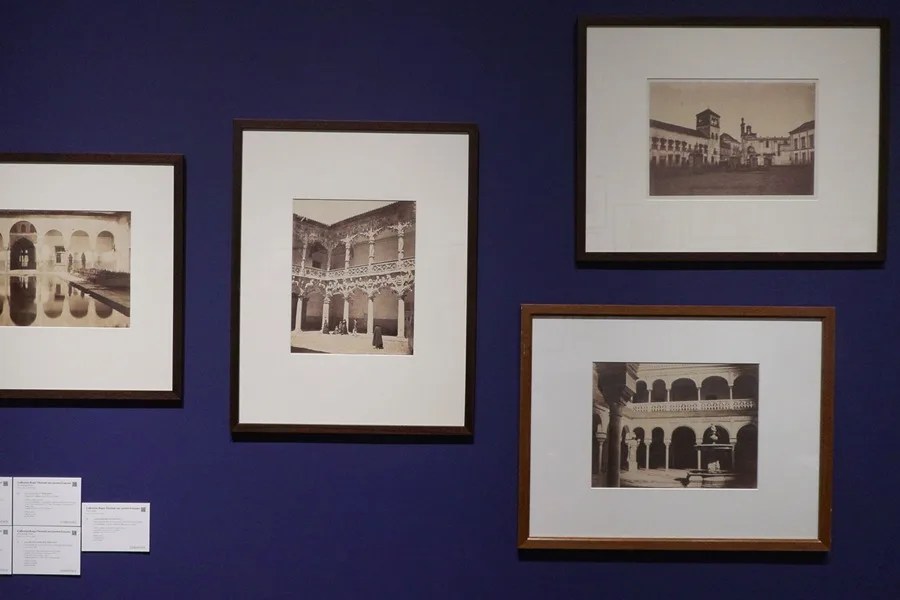
In Seville around 1856, British photographer Charles Clifford framed a warrior statue with a shield in a corner of the Casa de Pilatos, an aristocratic palace. From another angle, he took in the whole courtyard, with its fountain on the right. Christie’s estimates the statue view at €10,000 to €15,000 and the wider one at €30,000 to €50,000. Clifford’s Neptune fountain at the royal palace of La Granja in Segovia carries the lower estimate. The north side of the Lions’ Courtyard at Guadalajara’s Palacio del Infantado in central Spain comes in at €8,000 to €10,000.
The high estimate for the wider Seville view falls €10,000 short of the low one for Bogotá. About fourteen years separate the pictures. Clifford worked from paper negatives so that he could make another print of the same courtyard for another customer. Gros made his image directly on silvered copper. The object up for sale is the very surface that faced the house that morning.
The French know something about waiting for a photograph to come home. For the bicentennial, the University of Texas at Austin has agreed to lend Nicéphore Niépce’s view from his Burgundy window to a French museum in April 2027. In Bogotá, anyone can walk down Calle 9 and pull up Gros’s photograph on a phone. Whether people there can watch their street appear on the original silver as the light changes will depend on who buys it in Paris.