Paraguay Counts the Cost as Ueno Bank Exhausts Santiago Peña’s Political Credit
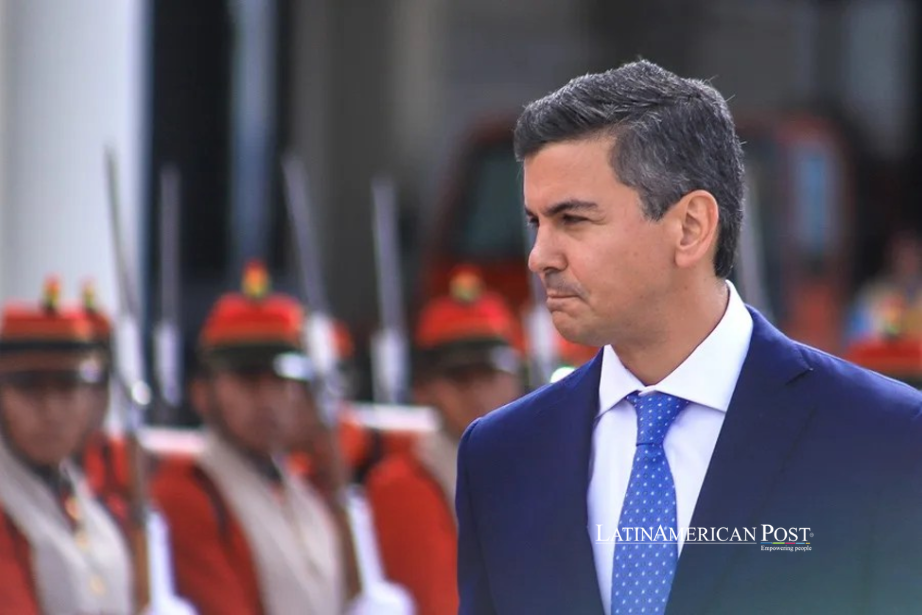
Santiago Peña promised Paraguay economic expertise and a younger political face. The Ueno Bank crisis instead exposed the risks of linking public savings, private finance, and Colorado Party power, leaving his presidency in jeopardy and depositors waiting to access their money.
The Economist Loses His Audience
Santiago Peña spent years learning how financial systems work. When a bank’s failure threatened his presidency, Paraguayans needed a simpler explanation: when could they get their money back?
The 47-year-old economist submitted his resignation Thursday, November 5, after Ueno Bank’s intervention and the withdrawal of support from his political mentor, former president Horacio Cartes. His five-year mandate was supposed to run until 2028.
“I have decided to submit my resignation as president of the republic,” Peña said in a video reported by EFE, invoking stability and the preservation of democratic institutions.
But announcing his departure did not complete it. Deputies approved an impeachment accusation by a vote of 78, and Congress failed to reach the quorum needed to decide on his resignation. Peña remained formally president as the process moved to the Senate.
The distinction mattered. His resignation had neither ended the impeachment proceedings nor resolved depositors’ claims.
Peña’s credentials had once been central to his appeal. He joined the central bank in 2000, earned a master’s in public administration at Columbia University, and worked in the International Monetary Fund’s Africa department before returning home. Cartes appointed him finance minister in January 2015, when he was 36.
His personal story softened that institutional résumé. A father at 17, married at 19 to Leticia Ocampos, Peña presented youth alongside responsibility. The couple has two children.
Those experiences helped furnish an image of modern competence. The bank crisis subjected that image to a harsher test than any campaign debate.
The Money Behind the Crisis
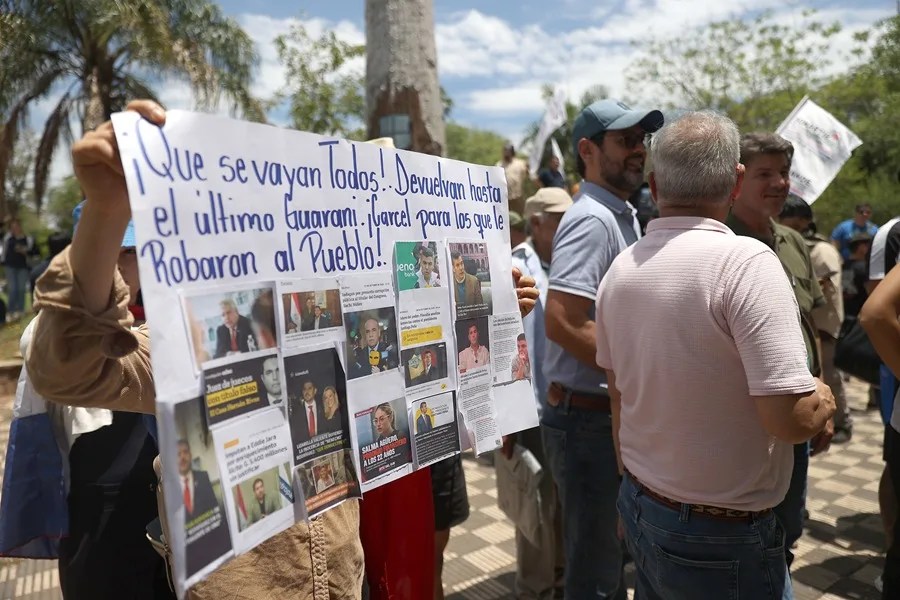
The central bank approved Ueno’s resolution on November 2 and announced it the following day. Its solvency indicator had fallen below half the required minimum after adjustments to its financial statements. This was a failure of the bank’s financial cushion, beyond an ordinary interruption of service.
Ueno had approximately 2.9 million customers and administered roughly $850 million in public funds, including pension, health and state enterprise resources. That exposure extended the consequences beyond people who had personally chosen the bank.
The $850 million figure does not establish that the entire sum has been lost. Recoveries depend on the bank’s assets and the resolution process. Yet even temporary restrictions can create pressure when institutions need cash to meet obligations.
EFE reported that the Social Security Institute, known as IPS, held $355 million in Ueno, approximately 9% of its investment portfolio. It had investments across 14 financial institutions. Ueno also handled pension payments for about 32,000 retirees.
The portfolio spread matters: Ueno was a substantial investment, but most IPS investments were elsewhere. The immediate challenge was preserving payment continuity while determining what could be recovered. The central bank said pension payments would continue on their usual dates.
Deposit protection also has limits. The central bank set the guarantee at 228.3 million guaraníes, about $38,600, per depositor per institution. That ceiling cannot be treated as blanket protection for every public investment or every account balance.
Peña had held shares in Ueno Holding, part of the business network behind the bank, and sold them in 2025. Selling an investment ends ownership; it does not settle questions about decisions made while interests overlapped.
Legislators also challenged his appointment of former Ueno executive Carlos Carvallo to lead the central bank. Their accusation concerns conflicts of interest and public oversight. Peña denied wrongdoing. An impeachment accusation does not establish criminal guilt.
A New Face, an Old Machine
Peña’s ascent depended on an established political structure. Originally affiliated with the Authentic Radical Liberal Party, he joined the Colorados in 2016 under Cartes’s sponsorship.
He lost the party’s 2017 presidential primary to Mario Abdo Benítez, then secured its nomination in December 2022. In April 2023, he won the presidency with 42.74% of the vote alongside running mate Pedro Alliana.
That was a winning plurality, not a majority. His authority combined electoral support with the backing of a party that has governed since 1947, interrupted only between 2008 and 2013. Its organization helped make a relatively recent recruit president.
Cartes’s decision to support impeachment exposed the limits of Peña’s independence. The same patron who had accelerated his rise could withdraw the protection that made governing possible.
The rupture was therefore larger than a dispute between two politicians. Peña had offered the appearance of generational change within an enduring governing apparatus. Once that apparatus judged him a liability, his international training and polished presentation could not provide an alternative power base.
The party supported proceedings against Peña while withholding that backing against Alliana. Its response suggested an effort to contain the crisis around the president while preserving a route to continued Colorado government.
Abroad, Peña cultivated President Donald Trump and joined a regional anti-cartel coalition at the March 2026 Miami summit. At home, more than 70 foreign trips earned the press nickname “Santi Tour.”
Travel could advertise Paraguay’s ambitions. It could not substitute for credible supervision at home.
The immediate measure of recovery is practical: restore access to deposits, protect public resources, and establish responsibility. For families awaiting their money, a presidential resignation is an event. Payment is the result.