Mexico Puts a Chihuahua in Uniform and Unleashes a Public Relations Sensation
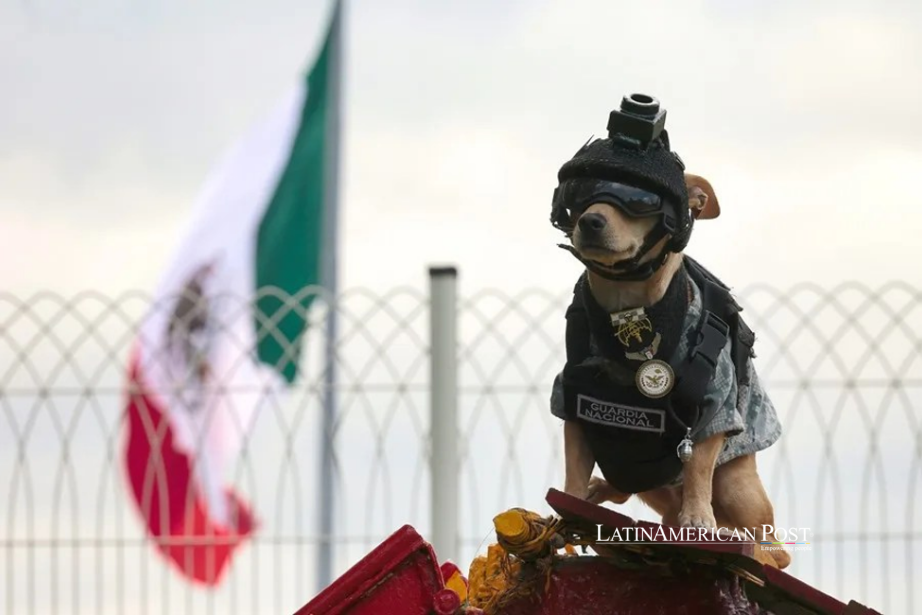
Comando Chihuahua, a tiny dog in a custom uniform, has become Mexico’s unlikely National Guard celebrity, drawing crowds and promoting adoption while showing how a security institution uses an approachable animal to start conversations that might otherwise never happen.
A Different Kind of Duty
People line up to meet him. Some bring presents; others arrive with treats. The attraction is a dog barely eight inches tall, dressed for an institution whose public appearances generally emphasize discipline and force. Comando Chihuahua offers something else: an excuse to approach the uniform, stop for a photo, and enjoy the encounter.
His breakthrough came during Mexico’s September 16 military parade in the capital. His official outfit caught social media’s attention, and the interest followed him into subsequent public appearances. Now, according to the account provided to EFE, dozens of people queue for pictures whenever he attends an event.
At 15 months old, he weighs about 15 pounds and has already changed households and occupations. Six months ago, an older couple in the northern state of Chihuahua gave him up for adoption because they could no longer manage his energy. The National Guard became his new home.
“They no longer knew how to care for him,” First Sgt. Andrea Elizabeth Vilchis told EFE, explaining that personnel quickly welcomed the newcomer. That starting point isn’t especially glamorous. A family had reached the limits of what it could provide, and another setting proved better suited to the animal.
That history matters to the adoption message. Finding another home can acknowledge an animal’s needs and an owner’s limits. The couple’s decision gave Comando access to handlers, facilities, and a structured routine. Behind the miniature military outfit sits a practical story about matching responsibility with the resources to sustain it.
Small Dog, Large Investment
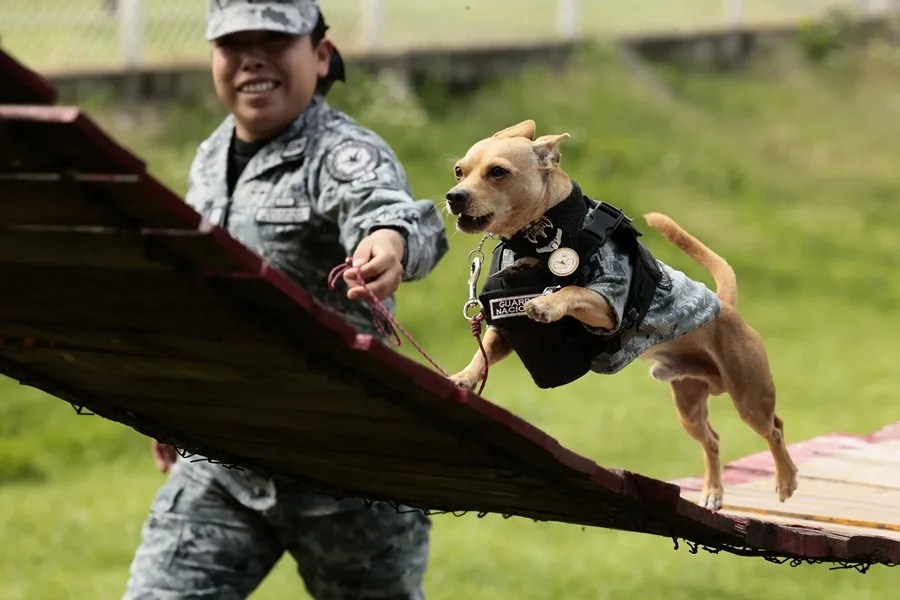
Comando’s assignment is community outreach. He visits schools, public squares, and neighborhood activities, accompanying personnel whose work involves building contact with residents. German shepherds and Belgian Malinois commonly perform detection duties. His contribution depends on being comfortable around people, attracting attention, and making an official appearance feel accessible.
The numbers help explain his visibility. Figures provided to EFE put the Defense Ministry’s canine contingent at roughly 1,000 and the National Guard’s at 300. Comando is described as the only Chihuahua. Within the Guard’s reported contingent, he represents roughly one dog in 300, an unusually distinctive face in a much larger operation.
His popularity also illustrates how visibility and operational scale work differently. Hundreds of trained dogs can remain largely anonymous while a single recognizable animal becomes the public’s point of entry into the institution. The uniform supplies the identification; the Chihuahua supplies the surprise. Together, they make an image that people want to circulate.
Making that image possible requires work. At the military installation in Mexico City, personnel built a training course to fit his dimensions. His day begins at 8 a.m., followed by training from 9 a.m. to 3 p.m. That six-hour window places the celebrity inside an organized program and gives his handlers a predictable daily framework.
Vilchis described him to EFE as steady and sociable with people and other animals. Those qualities carry more weight for this job than the breed’s reputation for nervousness. A dog expected to meet unfamiliar visitors needs an individual temperament suited to that environment. His handlers’ account presents sociability as a working qualification.
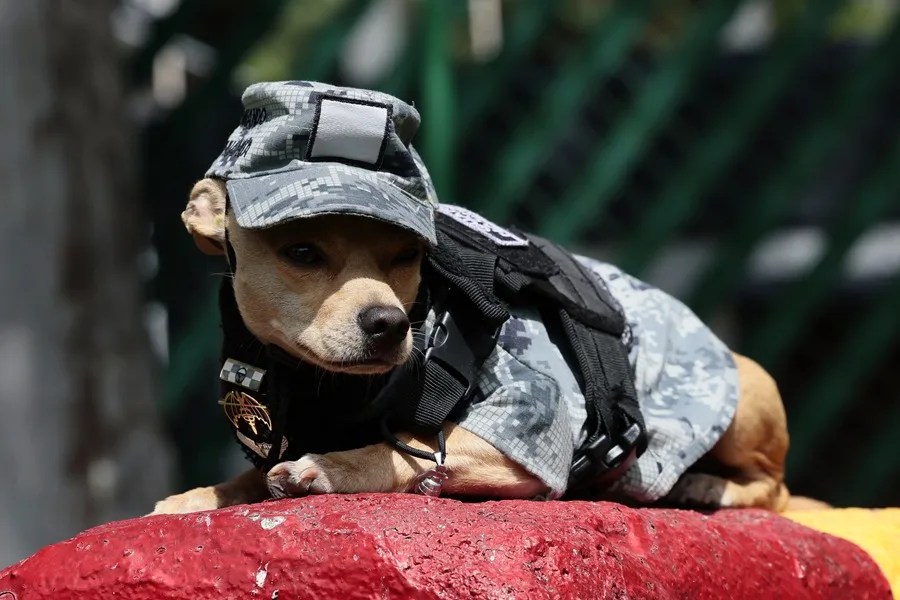
The wardrobe is equally deliberate: a jacket cut from the institution’s uniform fabric, a tactical vest, a scarf with course patches, protective goggles and a fitted helmet. Each detail makes him recognizably part of the organization. Each also reminds viewers that this apparent miniature soldier depends on people willing to adapt equipment to his body.
What a Photograph Can Prove
The crowds offer evidence of attraction. Dozens of visitors wait for a photograph, choosing an encounter with the National Guard, and the dog makes that encounter possible on friendly terms. For a security institution, such voluntary contact matters: it creates space for conversation beyond commands, checkpoints, or emergencies.
How far that goodwill travels remains an open question. The account provides no audience totals, engagement figures, or measures of changing public confidence. A queue demonstrates that people want to meet Comando. Whether the encounter alters their judgment of the institution requires evidence that photographs and viral popularity cannot supply.
The adoption campaign offers a more concrete message. Comando’s story shows the possibilities of rehoming when the receiving household, or institution, can meet an animal’s needs. His success also rests on unusually substantial support: dedicated personnel, tailored equipment and space for training. Ordinary adopters would need their own realistic arrangements.
“We are very happy that Comando Chihuahua is part of us,” Vilchis told EFE, emphasizing the importance of second chances and adoption. The strongest part of that appeal is its everyday implication. Caring for an animal means finding a place that fits its energy, temperament, and needs long after the initial excitement fades.
For now, his public assignment begins with something modest: getting people to stop. They bring gifts, wait their turn, and take home a picture of a small dog wearing an outsized institutional identity. Behind the photograph is the quieter achievement that gave the campaign its story: a restless animal found people prepared to make room for him.