In Chile, a Glacier Stonefly Upstages the Dragon Scientists Came to Find
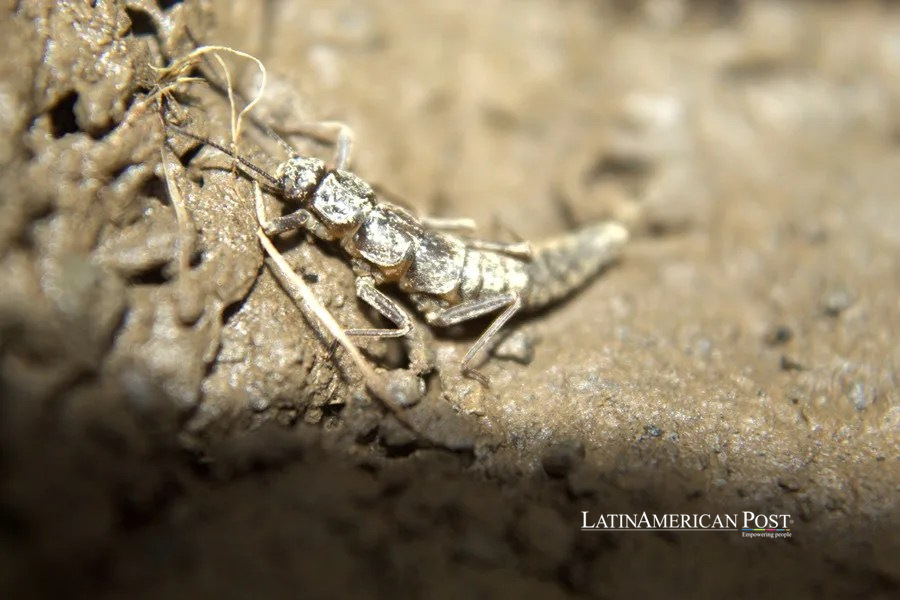
On Navarino Island, scientists found each adult of a new stonefly species within a meter of water. The insects have no wings. As Patagonia’s glaciers retreat, their future may depend on the distance between one wet rock and the next.
What the Rocks Were Hiding
Getting a good look at the stonefly meant disturbing it. Beside a glacier on Navarino Island, Javier Rendoll-Cárcamo and his colleagues found the adults tucked under damp rocks in the shade. When light reached them, they hid again. The biggest measured 18 millimeters, roughly the diameter of a dime. The smallest measured 15. They “seem to be nocturnal,” Rendoll-Cárcamo told EFE. Watching one duck away from daylight still leaves open what it does after dark.
The team had gone up the mountain looking for the Patagonian dragon, itself a stonefly. First described in 1956 from Argentina’s Upsala Glacier, Andiperla willinki spends its whole life on Patagonian ice. On Navarino, a Chilean island south of the Beagle Channel, the researchers searched the remnants of a small glacier at about 780 meters, or 2,560 feet, above sea level. What turned up among the rocks belonged to the dragon’s family, Gripopterygidae. The researchers couldn’t match it to any known species.
Across the border in Argentina, biologists working on Perito Moreno Glacier had already faced that problem. In 2019, they described a second species in the dragon’s genus in Zootaxa. A small, pointed lobe at the tip of the abdomen helped distinguish it from the original dragon. Counting two species under one name and an apparent abundance of insects could hide the disappearance of the rarer one.
“There’s no other stonefly on the island that looks like it,” Rendoll-Cárcamo told EFE. He works at the Cape Horn International Center in Puerto Williams. His team reported the find in the November issue of Ecology. Most aquatic insects associated with glaciers live in the streams that carry meltwater downhill. These adults turned up right where ice, water and rock meet. An earlier island survey used a dozen tentlike traps to catch emerging insects along three rivers, including the Róbalo, which supplies drinking water to Puerto Williams. A wingless adult sheltering under a rock would be an easy animal to miss that way.
On the water, the adults did something unexpected. They floated. Rendoll-Cárcamo wondered whether something about their legs helps hold them up, or whether the answer lies in chitin, a material in their outer covering. The team is still investigating. An adult that floats might make it across a pool, although no one has established how far it can travel that way.
More Glaciers on Paper
When Chile’s water authority released its 2022 glacier inventory, it reported about 2,000 more glaciers than the 24,114 it had counted in 2014. The area they covered had fallen roughly 8 percent. Sharper satellite images picked up small glaciers the earlier survey had missed. In other places, a single body of ice had broken into pieces, each now with its own outline on the map.
Those figures say little about how much shelter is left under a particular rock. What matters there is whether water still reaches it in summer and whether its underside stays cool and damp. Retreating ice can expose fresh stones, and meltwater could make some of them habitable for a time. If a channel then changes course, an adult could find itself separated from suitable ground by a stretch of dry gravel. A winged insect might fly across in seconds. For this one, it could be a long walk.
Rendoll-Cárcamo says the insect spends only part of its life around glacier ice. Could it complete its life cycle if the ice disappeared altogether? Cold water from a spring might offer shelter, provided the insect can reach it, and its young can grow there. Nobody yet knows whether this is the only glacier the species inhabits. A single known population gives researchers good reason for concern and very little on which to base an estimate of extinction risk.
A Reason to Go Back
In a photograph from a 2015 science fair, Alex Neira and Rodrigo Soto, two students from Puerto Williams, stand beside their poster at Chile’s National Museum of Natural History in Santiago. They are explaining to a museum official how a diving beetle grows. At home, nearly 1,550 miles south of the capital, they had studied its larvae in the field and in the lab. The Chilean journal Magallania published the photograph. Their teacher and scientific adviser was Rendoll-Cárcamo.
The stonefly, too, will take more than one field season to understand. For it to serve as a sentinel of climate change, researchers would need to visit at the same time each year, take the water temperature, and record which rocks still get wet. If adults turn up farther from the glacier, it would matter whether their young are there, too. An adult can find shelter for a night in a place where its eggs might never hatch.
Rendoll-Cárcamo hopes the small remnant will give scientists an early look at what a faster thaw could mean for life alongside larger Patagonian glaciers. A count of zero at the original site would leave him with a question. At the new waterline, another stone might have just the right amount of shade. Someone would have to lift it.