Brazil Youth Tune Out Traditional Parties but Keep Politics in Their Feeds

Brazil’s October elections reveal a gap between young voters and traditional parties. Falling teenage registration, digital communities and frustration over work suggest political engagement is changing shape, even as the promise of representation struggles to reach a generation’s everyday life.
The Missing First Voters
Not every young Brazilian stepping away from a party is stepping away from politics. Some are finding their arguments, allies and sense of belonging online, in communities that feel more accessible than an organization with a hierarchy to climb, political scientist Marco Teixeira told EFE.
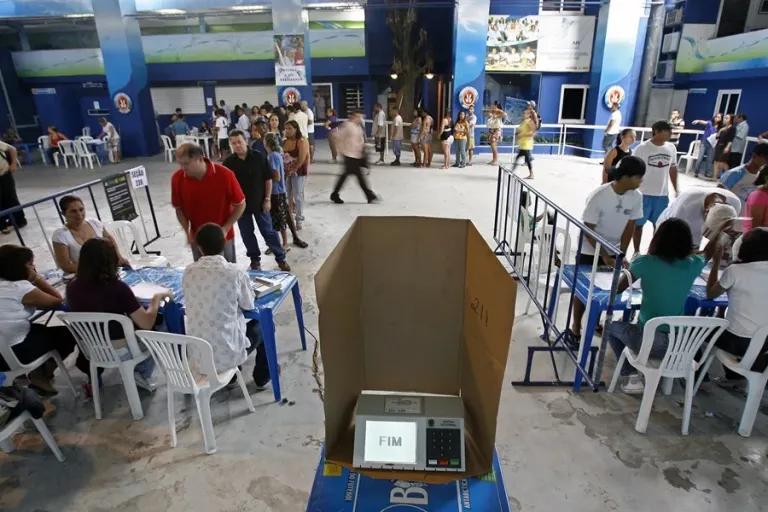
That distinction matters before Brazil’s October 4 election. EFE, citing electoral authorities, reports that registration among people ages 16 through 18 fell from about 4.2 million in 2022 to 3.6 million this year. More precise figures show 606,468 fewer registrations, a 14.52% decline.
The electorate moved in the opposite direction, growing 1.46% to 158.7 million. Teenagers in that age band now represent 2.25% of registered voters, against about 2.67% four years earlier.
Geography further complicates the picture. The Northeast accounts for about 1.32 million voters ages 16 through 18, roughly 37% of that national group, although it contains about 27% of the overall electorate. A single portrait of Brazilian youth, built around the most visible online communities, risks missing those differences.
Yet a smaller register is not a turnout result. The 2022 teenagers have aged out of this category; these are different cohorts. Changes in the population and registration campaigns could affect the comparison. The numbers alone cannot establish why some young people have not enrolled.
At 16 and 17, voting is optional. At 18, it generally becomes compulsory, so the category also includes people with different legal obligations.
Teixeira, of Fundação Getulio Vargas, sees an institutional mismatch. Parties remain “in-person, hierarchical and closed,” he told EFE, while young people organize in fast, fragmented digital spaces. His argument is not that a generation has nothing to say. It is that established institutions are not accommodating the conversation.
The Campaign Becomes a Community
Renan Santos, running for Missão, illustrates this route into electoral politics. EFE describes his appeal as built around the claim that conventional politics does not work. His candidacy joins a race that includes President Luiz Inácio Lula da Silva and Sen. Flávio Bolsonaro.
Missão received electoral court approval in November 2025, and the electoral court validated Santos’s presidential registration this September. The timeline captures a distinction: a campaign can present itself as an alternative to established politics through party registration and candidacy.
Santos is also a founder of Movimento Brasil Livre, the movement behind Missão. This is a new presidential candidacy, not a first encounter with political organizing. The distinction matters when describing an outsider: an existing movement can acquire a new party structure without erasing the political experience of the people who built it.
For Teixeira, these campaigns have flexible structures and fewer senior party leaders to bargain with. Social media offers more than distribution. Supporters can feel part of the project, rather than an anonymous audience waiting to be addressed. He says traditional parties’ attempts to seem younger online can appear forced.
That intimacy does not answer every question about power. Being able to comment is not the same as influencing a party’s program. Nor does online popularity establish a candidate’s position on judicial independence or the rule of law. A viral post is not a vote count, either.

The Diploma Meets the Deadline
Behind the screen is an older promise: finish school, and life should become more secure. Claudio Providas, the United Nations Development Program’s resident representative in Brazil, told EFE that many young Latin Americans have followed that educational path without finding jobs that match their qualifications.
Brazil’s labor figures complicate an account of unrelieved decline. Brazil’s statistics agency, IBGE, reported that 8.2 million people ages 15 to 29 were neither working, studying nor training in 2025, down from 11 million in 2019. Yet they still accounted for 17.5% of the age group, more than one in six.
Those figures describe a broader age group than the teenage electorate. Neither dataset proves that job insecurity causes nonregistration. Together, they suggest a more complicated backdrop than a label of apathy: measurable improvement can coexist with millions of young people still outside the classroom and workplace.
Providas also describes expectations that go beyond social assistance, with digital exposure intensifying demand for comfort and consumption. Where basic services remain unreliable, he says, frustration turns from a particular government toward the system itself.
“People are no longer satisfied with the basics,” Providas told EFE. That does not establish that assistance lacks value. It distinguishes immediate household support from the expectation that education will bring a more independent adult life. In his account, young people are not simply comparing today with yesterday. They are comparing their circumstances with the future they were encouraged to expect.
He still finds young people “deeply idealistic,” capable of mobilizing around global causes but disconnected from institutions that do not reflect those concerns. His response combines education, understanding digital participation, and “data and evidence” to rebuild trust and counter disinformation.
For the young person carrying a diploma but no clear prospect of stability, the political question is not only who speaks the language of the feed. It is what happens after the conversation ends, when the screen goes dark and the search for a future resumes.
Also Read: Latin America Reads Between Trump’s Map Lines in an Old Naming Dispute