Nine Coaches, One Legend: Messi’s Epic Journey to Argentina’s Farewell
Lionel Messi’s Argentina farewell brings 21 years, nine coaches, and 125 goals into focus. Behind the trophies lies a harder story: a gifted teenager became a burdened captain before a team finally learned that even genius needs someone alongside him.
The Shirt Came Before the Crown
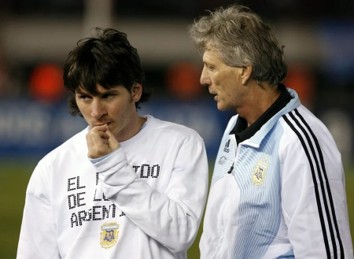
Lionel Messi’s first senior appearance lasted less than a minute. José Pekerman sent the 18-year-old onto the field against Hungary in August 2005; a red card sent him straight back. His international career began with a teenager walking off before he had properly arrived.
On Tuesday, October 6, the 39-year-old is scheduled to leave the national team on different terms, against Benin at Buenos Aires’ Monumental stadium. He enters his farewell with 207 appearances and 125 goals, roughly 0.60 goals per game. The numbers record extraordinary production. They do not explain why belonging took so long.
That average also compresses very different jobs. A substitute’s brief appearance counts alongside a captain’s full match. It cannot show how often Messi created an opening rather than finished one, or how each coach changed the positions from which he received the ball.
Because he had grown up as a footballer in Barcelona, critics sometimes treated him as an outsider in his own national team. The complaint was not simply that Argentina had lost. It was that the player celebrated in Spain somehow owed home a different version of himself.
Pekerman brought the 2005 youth world champion to Germany in 2006 without making him the attack’s centerpiece. Messi scored his first World Cup goal there. Alfio Basile then established him as a starter alongside Juan Román Riquelme and Carlos Tévez. Argentina reached the 2007 Copa América final but lost to Brazil.
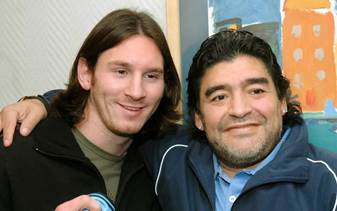
Diego Maradona’s arrival in 2008 changed the symbolism. He handed Messi the No. 10 shirt and, against Greece at the 2010 World Cup, his first captain’s armband. The man whose achievements defined Argentine soccer’s expectations was now coaching the player repeatedly asked to match them.
Three Finals, No Argentine Goals
Sergio Batista had already coached Messi to Olympic gold in Beijing in 2008. His senior spell ended differently: elimination by Uruguay at Argentina’s home Copa América in 2011 and hostility from disappointed supporters. The Olympic medal was real. So was the distinction between winning an age-restricted tournament and satisfying senior expectations.
Alejandro Sabella made the captaincy permanent in 2011. He built a more balanced side around Messi and took Argentina to the 2014 World Cup final. Germany won 1-0 in extra time. Reaching that match demonstrated collective progress, even if the final photograph showed someone else holding the trophy.
Under Gerardo Martino, Argentina returned to continental finals in 2015 and 2016. Both finished scoreless through extra time; Chile won both penalty shootouts. Across those two matches and the 2014 final, Argentina played 360 scheduled minutes without scoring. That is a team statistic, not a personal indictment of Messi.
It exposes something the career total conceals. Hundreds of successful attacks elsewhere couldn’t buy a goal in those hours. The shootouts settled the Copa América titles, but the inability to score beforehand belonged to the entire attack.
After missing his penalty in 2016, Messi announced his international retirement. He returned within three months under Edgardo Bauza. Jorge Sampaoli succeeded Bauza in 2017 and needed Messi’s hat trick in a 3-1 victory over Ecuador in Quito to secure World Cup qualification.
The rescue proved temporary. Argentina exited Russia 2018 against France in the round of 16. Another coach departed, and another version of the national team had to be assembled around the same experienced forward.
Scaloni Shared the Weight
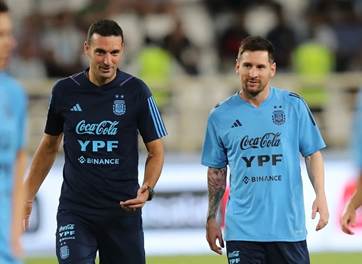
Lionel Scaloni inherited more than a selection problem. Messi had played under eight senior coaches in approximately 13 years. Scaloni would oversee the next eight. The contrast does not prove that longevity automatically produces trophies. It does show how much of this career was spent rebuilding relationships and routines.
His renovation gave younger players substantial responsibilities rather than treating them as an audience for the captain. Rodrigo De Paul supplied midfield energy; Julián Álvarez offered movement ahead of and around Messi. The tactical bargain was practical: others could cover ground and occupy defenders, while the No. 10 found useful space.
The 2021 Copa América ended Argentina’s 28-year wait for a major senior title. That drought never meant Argentine soccer had stopped producing champions, as Messi’s youth and Olympic medals demonstrated. It meant success in one generation, or competition had repeatedly failed to translate into the senior trophy everyone demanded.
The World Cup followed in 2022, then another Copa América in 2024. The latter final clearly illustrated Scaloni’s achievement. Messi left injured against Colombia, but Argentina kept functioning. Three substitutes combined for the winner: Leandro Paredes won the ball back, Giovani Lo Celso delivered the decisive pass, and Lautaro Martínez finished.
Messi didn’t need to be on the field for the team to do the job.
Argentina’s defeat in the 2026 World Cup final ended their bid for consecutive world titles. It did not undo the transformation behind them. Nine coaches had encountered different versions of Messi, from protected teenager to exhausted captain to world champion. At the Monumental, the farewell belongs to the player. The fuller story belongs to the teams that made room for his talent and eventually made room for his limitations.