Colombian Pacific Asks Whale Watching Tourists to Give Its Biggest Visitors Some Space
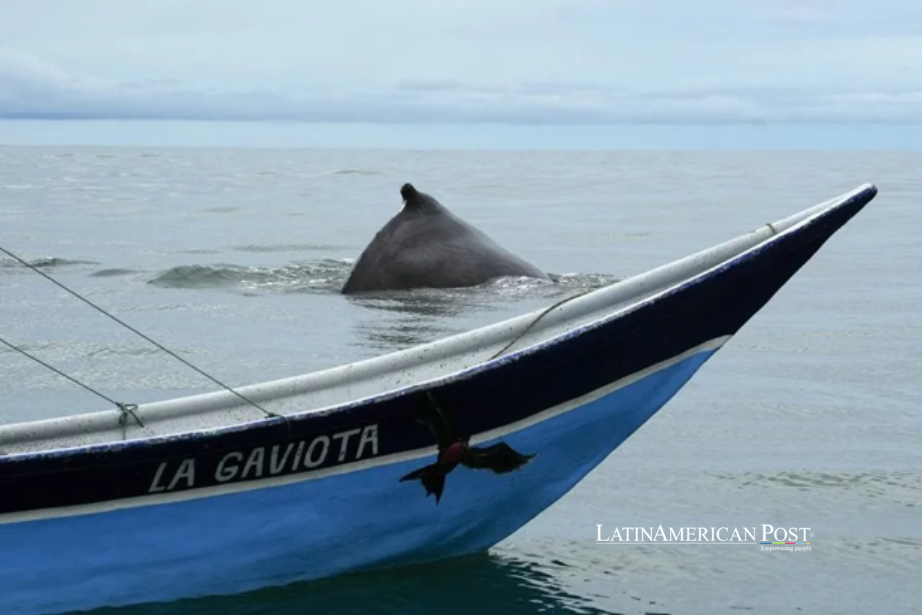
In Buenaventura, Colombia, whale watching helps La Barra families earn a living. But boat traffic is testing a relationship older than tourism, pushing residents to turn inherited respect for humpback whales into practical rules for sharing their Pacific coastal waters.
When the Sea Had Quiet
Before the visitor briefings, there were bonfires. Before whale watching became a business, people in La Barra welcomed the animals with songs, rituals, and a biblical warning: anyone who ventured out might end up like Jonah, swallowed by a great fish.
Fred Ortiz, the community council’s legal representative, recalled that history in an interview with EFE. When humpbacks arrived in Bahía Málaga to mate, he said, boats stayed ashore. People neither watched them from vessels nor went fishing.
For roughly two or three months, the whales brought what Ortiz described as something resembling a fishing closure. This restraint was rooted in belief and local practice, not government prohibition. The sea received a seasonal break because people understood their place in it through stories.
That memory complicates the familiar tourism pitch, where conservation arrives with an outside expert and a new business opportunity. Here, the community already had a way of leaving animals alone. Tourism has required it to reconsider how that restraint works when approaching whales can help pay household bills.
La Barra lies within Uramba Bahía Málaga National Natural Park, in Buenaventura municipality on Colombia’s Pacific coast. Humpbacks arrive from the South Pacific during the annual migration, which locals describe as occurring from July through September. For residents, their return carries both cultural meaning and the prospect of earnings.
Neither can be discarded. A community that depends partly on visitors cannot settle the question by shutting everyone out. But welcoming every additional boat without limits would put pressure on the attraction itself.
The Price of Getting Closer
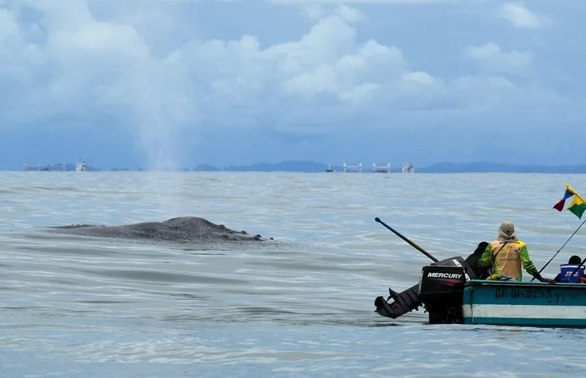
Ortiz believes that pressure is already visible. He told EFE that whales no longer complete their routes toward La Barra because so many boats disturb them.
His account deserves attention as testimony from someone whose community lives alongside the migration. It does not, by itself, establish a population decline or measure how much behavior has changed. EFE’s report includes no tracking series or comparable annual counts. Those distinctions matter: managing disturbance requires knowing where animals go, not merely counting tickets sold.
A useful record would pair boat numbers with observation times and sightings, showing whether crowding coincides with changes in routes.
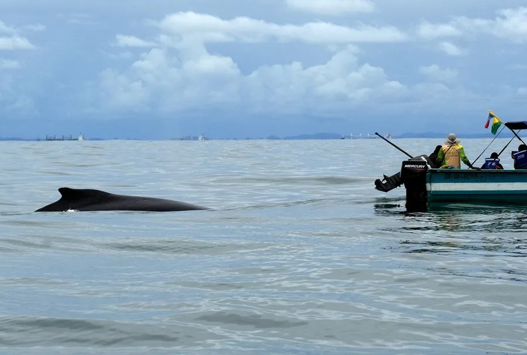
The community’s response begins before departure. Every visitor now receives an awareness talk. Boat operators also train in responsible whale watching, including through La Barra’s World Festival of Whales and Women Singers, held in early October.
The practical limits reveal why education alone cannot carry the entire burden. Regional environmental authority CVC recommends no more than 30 minutes of observation when one boat is present, falling to 15 minutes when several gather. It also warns against pursuit, encirclement, or blocking the animals’ path.
Halving the permitted encounter when boats congregate recognizes that visitors share a limited space. More customers do not create more undisturbed water. Yet shorter encounters would offer little relief if one cluster of vessels immediately replaced another. Coordination between operators matters as much as each captain’s conduct.
That creates an economic test for responsible tourism. A guide who keeps an appropriate distance must deliver an experience passengers value without promising a closer approach than competitors. Briefings can help change those expectations before a disappointed customer starts demanding more.
The difficult work is making restraint a shared condition of doing business. Otherwise, careful operators risk losing customers to those willing to crowd the whales, while the whole community bears the consequences.
More Than a Boat Ticket
Yamile Perdomo Quintero, an environmental official working in the Buenaventura and Bahía Málaga area, described La Barra’s effort to EFE as an organizational process that protects both animals and people.
“There has to be harmonious development,” she told EFE, explaining that communities, social welfare, and natural resources must all benefit. Her emphasis on equity moves the discussion beyond whether tourism brings money. It asks who receives that money and who helps decide the conditions under which it is earned.
The community council gives that question an institutional home. Residents are helping set expectations for visitors rather than simply supplying labor for an activity organized around them. Their knowledge of the coast becomes part of how tourism operates.
The festival offers another opening. Alongside conservation, its program brings together local food, traditions, and women singers. CVC’s account identifies Ortiz as the representative of La Barra’s Afro-Colombian community council and describes benefits reaching women who head households.
That wider economy is important. Spending on a meal or a cultural event can reach people who do not own boats. It also gives visitors reasons to value La Barra beyond the length or closeness of a whale encounter. These are possibilities for distributing income, not proof that every family already benefits equally.
EFE’s reporting offers no household earnings figures to establish that result. The measure of success must eventually include what remains with residents, alongside whether whales can move without being pursued.
For Ortiz, the choice is to conserve while sustaining the tourist livelihood. The old welcome left boats ashore. Today’s welcome needs room for people to earn a living and enough room for the whales to pass.