Why VPN Adoption Is Growing Across Latin America
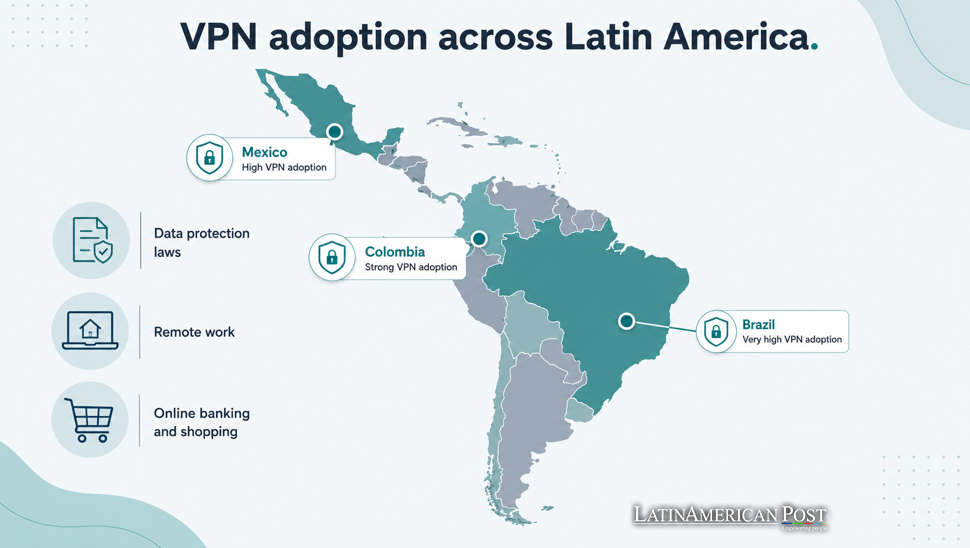
A few years ago, most people in the region who used a VPN were either gamers chasing lower ping or fans trying to unlock a streaming catalog from another country. That has changed. Across Latin America, virtual private networks have moved from a niche trick into something closer to a routine part of getting online, and the reasons say a lot about where the region’s digital life is heading.
The regional numbers are still modest next to the giants. Latin America holds roughly 8 percent of the global VPN market, well behind North America and Asia Pacific. But the growth curve is the interesting part. In Brazil and Mexico, close to a third of internet users now reach for a VPN regularly, and the regional market is expanding at a pace that outstrips several wealthier regions. This is not a plateau. It is a region catching up quickly, and doing it for practical reasons rather than novelty.
What is actually driving the shift
Three forces are pushing adoption at the same time, and they reinforce each other.
The first is privacy law. Latin America has spent the last several years building real data protection frameworks. Brazil’s LGPD, in force since September 2020 and enforced by the ANPD, is the region’s most influential privacy law, and Mexico, Chile, Colombia, and others have moved in the same direction. When governments and companies start treating personal data as something with legal weight, ordinary users notice, and many respond by taking their own privacy into their own hands.
The second is work. Remote and hybrid arrangements stuck around after the pandemic in a way few employers predicted. A distributed workforce means company logins traveling across home routers and public Wi-Fi, and encrypted connections are the cheapest way to reduce that exposure.
The third is money moving online. Digital banking, fintech apps, and e-commerce have grown fast across the region, and that growth has made both businesses and shoppers more aware of what an unsecured connection can leak.
How the region compares
It helps to see the regional picture in context rather than in isolation.
| Region | Approx. share of global VPN market (2025) | Main growth drivers |
| North America | About 38% | Enterprise adoption, remote work, privacy regulation |
| Asia Pacific | About 30% | Rapid digitalization, censorship, cheap mobile VPNs |
| Latin America | About 8% | Data protection laws, remote work, online banking and shopping |
| Middle East and Africa | About 4% | Securing high-value operations, frequent data breaches |
The gap with the leaders is real, but so is the trajectory. A region sitting at 8 percent today with regular usage already near a third of internet users in its two largest markets is not a mature market. It is an early one.
Not all VPNs are equal
Growth brings a familiar problem: a flood of apps, many of them free, and not all of them trustworthy. Free VPNs are especially common outside the United States, and independent testing has repeatedly found that some log user activity, inject ads, or quietly sell the very traffic data users installed them to protect. For a region where privacy awareness is still maturing, that is a real risk, because the tool people trust to shield them can become the thing exposing them.
This is where doing a little homework matters. According to the VPNPro team, the quality gap between providers is wide enough that the label “VPN” tells you very little on its own, and their hands-on comparisons repeatedly show large differences in speed, leak protection, and logging honesty between services that look similar on a download page. If you want to see how providers hold up under real conditions rather than marketing claims, VPNpro’s VPN testing puts them through measured, repeatable benchmarks. Research collected by VPNPro on the 2026 market also underlines the point that the drivers behind Latin American growth, remote work and data protection, are the same ones now shaping the global industry.
What it means going forward
For readers across the region, the takeaway is not that everyone suddenly needs a VPN. It is that the reasons people are choosing one are becoming harder to ignore: stronger privacy laws that raise expectations, more work and money flowing through networks nobody fully controls, and a growing understanding that a bad free app can be worse than none. For anyone new to this, a few basic online privacy habits are still the sensible first step before adding any tool on top.
If VPN use in Latin America keeps climbing at its current rate, the more useful question stops being whether the region will adopt the technology and becomes whether users will learn to pick the good tools from the bad ones. That is a better problem to have than the one the region started with, and it is one worth paying attention to as the next wave of privacy legislation moves through the region’s data protection debates.