Costa Rica Sends Seized Cocaine Packing but Cannot Ship Its Violence Away
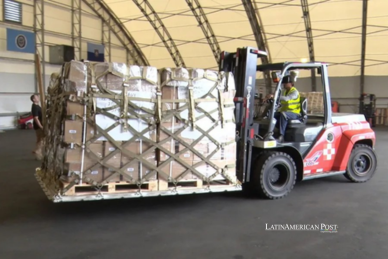
A U.S. military aircraft carried 45 metric tons of seized cocaine out of Costa Rica for destruction. The remarkable cargo exposes a less triumphant reality: near-record drug seizures, persistent killings and a government unable to afford destroying its own haul.
The Cargo and the Catch
The cocaine had a way out. Costa Rica’s predicament did not. At Juan Santamaría International Airport outside San José, a U.S. Air Force C-17 departed carrying drugs confiscated over recent months. Authorities presented Tuesday’s operation as a demonstration of international cooperation. But the most revealing detail was not the aircraft or its extraordinary load. It was the explanation for why the flight was necessary.
“Because of budgetary limitations, we couldn’t carry out the destruction” in Costa Rica, Attorney General Carlo Díaz said in remarks reported by EFE. His admission punctured the celebratory language. A country capable of intercepting enormous quantities of cocaine still lacked the resources to complete the task at home.
That does not make the operation a failure. These drugs were seized, and removing them for destruction is a concrete achievement. But it exposes an imbalance: capturing contraband attracts headlines; paying for its secure disposal is less glamorous. Both are essential. This cooperation also exposes a dependency at the final stage of the enforcement process.
His reported explanation did not quantify the shortfall. That leaves an essential question unanswered: what would reliable domestic destruction cost? Without that figure, the airlift shows a workaround, not a funded plan for the next large seizure at home.
The scale invites comparisons, provided they are honest. The 45 metric tons amount to approximately 97 percent of Costa Rica’s entire 2025 cocaine seizure total of 46.5 tons. This was not one spectacular interception, however. It was accumulated material from multiple operations over recent months, not a measure of trafficking on a single day.
Nor does the suggested value, potentially exceeding $1 billion, settle the question of damage to criminal organizations. Without specifying the market or valuation method, that figure cannot establish traffickers’ lost profits. A cargo’s estimated value and the money a particular network actually loses are not interchangeable.

What the Numbers Cannot Prove
Costa Rica’s 2025 seizures were its second-highest, behind 47.1 metric tons in 2020. The difference was just 600 kilograms, about 1.3 percent. That places both years near the same enforcement benchmark. It does not tell us whether the country intercepted a larger share of the cocaine moving through it.
Bigger seizures can reflect better policing, heavier traffic, or both. Without a reliable estimate of total flows, the success rate remains unknown. The same caution applies to declarations that a spectacular haul has weakened cartels: the weight removed says little by itself about whether financing, recruitment, and distribution networks remain intact.
The homicide figures provide a harder test. Official numbers cited by EFE show 880 killings in 2024 and 873 in 2025, a reduction of seven deaths, or roughly 0.8 percent. Every life matters. Statistically, though, that is a marginal improvement, not a decisive retreat from violence.
The 2025 rate stood at 16.8 homicides per 100,000 residents. Its annual toll amounted to approximately 2.4 killings a day. Behind that average are families whose measure of security is not a cargo manifest but whether someone comes home. A departing aircraft cannot answer that question.
Authorities link more than 60 percent of homicides to drug trafficking. They also describe Costa Rica as a center for transit, storage and reexport, with cocaine arriving principally from Colombia. The distinction matters. Warehousing and redistribution create local stakes in an international business, rather than simply allowing foreign cargo to pass through.
Payments can deepen those stakes. When international suppliers compensate local logistics groups with cocaine instead of cash, the product becomes an inventory that must find buyers. Transportation work can feed domestic dealing and territorial competition. Confiscating a shipment interrupts supply; it does not automatically dissolve the local market or the rivalries surrounding it.
Cooperation Without a Blank Check
Washington’s embassy described the airlift as evidence that a new era of security cooperation was delivering results against cartels. On this occasion, there was a tangible basis for that claim: seized drugs leaving for destruction. Elsewhere in the region, the evidence behind intervention has proved more contested.
EFE’s reporting from Ecuador described eight fishing vessels destroyed in less than three weeks. U.S. forces removed crews before destroying the boats, which Washington alleged had supplied trafficking operations linked to Los Choneros. Those allegations must remain distinct from established guilt. This was not the same kind of operation as transporting cocaine already confiscated in Costa Rica.
The judicial results sharpen the contrast. According to EFE, judges released at least 56 crew members after finding no evidence of a crime; another 32 received conditional release after accusations of unlawful association. Those outcomes do not resolve every allegation. They do show why military claims cannot substitute for evidence tested in court.
Costa Rica’s airlift offers a more concrete form of cooperation, but its budgetary weakness deserves as much attention as its cargo. Sustainable security requires the capacity to investigate, prosecute and safely dispose of seizures, alongside protection for communities living with the consequences.
The country has sent away 45 metric tons of cocaine. The harder task remains stubbornly local: making an ordinary day less dangerous for the people left behind.