Latin America’s Rising Digital Privacy Challenges
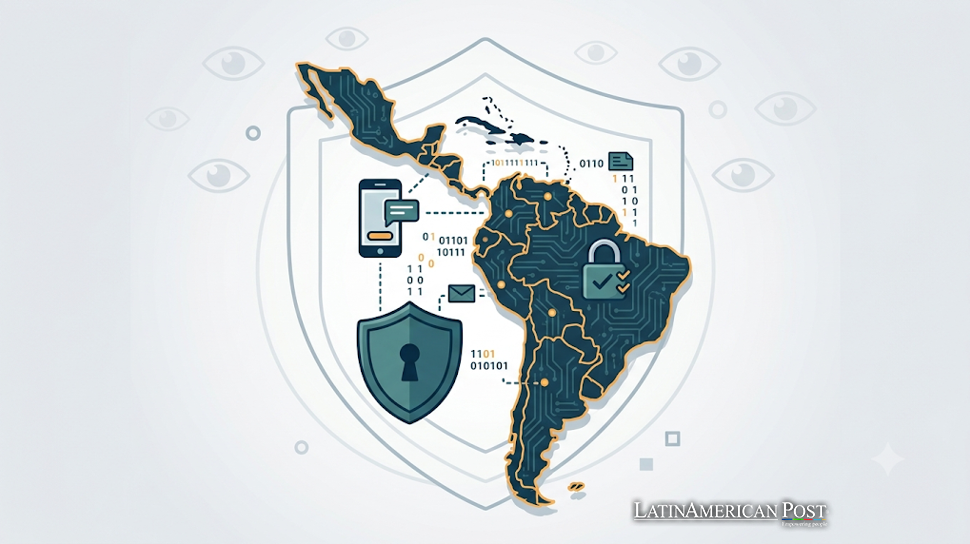
Latin America came online fast. In barely two decades, the region went from patchy, expensive dial-up to a mobile-first internet woven into daily life, where people bank, work, organize, and socialize through a smartphone. That speed brought real gains. It also outran the rules, habits, and institutions that are supposed to keep personal information safe. The result is a widening gap between how much of their lives Latin Americans now conduct online and how little protection most of them actually have. Digital privacy has quietly become one of the region’s more pressing and least discussed problems.
A region that went mobile before it went protected
Much of Latin America skipped the desktop era and jumped straight to smartphones. For millions of people, the phone is the only computer they have ever owned, and cheap data plans and free public Wi-Fi are how they get online. That is a genuine democratizing force. It is also a privacy problem, because a mobile-first population is constantly connecting through networks and apps that collect far more than users realize.
Public Wi-Fi is a good example. In many cities, connecting through an open network at a plaza, a mall, or a transit station is normal and often necessary for people on limited data. Those networks are convenient and rarely secure, which makes them an easy place for personal information to be intercepted. The same pattern repeats across the mobile ecosystem: free apps funded by data collection, social platforms with sharing defaults tilted toward exposure, and a general assumption that if a service is free, using it carries no cost.
Data protection laws that are catching up unevenly
The legal picture is improving, but it is patchy. Brazil’s General Data Protection Law, known as the LGPD, is the region’s most developed framework and draws heavily on the European model. Other countries have data-protection rules of varying strength and enforcement, and some are still debating or updating basic legislation. The effect is a checkerboard: a person’s rights over their own data can change significantly depending on which side of a border they live on, and enforcement often lags well behind whatever the statute promises.
This unevenness matters because data does not respect borders. A citizen in one country routinely uses apps and services governed by rules written somewhere else entirely, or by no meaningful rules at all. For the average person, the practical takeaway is that they cannot assume the law is protecting them by default. In much of the region, it is not, or not yet.
Surveillance and trust
Privacy in Latin America is not only a commercial issue. It is also political. The region has a long and complicated history with state surveillance, and concerns about governments monitoring journalists, activists, and ordinary citizens have not disappeared with democratization. Reports of spyware and monitoring tools turning up in the hands of state actors have surfaced in several countries, which feeds a broader and well-founded wariness about who is watching online activity and why.
That history shapes how privacy is understood here. For many people, protecting their communications is not an abstract preference but a response to a real and remembered risk. It also means digital privacy tools carry a significance in this region that they might not in places with more settled institutional trust.
Cybercrime raises the stakes
On top of all this sits a fast-growing cybercrime problem. As more of the region’s economic life moves online, criminals have followed. Phishing, financial fraud, account takeovers, and data breaches have all climbed, and a population still building its digital literacy is an appealing target. When someone’s entire financial life runs through a phone, a single compromised account can be devastating in a way it would not have been a generation ago.
This is where the abstract question of privacy becomes concrete and urgent. The same exposed connections and oversharing that advertisers exploit are the openings criminals use, and the consequences land hardest on people with the least margin to absorb a loss.
How users are responding
Faced with weak defaults, uneven laws, and real threats, a growing number of Latin Americans are taking privacy into their own hands. Interest in encrypted messaging, private browsing, and virtual private networks has risen across the region, both as a shield against interception and as a way to reach content and services that are otherwise restricted. A VPN encrypts a user’s connection and hides their browsing from their internet provider and from anyone watching the network, which is particularly useful given how much of the region relies on public and shared Wi-Fi.
According to insights from VPNOverview, unsecured public and shared networks are among the easiest points for personal data to be intercepted, which is exactly the environment many people in the region connect through every day. The important caveat is that not all tools are equal. A poorly chosen free VPN of unknown origin can collect the very data it claims to protect, so independent testing and transparency about who runs a service matter more here than in markets where the legal safety net is stronger.
What comes next
Latin America’s privacy challenge is not going to be solved by any single law, tool, or awareness campaign. It is the product of a region that adopted the internet faster than its institutions could adapt, and closing that gap will take time on several fronts at once: stronger and better-enforced data-protection laws, higher digital literacy, more secure defaults from the platforms people actually use, and individuals who understand the basics of protecting themselves.
There is reason for cautious optimism. The same rapid adoption that created the problem also means the region is young, connected, and increasingly aware. Brazil’s LGPD showed that serious data-protection law is possible in the region, and public conversation about surveillance and data rights is louder than it was even a few years ago. The direction of travel is toward more protection, not less. The open question is how much personal information gets exposed in the years it takes to get there, and how many people learn to guard their own privacy in the meantime.
For readers who want to understand the broader legal backdrop, the United Nations Conference on Trade and Development tracks data-protection legislation worldwide, including across Latin America, and is a useful reference for where each country currently stands.