Peru Burns Seized Drugs. Who Still Collects the Protection Money?
Peru destroyed nearly 65 metric tons of drugs in 2026. Cocaine seized in a Lima furniture factory was bound for Mexico. Gangs can also make a living much closer to home, as the country’s cumbia musicians and bus drivers know.
The Furniture Factory in Villa El Salvador
Villa El Salvador is a good place to buy a table. Families who settled this stretch of sand south of Lima in 1971 set aside land for industry as they laid out streets and built their homes. Some families ran carpentry shops out of their homes. Over the years, the district made a name for itself in furniture. On November 10, police entered what appeared to be another business making particleboard furniture. Inside were 608 kilograms of cocaine hydrochloride.
The cocaine was bound for Mexico, Interior Minister César Astudillo said. Police arrested three people, and the ministry said it had dismantled a group called Los Caleteros de Villa. The people who chose that factory as a front were borrowing a reputation local carpenters had spent half a century earning.
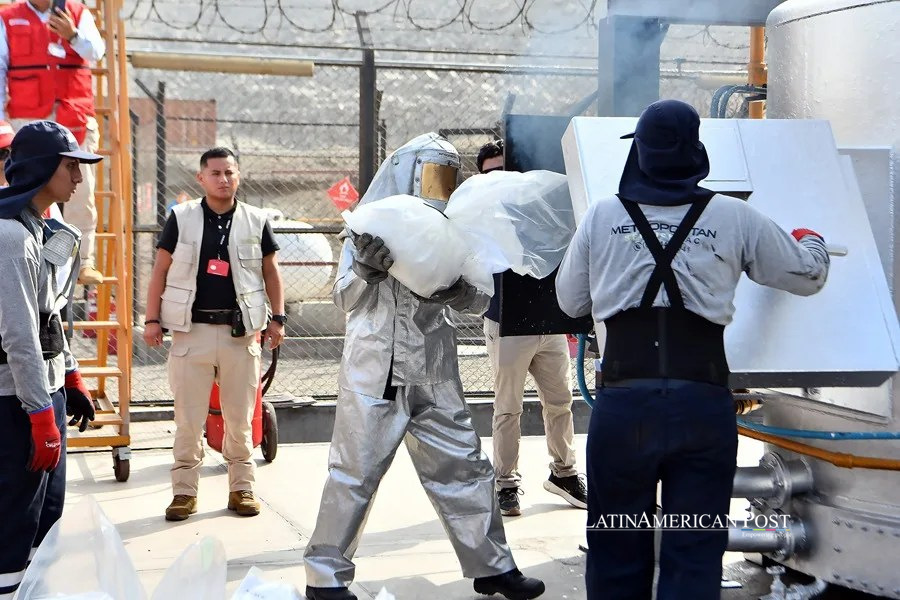
Sixteen days later, at the National Police special operations headquarters in eastern Lima, a ministry photograph showed a worker tossing a bag into a furnace. The final burn of 2026 destroyed some 10.7 metric tons of seized drugs, bringing the total from seven burns to roughly 64.8 tons. “Every ton of drugs we seize and destroy means fewer resources for criminal organizations,” Astudillo said at the ceremony, according to EFE.
A buyer in Mexico will never take delivery of those 608 kilograms. How much income traffickers lost across Peru is harder to calculate. The ministry weighed cocaine alongside marijuana and ketamine, each with a different price. The first six burns accounted for 54.1 tons. The November fire added roughly a sixth of the annual total in a single day. That tells Peruvians when police destroyed the drugs. How much cocaine moved through the country that month remains an open question.
Most of the seized cocaine came from operations in Apurímac, Ayacucho and Junín. The valley of the Apurímac, Ene and Mantaro rivers, known as the VRAEM, accounts for nearly half the cocaine made in Peru, the world’s second-largest producer, according to EFE. Marijuana seizures ranged from Puno on the Bolivian border to Tumbes on the Ecuadorian border. The Mexico connection gives investigators in two countries a shipment whose financing they can trace. The border seizures alone say little about who stood to collect the proceeds.
A Cumbia Band’s Second Show
Astudillo acknowledged that criminal groups also make money from illegal mining and human trafficking. In Trujillo, the northern city long troubled by extortion, gangs associated with illegal mining were already squeezing local businesses by 2025, EFE reported. A merchant paying for the privilege of opening tomorrow provides income even when a drug deal falls through.
In Lima, Paul Flores was on his way to his second show of the night when gunmen fired on the bus carrying his cumbia band, Armonía 10, in March 2025. His bandmates took him to the hospital in that same bus. He died there. Prosecutors sought testimony about possible extortion. Later that year, members of Armonía 10 took the stage in bulletproof vests.
After Flores died, the government of then-President Dina Boluarte declared a state of emergency in Lima and neighboring Callao. Peru’s death registry had recorded 368 homicides in January and February of 2025, up from 111 in the same months of 2018. Political scientist Eduardo Dargent told EFE that comparisons with more violent countries missed what Peruvians themselves were experiencing. In seven years, the country had gone from roughly two killings a day to six over those same weeks.
Security researcher César Bazán told EFE in 2025 that shopkeepers and transport workers had faced extortion for years. What had changed was the violence used to collect, including the hiring of killers. He described smaller outfits working across several rackets and questioned how much another emergency decree could accomplish while some officers remained complicit with gangs. Bazán had a word for those declarations. He called them “fireworks.” For a shopkeeper deciding whether to report a threat, it matters who takes the complaint.
Police recorded 26,585 extortion complaints nationwide in 2025, up from 4,670 in 2021. Even that nearly sixfold increase leaves much of what families experience out of the count. A United Nations Development Program report published in 2026 put the share of victims who report extortion at about one in five.
The Price of Keeping the Buses Running
On the day Peru held its final drug burn, bus operators in Guatemala suspended service between Antigua and the capital. Two transport associations said a criminal group had demanded 250,000 quetzales up front and another 15,000 every week. Drivers, their assistants and even passengers had been threatened. The shutdown was indefinite.
That weekly charge explains part of extortion’s appeal across Latin America. A shipment of cocaine earns money when somebody sells it. A bus route can generate income for a gang for years while other people buy the vehicles, pay for fuel and turn up to drive. When the buses stop, a passenger who never received a threat can still lose a day’s pay. The Guatemalan operators said they would resume service when authorities could guarantee people’s safety.
In Lima, concert bookings changed, too. After Flores died, a music industry worker told El País that his colleagues had added a question to their conversations with concert promoters. They still had to settle what the band would need onstage. They also wanted to know whether the promoter had paid the protection money. If a promoter skipped a payment, the musicians had to walk out under the lights.