As Brazil Loses Its Living Coral, the Cost Comes Ashore
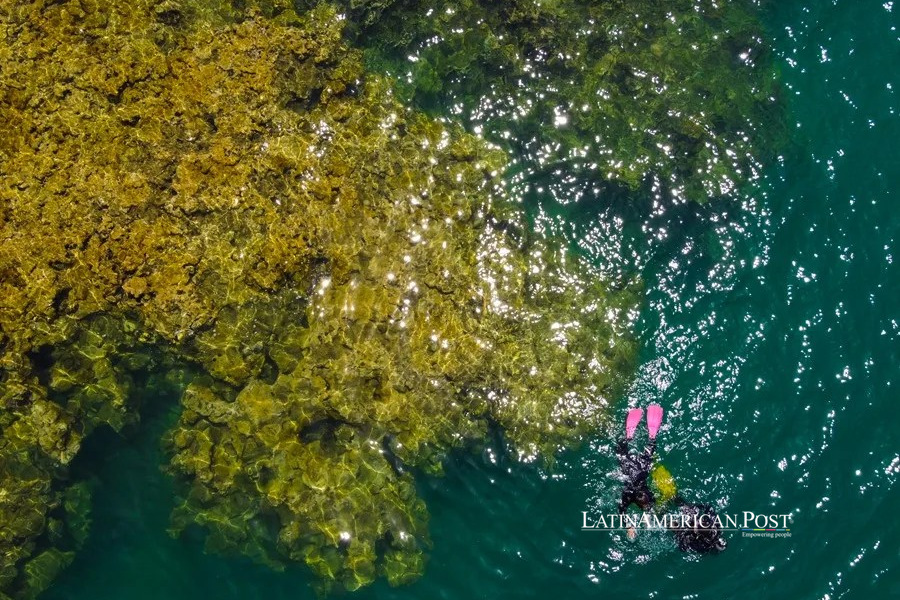
Brazil lost a third of its live coral cover in eight years. Along the coast of Pernambuco, the consequences reach people who take visitors out on rafts, fish for a living, or depend on a reef to break the waves.
Twenty Minutes on the Reef
Armando Júnior was 14 when he started working on a jangada, the traditional raft that carries visitors to the natural pools of Porto de Galinhas. He used to drop off eight or ten passengers on the reef and agree on a time to pick them up. By 2023, he told Agência Brasil that he stayed with them for the whole trip. They got 20 minutes on the reef, enough for a photograph, before climbing aboard again.
The rules changed because so many people wanted to see the place that their feet were wearing it down. Buoys marked the areas where visitors could stand. The boatmen could keep everybody inside those lines and still come back the next morning to find the coral in trouble. The greatest threat to the reefs off this stretch of northeastern Brazil now comes from the Atlantic’s temperature.
In Tamandaré, farther down the Pernambuco coast, Brazil’s Environment Ministry and researchers presented two international assessments on November 25. The Global Coral Reef Monitoring Network estimated that living hard coral covered 26.6 percent of the monitored reef surface in 2016. By 2024, that figure had fallen to 17.6 percent. For every 100 square meters of reef, that works out to nine fewer square meters of living coral on average. Brazil had lost 33.8 percent of the cover it had eight years earlier.
Living coral cover had climbed from 15.9 percent in 2002 to its 2016 peak. It took 14 years to gain 10.7 percentage points and eight years to give back nine of them. Roughly five-sixths of that gain disappeared. The scientists also caution that their record began after earlier bleaching had already damaged Brazilian reefs. What people remember as a good year depends in part on when they first went into the water.
When the Reef Turns White
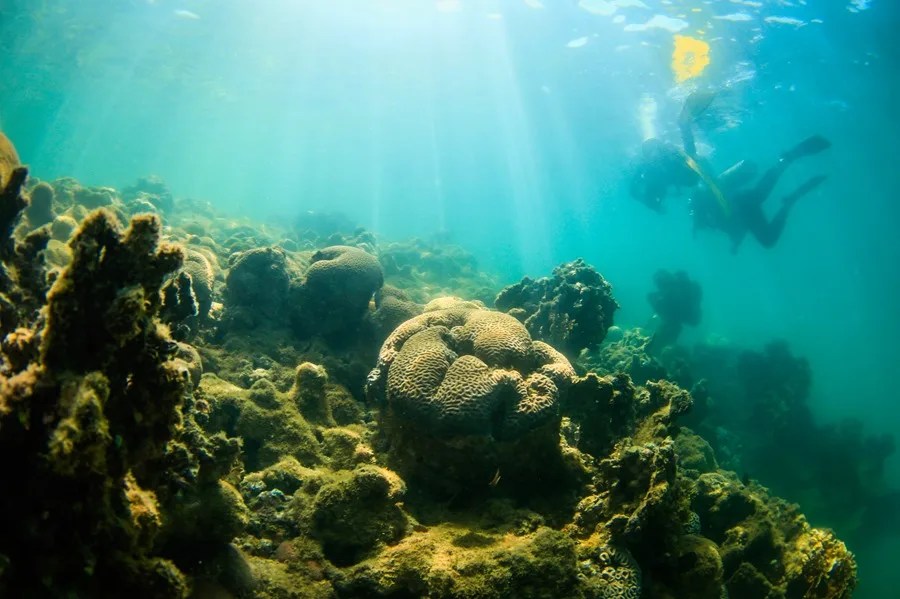
In 2020, jangadeiros in Tamandaré who had learned to recognize bleaching reported pale corals a day before a U.S. satellite system issued its alert, oceanographer Beatrice Padovani Ferreira told Eco Nordeste. Heat can cause corals to lose the microscopic algae that live in their tissues and supply much of their food. The white skeleton shows through. If the water cools soon enough, the colony can recover. Severe heat struck Brazil’s reefs in 2019 and 2020. When it struck again in 2024, many northeastern reefs were still recovering.
The hardest losses came on the northeastern coastal reefs, where hard coral cover fell from 14.3 percent in 2019 to 4.8 percent in 2024. Brazil’s reef formations occur along some 1,900 miles of coast. The Environment Ministry describes them as the only known true coral reefs in the South Atlantic. Farther south, the Abrolhos Bank off Bahia held up better. Its mushroom-shaped pinnacles are built in part by corals found nowhere outside Brazil. Yet Abrolhos is among the five Brazilian reef regions the International Union for Conservation of Nature rated critically endangered. For the remaining three, researchers had too little evidence to judge the risk.
At Abrolhos, the assessments answer different questions. One measures how much of the reef surface supported living coral during the survey years. The risk assessment also considers the heat projected over the next 50 years and whether reefs will still be able to shelter fish and protect the shore. Repeated heat waves could eventually leave too few corals growing fast enough to replace the structure that waves and other organisms wear away.
What Reaches the Beach
People on land benefit from that structure every time a wave breaks over the reef. It takes some of the wave’s force before the water reaches the beach. A dead coral skeleton can do that for a while, too. The danger builds as the reef wears down and the sea rises over it. “We’re going to be more exposed along the coast,” Ferreira, a professor at the Federal University of Pernambuco, told EFE. In 2020, some 3.5 million people in Brazil lived within about three miles of a reef.
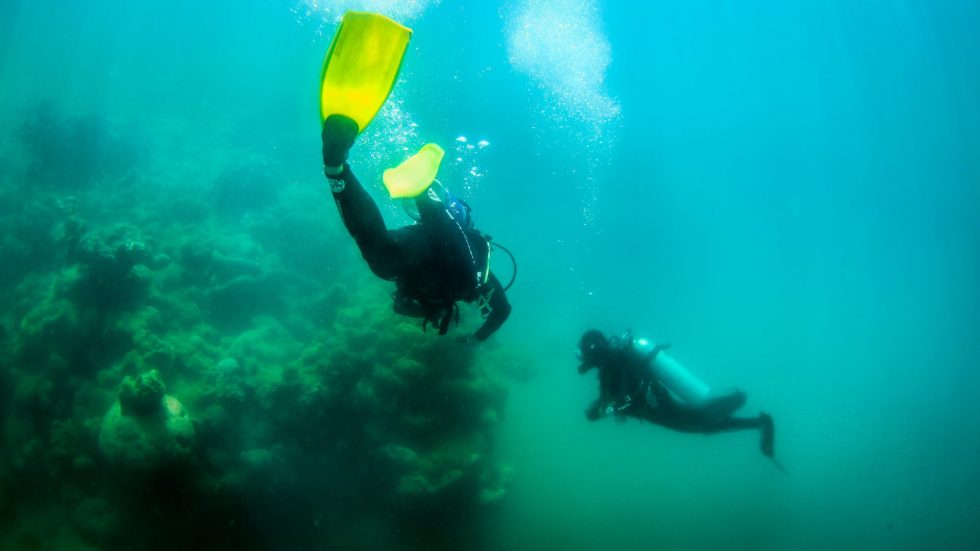
The connection to a family’s catch can be harder to see. Many young fish shelter and feed on reefs before moving into waters where small boats catch them. Off Tamandaré, fishers helped researchers count fish after a reef called Ilha da Barra closed to fishing and tourism in 1999. A year later, divers counted about four times as many fish per square meter inside the reserve as outside it among the species local fishers targeted. They also noticed the fish had grown less wary.
Brazil plans to expand marine protection, restore damaged reefs and keep monitoring them under its national coral strategy. It has already enlarged the Costa dos Corais protected area to include places where reef fish gather to spawn. Better sewage treatment ashore can keep excess nutrients from feeding seaweed that crowds out young corals. Protecting the fish that graze on it helps keep space open for new colonies. How long those colonies have to grow between heat waves depends heavily on global emissions.
In Porto de Galinhas, a boatman’s livelihood can stay in the family. A jangadeiro’s registration, as Agência Brasil reported, could pass to one of the boatman’s children. The rules barred renting or selling it. Júnior learned the work as a boy. A parent can pass on the raft, the right to take passengers, and the knowledge of where to go at low tide. What the child will find there is another matter.