Peru Hears Old Ghosts Rattle as Markets Chase Election Nerves
Peru’s tightening presidential race has revived a familiar national argument over growth, exclusion, and elite fear, as Roberto Sanchez gains ground and investors recoil, exposing how deeply the country still struggles to reconcile macroeconomic stability with demands from voters long kept at the margins.
When Markets Smell a Political Earthquake
Peru’s markets are not just reacting to a candidate. They are reacting to a memory.
As left-wing congressman Roberto Sanchez gains ground in a tight presidential race, investor nerves are fraying around the prospect that the country could once again hand real momentum to an anti-establishment figure promising to reorder the terms of national life. Reuters reports that Sanchez, a former cabinet minister under ousted ex-President Pedro Castillo, could face conservative frontrunner Keiko Fujimori in the June 7 runoff once the official count is complete. With nearly 92% of ballots counted as of Wednesday evening, Sanchez had around 12% of the vote, behind Fujimori’s 17%, in an election already marked by delays and competing claims of irregularities. External observers, however, acknowledged problems with the ballot while citing no evidence of fraud.
That last detail matters because it places Peru once again in one of its most recognizable political moods, a state of democratic suspense where formal legitimacy remains standing, but trust is thin, nerves are raw, and every late-counted rural vote begins to feel like an ideological event. Sanchez’s rise has become the focal point not simply because of who he is, but because of what he evokes. In Peru, markets do not respond only to platforms. They respond to political ghosts, unfinished crises, and the lingering trauma of a state that has never fully settled its relationship with popular rage from outside Lima’s traditional centers of power.
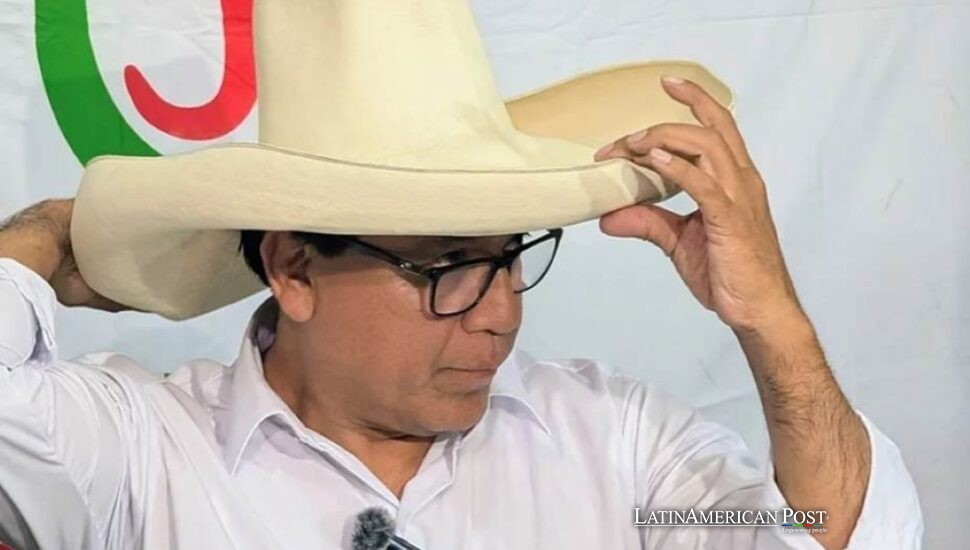
Sanchez knows this, and he leans into it. In his Reuters interview before Sunday’s vote, he called for a “new beginning” after decades of exclusion under the current economic model. He said Peru needs “a new social contract, a plurinational state that recognizes the true face of Peru,” speaking from the office of the Together for Peru party in Lima, where he displayed a wide-brimmed straw hat he said belonged to Castillo, still one of the most potent symbols of Peru’s rural political rebellion. The symbolism is not subtle. It suggests continuity with an electorate that felt spoken for, however imperfectly, by Castillo’s rise and furious removal.
This is why the race is shaking investors. Sanchez is not merely another left candidate offering a slightly different spending plan. He is presenting himself as the voice of a Peru that believes it has been seen, used, and discarded by the existing model.

The Country Behind the Numbers
What Sanchez is saying resonates because it names an old wound rather than inventing a new one. He argues that Peru’s economic model has excluded remote and Indigenous groups, and his language is built around recognition as much as redistribution. “The rural vote, the Andean vote, the Quechua, Aymara, and Amazonian vote was never respected,” he told Reuters. He also offered one of the sharpest lines in the campaign’s economic debate: “We sell stones. Thirty years of mining, and the mining towns are still the poorest in our country.”
That complaint goes to the heart of Peru’s contradiction. The country has long been praised for macroeconomic discipline and resource wealth. Yet, the social legitimacy of that model has always been fragile because too many Peruvians experience extraction without transformation. Wealth flows upward, outward, or elsewhere. The towns that live alongside the riches often remain poor enough to treat promises of growth as a language spoken for someone else.
So Sanchez’s platform is not hard to decode. He wants a constituent assembly to replace the constitution adopted in the 1990s under Alberto Fujimori. He backs stronger state control over natural resources. He wants mining and gas contracts reviewed, windfall profits taxed, and a wealth tax imposed. At the same time, he insists, “We are not talking about expropriating anyone’s property. We are demanding justice for a people that remain poor despite living atop enormous wealth.”
That mix is precisely what unsettles the business world. It is radical enough to signal rupture, but measured enough to claim democratic legitimacy. For investors, that can be more unnerving than rhetoric alone, because it suggests a real attempt to shift the balance of who benefits from Peru’s commodity economy. Reuters notes that markets reacted swiftly as Sanchez advanced in the ballot count. The sol slid 1.46% against the dollar to its weakest level since late September, while the benchmark Lima stock index fell nearly 5%. Cesar Huiman, analyst at Renta4 SAB, said investors were forced to “recalibrate their positions,” describing Sanchez as less business-friendly.
Yet that market recoil also tells on Peru’s elite consensus. It reveals how quickly demands for social redress are translated into threats to order, even when the candidate in question is explicitly denying any plan to seize property. The fear is not only about economics. It is about control.

Castillo’s Shadow and Peru’s Limits
Sanchez’s alliance with Castillo deepens all of this. Castillo endorsed him from prison. He remains jailed on rebellion and conspiracy charges after his failed attempt to dissolve Congress in 2022, and during the Reuters interview, Sanchez repeatedly referred to him as “president,” reinforcing the sense that this campaign is a continuation of that political story by other means. Sanchez says he would not hand power back to Castillo if elected. Still, he also says they are closely aligned, in regular contact, and that he would seek Castillo’s release while pursuing justice for those killed during protests after his removal.
For investors and conservatives, that is enough to confirm their worst suspicions. For others, it may read differently. In a country where institutional legitimacy is already fractured, Castillo still symbolizes not just failure or recklessness, but the anger of voters who believed the system only respects democracy when democracy chooses familiar people. Sanchez is trying to inhabit that emotional and political space without fully repeating Castillo’s collapse.
Whether he could actually transform Peru as much as markets fear is another question. Some analysts argue the country’s fragmented political landscape would limit change regardless of who wins. Reuters cites Eileen Gavin of Verisk Maplecroft, who said the only certainty in Peru’s chaotic 2026 election is that Fujimori has a place in the June runoff and that Congress and the new Senate will lean strongly conservative, even if fragmented. That conservative weight in the legislature, she argued, suggests economic policy is likely to remain broadly steady once the immediate political shock fades.
That may calm traders. It does not solve Peru’s deeper problem.
The country is once again confronting the distance between economic confidence and democratic belonging. Markets may prefer continuity. Marginalized voters are demanding recognition, redistribution, and a state that finally reflects what Sanchez called the “true face” of Peru. That conflict is not a side story to the election. It is the election. And until Peru finds a way to make growth feel less like an extraction machine and more like a national compact, every race like this will keep sounding the same alarm. The markets will panic. The countryside will insist on being counted. And the republic will keep discovering that the old ghosts were never really gone.
Also Read: Cuba Rides a Tunnel Bus Through Its Deepening Energy Squeeze