Latin American Football Gets Younger, but Its Old Problems Refuse to Retire
Latin American football’s generational makeover has arrived with teenage goals, late collapses and familiar frustrations. Across eight national teams, four draws and four defeats suggest that finding fresh talent is easier than building the structures that let it actually flourish.
New Faces, Old Isolation
Mexico needed a way back into the match. Gilberto Mora supplied it. At 17, he scored the 62nd-minute equalizer against Colombia in Baltimore, rescuing a 1-1 draw for Rafael Márquez on his coaching debut with the national team. According to EFE, Mexico had started disconnected, conceding to Luis Javier Suárez after nine minutes. The teenager’s promise was unmistakable. So was the burden placed upon it.
Colombia, meanwhile, was testing life without James Rodríguez and Juan Fernando Quintero. Jhon Arias assumed the creative responsibility, while Yáser Asprilla offered another glimpse of the next generation. Yet identifying successors did not solve the collective problem. Colombia became too vertical, struggled to combine and lost its bearings as Mexico gained control.
The match produced 31 fouls, with an especially fractious finish. That matters beyond the bruises. A rebuilding team needs sequences of possession in which new partnerships can develop; repeated interruptions provide a poor laboratory. Neither the teenage scorer nor the emerging playmakers could make cohesion appear on demand.
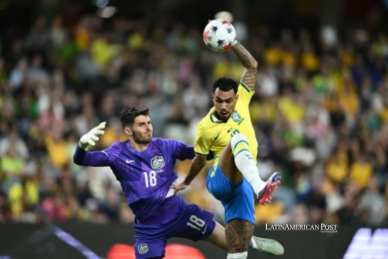
Brazil’s relief arrived even later in Townsville. Rayan Rocha, 20, headed an equalizer from a corner against Australia in the 95th minute. Carlo Ancelotti’s renewed side had kept pushing, but persistence and construction are different things. The appearances of 19-year-old Estevao and 20-year-olds Endrick and Vitor Reis gave that renewal recognizable faces. But selection is only the beginning of integration.
There were 47 deep passes and 24 crosses. Those numbers describe Brazil’s preferred routes forward, not the quality of its chances. With the attacking trio frequently isolated, the issue was not a shortage of promising forwards. It was getting them the ball under conditions that made their talent useful. A last-gasp header prevented defeat without resolving that problem.
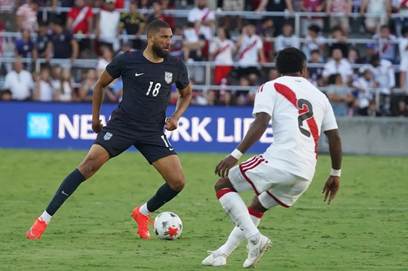
Pie de foto: George Campbell (L) of the United States battles for the ball with Oslimg Mora of Peru. EFE/Kenneth Fernández
When Legs and Discipline Go
The regional ledger needs careful reading. Eight Latin American teams recorded four draws and four defeats. Mexico’s draw with Colombia accounts for two of those drawn results. Across the six matches against opponents from outside Latin America, the region scored four goals and conceded 13. This is a small, uneven sample of friendlies, not a forecast. Still, nobody won.
Chile illustrated how quickly experimentation can become survival. Jonathan David put Canada ahead in the 12th minute. Lucas Cepeda was sent off in the 35th, and captain Gabriel Suazo followed after a second booking in the 50th. Chile therefore spent 40 regulation minutes with nine players, after already playing 15 with ten.
Goalkeeper Lawrence Vigouroux kept the defeat at 1-0. Canada’s high press had disrupted Chile, but its inability to finish off nine opponents left room for a late scare. For Chile, the narrow margin offered little reassurance about its rebuilding: so much time shorthanded made sustained attacking development almost impossible.
Peru’s 4-1 defeat against the United States exposed a different limit. After conceding in the fourth minute, Peru equalized ten minutes later through Gianluca Lapadula, who headed home Yoshimar Yotún’s delivery. The familiar attacking connection still worked.
It could not compensate for what followed. Coach Mano Menezes acknowledged the Americans’ advantages in strength and speed. Peru’s second-half exhaustion turned individual duels against it. The lesson was not that technique had become irrelevant. Technique needs teammates close enough, and fresh enough, to turn a good touch into the next action.
Even the winners supplied a caution. EFE noted uncertainty in American goalkeeper Patrick Schulte’s decisions and communication with his center backs. A three-goal victory did not erase those weaknesses, just as Chile’s one-goal defeat could not conceal the scale of its disciplinary and attacking problems.
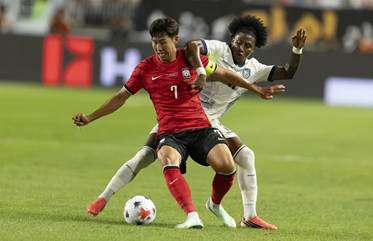
Pie de foto: Son Heung-min (L) of South Korea in action against Angelo Preciado (R) of Ecuador. EFE/Jeon Heon-Kyun
The Bench Is Part of the Team
Panama improved during the interval against India. Higher positioning and more aggressive pressure helped produce 58 percent possession, while Omar Valencia’s 68th-minute equalizer began with a recovery in opposition territory. Five players made their debuts in the 1-1 draw.
Yet the possession figure should not be mistaken for control throughout the match. Panama had wasted much of the first half. Thomas Christiansen acknowledged that extensive changes had damaged collective understanding, EFE reported. His adjustment showed that renewal can improve through clearer coordination, not merely another substitution.
Uruguay experienced the opposite against Japan. Maxi Araújo’s equalizer had made it 1-1 before halftime, but successive second-half changes dismantled the structure supporting that score. Goals in the 92nd and 96th minutes transformed a previously competitive game into a 3-1 defeat. Four minutes exposed how fragile continuity had become.
Ecuador also reached halftime level, at 0-0 against South Korea, before losing 3-0. Its 40 percent possession reflected difficulty taking control, while EFE described physical deterioration from around the 50th minute after the long intercontinental journey. Introducing younger players did not restore the team’s energy or protect its defense.
These matches leave room for encouragement, but not shortcuts. Mora’s goal belongs to a teenager with a future; Brazil’s equalizer showed youthful persistence. Neither should excuse overlooking the work around them. Renewal means building a team that still functions after substitutions, after fatigue, and after conceding. Otherwise, the faces change, and the same lonely forwards wait for the ball.