Colombia’s ELN and FARC Dissidents Fight Over Power, Leaving Civilians Under Siege
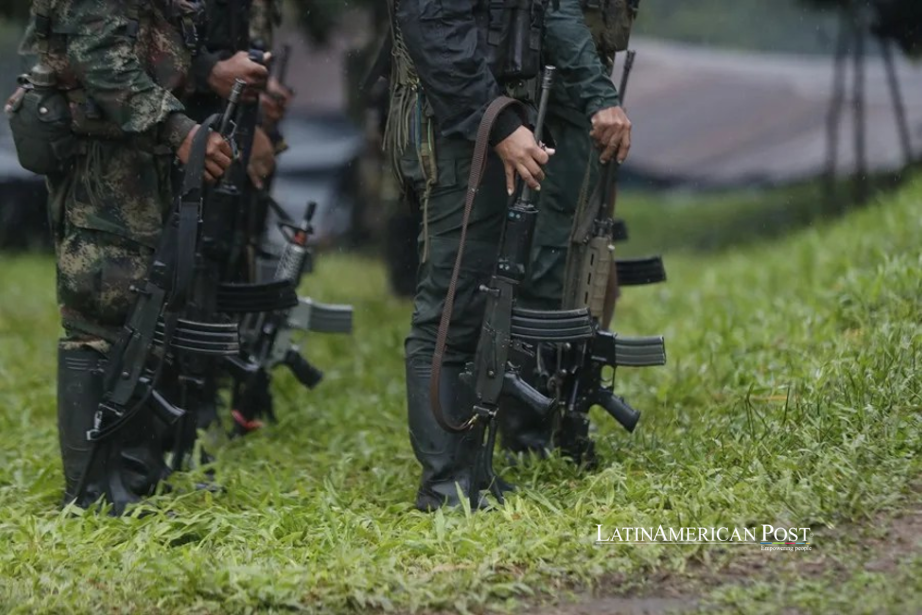
Across Arauca and Catatumbo, the ELN and FARC dissidents fight over territory, livelihoods and the right to rule. Their revolutionary roots offer civilians little protection as cocaine, oil, Venezuela and old paramilitary scars shape wars that keep driving families out.
One Hour to Leave
Antonio had spent 20 years on his plot. Then the ELN gave him an hour to leave.
In testimony collected by Colombia’s Ombudsman’s Office, which used a pseudonym to protect him, he described being accused of collaborating with the former FARC. His dog, Capitán, followed for a kilometer before he could get it onto his motorcycle. Guerrillas occupied the house, he said, and threatened to kill him if he returned.
The accusation was enough to make a farmer a target. His land, his home, and the time invested in both counted for less than an armed group’s judgment about whom he supposedly supported.
Across Colombia’s frontier with Venezuela, such judgments have become instruments of war. In Arauca, a department of eastern plains and foothills, the National Liberation Army, or ELN, fights dissident formations descended from the Revolutionary Armed Forces of Colombia, or FARC. Farther north, in the Catatumbo subregion of Norte de Santander, its principal dissident opponent is Front 33.
Both insurgent traditions grew from Marxist promises to challenge exploitation. Their common ancestry has never settled who gets to command. Today, their disputes reach into houses, schools and farms, where refusing either side can be dangerous.
For civilians, neutrality offers no dependable shelter.
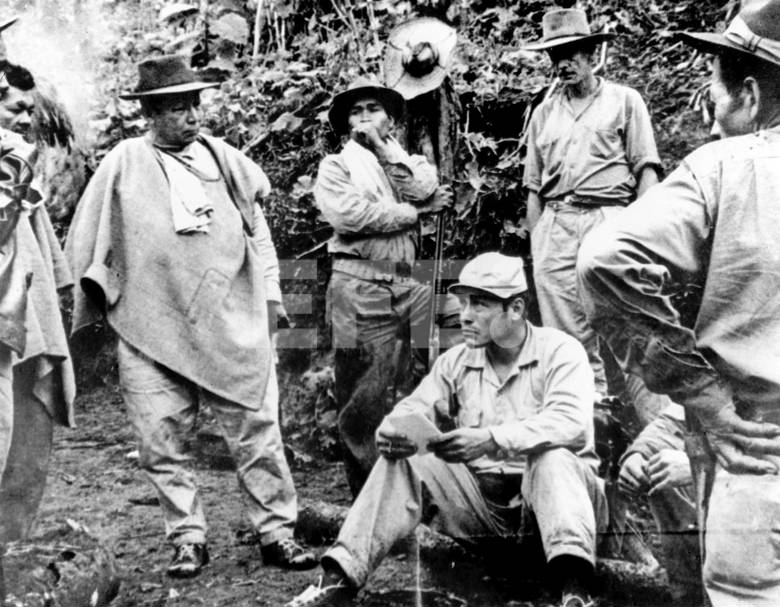
The Revolution Split Long Ago
Colombia’s guerrillas emerged from a country already scarred by Liberal-Conservative bloodshed, concentrated landownership and rural exclusion. Beginning in 1958, the National Front reserved the presidency and divided public power between the two traditional parties. It reduced their confrontation while restricting political alternatives.
The FARC grew out of communist peasant self-defense networks. The army’s 1964 assault on Marquetalia became its foundational episode; the FARC name followed in 1966. Manuel Marulanda and Jacobo Arenas joined military organization to an agrarian political project.
The ELN formed in 1964 under the influence of the Cuban Revolution. Founders, including Fabio Vásquez Castaño, embraced armed insurrection. Catholic priest and sociologist Camilo Torres, killed in his first combat in 1966, helped give the organization a revolutionary-Christian inheritance alongside Marxism.
These were separate movements with different leadership traditions. The FARC built a comparatively centralized hierarchy. The ELN’s regional war fronts retained greater autonomy and developed their own relationships with local economies and communities.
The 2016 peace agreement fractured the FARC’s armed legacy further. Most fighters disarmed. Others rejected the agreement, returned to arms or joined later, creating organizations whose political commitments and command structures cannot be assumed identical.
The distinction matters on the ground. The Ombudsman identifies Arauca’s dissident Fronts 10, 28 and 45 with Iván Mordisco’s coalition. Catatumbo’s Front 33 belongs to the separate coalition led by Calarcá Córdoba. They face different ELN regional structures.
A peace deal with one commander therefore cannot automatically bind everyone wearing similar insignia.
Arauca’s Truce Had a Price
Arauca had already lived through an ELN-FARC war between 2006 and 2010. Human Rights Watch, citing Colombia’s victims agency, recorded at least 868 civilians killed by armed groups during those years and more than 58,000 displaced.
A truce followed in 2010. The organizations could coexist when each accepted the other’s position. Residents still lived under armed rules.
Fighting resumed on January 1, 2022, across Arauca and neighboring Apure, Venezuela. Eighteen days later, a car bomb exploded near a Saravena building housing community and human rights organizations, where threatened leaders had sought shelter. Dissident Front 28 claimed responsibility, alleging that the building was an ELN command center.
For organizations representing farmers and defending local rights, the accusation turned public participation into a potentially lethal liability.
“As leaders, we are at the mercy of this conflict,” Adelis Contreras, a community leader from rural Saravena, told EFE that February. EFE’s reporting described streets emptying as darkness fell, ahead of a nighttime curfew.
The fighting persisted. Caracol Radio reported four fighters killed and nine wounded in a nearly three-hour clash at La Esmeralda, Puerto Rondón, in February 2025.
Other violence was less visible. The UN human rights office documented 90 conflict-related arbitrary deprivations of liberty in Arauca in 2023, 163 in 2024, and at least 277 through December 10, 2025. The documented count more than tripled. Many detentions served coercive social control, with armed groups claiming to investigate their captives.
A quieter road could still lead to a disappearance.
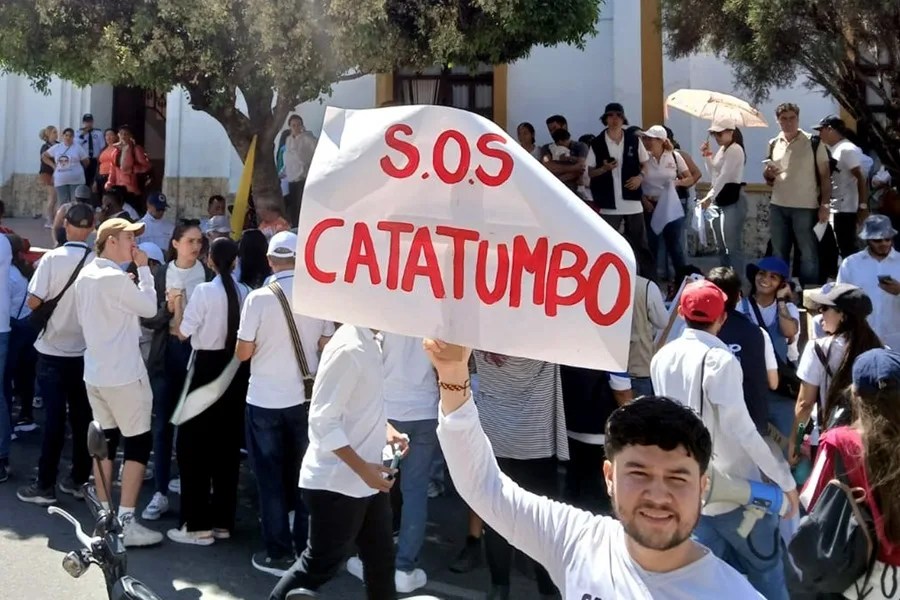
Catatumbo’s War Came Home
In Catatumbo, an arrangement of armed coexistence between the ELN and Front 33 had lasted since 2018. On January 16, 2025, the ELN launched an offensive that reached across five municipalities.
Human Rights Watch documented largely simultaneous killings in Teorama, Convención, Hacarí, Tibú and El Tarra. Fighters searched homes and workplaces for suspected Front 33 associates. Community leaders and former FARC members who had demobilized were among those targeted.
Laying down a weapon had not guaranteed safety.
The offensive attacked the rival’s supposed civilian relationships as well as its fighters. Calling someone a collaborator could sever a family from its home, empty a village or silence an organization without winning a conventional battle.
Front 33 also recruited children and imposed forced labor as punishment, according to Human Rights Watch. Civilians faced abuses from both sides, although responsibility for particular operations must remain distinct.
From January 16 through December 7, 2025, the Ombudsman reported 101,587 registered displacement victims, equivalent to about 27% of Catatumbo’s population. That figure measures the crisis’s cumulative reach, not how many remained displaced afterward. About 500 teachers fled during the initial emergency, leaving 46,032 students without classes.
When teachers leave alongside families, displacement removes part of the infrastructure needed to recover. Missed schooling also weakens one of the protections against recruitment.
The emergency continued into October 2026. On October 21, three drone-delivered explosions struck El Tarra’s Villa Esperanza neighborhood and El Llano village, the Ombudsman reported. That afternoon, more than 50 displaced families arrived in town. The statement did not identify who carried out each strike.
Silvana’s Two Arenas
The conflict’s political machinery is visible in Luz Amanda Pallares Pallares, known as Silvana or Silvana Guerrero.
A senior political figure in the ELN’s Northeastern War Front, she studied education and participated in negotiating delegations in Quito and Havana. Colombia’s police wanted list includes her identity and ELN affiliation; intelligence reporting published by Caracol describes her regional political and organizational responsibilities.
She has represented an organization at the negotiating table while remaining part of a movement that exercises coercive authority in contested territory.
That combination helps explain why peace talks and local offensives can coexist. Holding territory can strengthen an organization’s bargaining position. Political cadres articulate the claims through which an armed group seeks recognition, recruits supporters, and justifies its decisions.
In March 2026, reporting identified Andrey and Richard as Front 33 leaders and Jhon Mechas as commander of the wider Magdalena Medio bloc. Prosecutors charged the three in a case involving 37 killings, 31 child-recruitment cases and the displacement of 87 people. The charges are allegations, not convictions.
Arauca has its own leadership networks. Gustavo Aníbal Giraldo Quinchía, alias Pablito, is associated with the ELN’s powerful eastern base. Longtime Front 28 commander Antonio Medina became a prominent dissident adversary.
These commanders matter because they connect fighters, money, and local influence. Their names alone, however, explain little about why the same roads remain worth killing over.
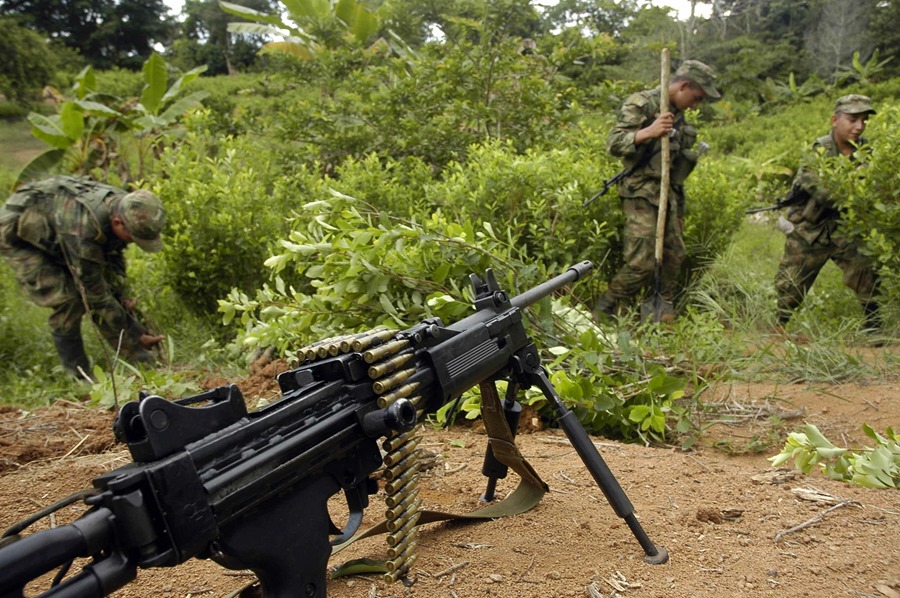
What Makes the Border Worth Fighting For
Catatumbo links coca cultivation and processing to trafficking routes through Venezuela’s Zulia state. Government figures cited in a Constitutional Court ruling put its coca cultivation at approximately 43,179 hectares in 2023. Tibú and Sardinata accounted for 63.3%.
That concentration makes control of particular purchasing areas and transport routes especially valuable. An armed organization can extract revenue without owning every crop: it can determine who buys, who moves goods and who pays to operate.
The hectares measure cultivation. They do not measure guerrilla income or farmers’ political loyalties.
For a grower, leaving coca requires somewhere to sell a replacement crop, affordable transport and confidence that an armed group will not punish the decision. Without those conditions, eradication can destroy an income before another exists.
Arauca’s economic base differs. Oil activity, cattle ranching and commerce create targets for extortion, while its connection to Apure supplies cross-border routes. The Ombudsman identifies Sarare and La Sabana as corridors for trafficking and smuggling, including drugs, weapons, and fuel.
Controlling movement makes legitimate and illicit business vulnerable to the same armed collectors. A cattle trader and a trafficker have different livelihoods, but both need to get goods past someone’s checkpoint.
Here the contradiction with revolutionary promises becomes concrete. Communities that were supposed to gain political freedom instead face compulsory payments and restrictions on their economic choices.
The Other Armies Left Their Mark
Guerrillas did not build this landscape of fear alone.
In 1999, the Bloque Catatumbo of the United Self-Defense Forces of Colombia, known as the AUC, entered the region. Associated with commanders Salvatore Mancuso and Jorge Iván Laverde, known as El Iguano, it helped turn La Gabarra into a notorious site of paramilitary terror. Massacres and displacement reorganized local power.
Colombia’s historical memory institutions document judicial findings concerning support from some state agents. For communities that experienced such complicity, promises of a stronger state raise another question: which officials will protect them, and who will hold those officials accountable?
In Arauca, the Mejía Múnera brothers’ Bloque Vencedores operated from 2001 to 2005. Historical memory research describes an invading counterinsurgent force financed principally by drug trafficking, whose activities accompanied changes in the regional political elite.
These histories help explain why replacing one armed authority with another can deepen distrust.
Today’s formations have different lineages. The Pelusos descend from the EPL guerrilla, while organizations such as the Autodefensas Conquistadoras de la Sierra Nevada have paramilitary roots. A March 2026 Ombudsman warning described possible Front 33–Pelusos alliances and expansion by the Sierra Nevada group around Catatumbo and southern Cesar.
The ideological labels do not reliably predict the next local arrangement. Territory and survival can produce partnerships that yesterday’s enemies would have rejected.
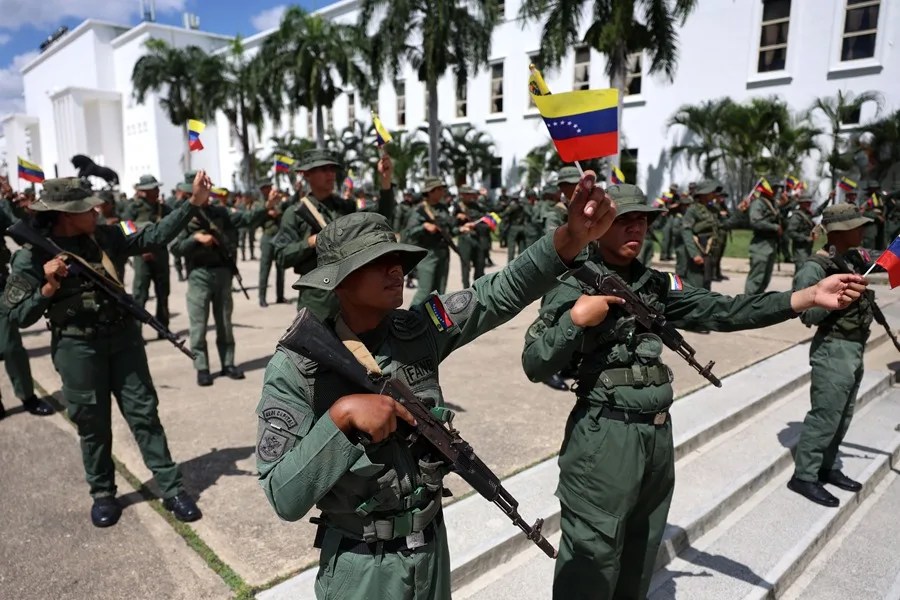
Venezuela Connects the Wars
The frontier separates governments while joining armed networks.
Human Rights Watch documented Venezuelan security-force members conducting joint operations with ELN fighters and participating in abuses in early 2022. Its findings establish selective cooperation but do not prove that Caracas directed every attack.
InSight Crime subsequently reported that ELN reinforcements traveled from Arauca to Catatumbo through Venezuela for the 2025 offensive. The ELN denied moving those fighters. The investigation described the route’s strategic advantage: access between two Colombian conflict zones without crossing the Colombian territory between them.
Under Nicolás Maduro, InSight Crime identified overlapping incentives for cooperation, including ideological affinity, illicit revenues and the usefulness of an experienced armed ally. That was its analysis of a relationship whose benefits extended beyond a shared political vocabulary.
The political setting changed after U.S. forces captured Maduro in January 2026 and Delcy Rodríguez became acting president.
In May, EFE reported that Rodríguez’s government condemned an escalation following a Colombian military strike against the ELN near Tibú. Then-President Gustavo Petro said the strike fell within an understanding with Venezuela; Caracas said the developments had surprised it.
That disagreement revealed how unsettled cooperation remained. Venezuela’s statement did not establish that armed groups had lost access to its territory. Equally, evidence of Maduro-era protection cannot establish every feature of Rodríguez’s policy.
For border residents, the consequential questions concern who can cross with weapons, who can report abuse, and whether an investigation survives the trip from one jurisdiction to the other.
The Distance Between Leaving and Returning
Petro suspended talks with the ELN after the January 2025 offensive. On October 19, 2026, President Abelardo de la Espriella ordered a new offensive against the ELN and dissidents in Arauca, alongside stronger border operations.
The test comes after an announcement. Troops can disrupt a camp without making a witness safe. A ceasefire can reduce shooting while leaving extortion intact. A family can receive emergency aid and still have no way home.
Protection therefore has to outlast the operation: teachers able to return, investigators able to work, legal crops with buyers, and community leaders able to disagree with whoever claims to speak for them.
Antonio’s account leaves a concrete test. Armed men occupied his home and warned that returning to reclaim anything could cost his life.
They gave him an hour to leave. Peace would mean being able to choose whether to go home.