Colombia Seeks Solid Ground as August Earthquake Aftershocks Could Last for Years
Colombia’s August earthquake may keep producing aftershocks for years, scientists warn. But renewed shaking in Chocó and Tolima raises a different question: which tremors belong to the original disaster, and how can families rebuild confidence without promises geology cannot keep?
The Ground Keeps Its Own Calendar
For someone trying to feel safe at home again, “years” is a difficult word. It stretches an emergency beyond damaged walls and interrupted routines into an uncertain future. The shaking may stop. The question of whether it will return can remain in the room.
Freddy Tovar, coordinator of the Colombian Geological Service’s National Seismological Network, told EFE that aftershocks from the magnitude 7.4 earthquake of August 10, 2026, could continue for “days, weeks, months, even years.” He described the subsequent surge as the geological adjustment following a major release of energy.
That is an explanation, not an expiration date. Aftershock frequency generally declines over time, but the sequence is not a staircase on which every new tremor must be smaller than the last. A stronger aftershock can follow weaker ones. Less frequent activity does not mean the possibility of damaging shaking has vanished.
The distinction matters because reassurance built around steadily shrinking magnitudes can collapse with the next noticeable jolt. Families need to understand what a quieter period means without being told that uncertainty has ended.
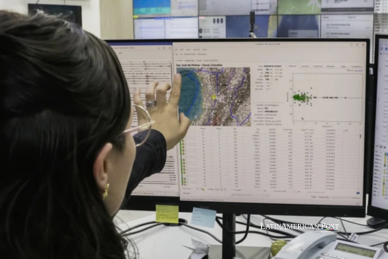
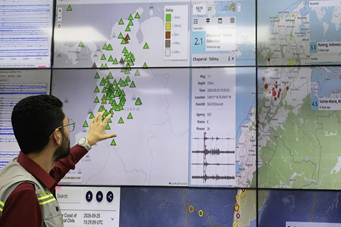
Colombia’s current activity also involves more than one process. Alongside aftershocks, the network has identified a seismic swarm in Chocó and another sequence around Chaparral, in Tolima. The SGC describes activity above its usual average. But without a specified baseline, observation period, and magnitude threshold, that description alone cannot establish how much national seismicity has increased.
Treating every new dot on a map as another installment of August would offer a simple story. It would not necessarily offer the correct one.
Chaparral’s Numbers Need Their Depth
In Chaparral, recorded earthquakes have reached magnitude 4.5 at depths of less than 30 kilometers (roughly 19 miles). Their relatively shallow origins help explain why residents feel them despite their smaller magnitudes. Seismic waves have less distance to travel before reaching nearby communities, although local ground conditions also influence shaking.
The difference between 7.4 and 4.5 is enormous, not merely 2.9 units on an ordinary scale. Using the standard approximate relationship between magnitude and energy, a 7.4 earthquake releases about 22,000 times the energy of a 4.5. That comparison describes energy at the source, not how much a particular kitchen floor will move.
Magnitude measures an earthquake’s size. Intensity describes its effects at a particular place. Distance and depth help determine the shaking that reaches a neighborhood; building condition and construction quality influence how structures withstand it. A smaller number on a bulletin is therefore not a certificate of safety for every house. Damage sustained in August can also change what a building withstands now. USGS
Tovar says scientists are considering whether August’s earthquake changed geological stresses in ways connected to Chaparral’s activity. He explicitly calls that a preliminary hypothesis. One event following another is not enough to prove a connection. Monitoring must establish whether the locations, depths, and evolution support it.
Nor does a cluster of tremors provide a reliable countdown to a larger earthquake. Aftershocks and swarms describe patterns scientists observe; they are not interchangeable labels for whatever happens next. Public communication loses something important when the distinction disappears: an honest account of what investigators know and what remains unresolved.
For residents, the geological label may initially seem less urgent than whether to trust a bedroom wall. Yet the classification matters to understanding the sequence. Explaining uncertainty is not abandoning people to it.
What a Map Cannot Repair
Colombia’s exposure is not new. The interaction of the Nazca, South American, and Caribbean plates, together with numerous faults, makes seismic activity part of the country’s geography. The magnitude 8.8 offshore earthquake of 1906 generated a tsunami; Popayán in 1983 and Armenia in 1999 suffered later destructive earthquakes.
Those dates belong in the present discussion without becoming predictions. Historical records identify places with recurring hazards and help estimate future shaking. They cannot supply the date, location, and magnitude of the next earthquake. No scientifically validated method can reliably provide that combination in advance.
The practical value of monitoring lies elsewhere. Colombia’s seismic records feed hazard maps used in earthquake-resistant design. These translate accumulated observations into expectations that engineers can work with. Their usefulness depends on that knowledge reaching an actual building, rather than remaining a colored zone on a screen.
There is an economic distinction here. Securing a shelf is not the same expense as reinforcing a structure. For a household unable to finance an assessment or repairs, advice to prepare does not answer whether its home is safe. Household precautions cannot substitute for structural protection.
Tovar recommends fastening objects that could fall and establishing family meeting points in case communications fail. These are concrete measures within a larger challenge: making uncertainty manageable without pretending that everyone has the same resources to respond. Colombia cannot negotiate an end to the aftershocks. It can distinguish evidence from rumor and preparation from prediction. For the family listening to another rattle, progress need not mean being promised that the ground will never move again. It should mean having fewer reasons to fear what happens when it does.