Brazil Arrests Drug Trafficker Whose Résumé Includes the Ukraine War
Rio police say a convicted trafficker fought for Ukraine before guarding drug bosses at home. A separate investigation alleges a rival gang paid other men’s airfares, betting that what they learned overseas would be worth the price when they returned.
Flip-Flops in the Barracks
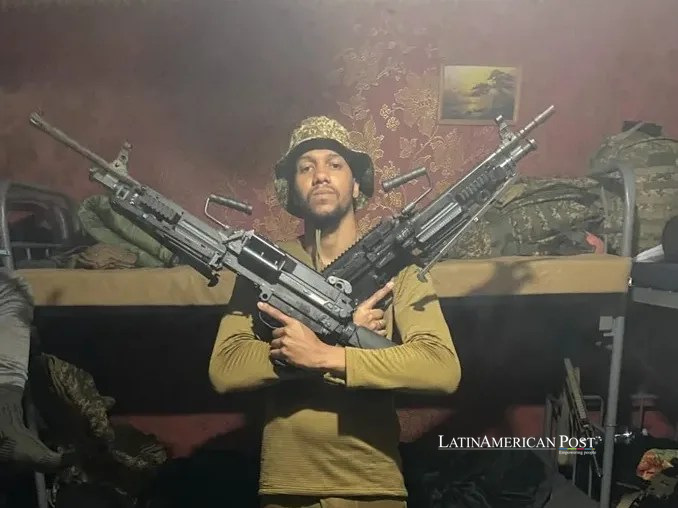
In a photograph released by Rio de Janeiro’s Civil Police, Luiz André dos Santos Souza poses in front of bunk beds, a machine gun in each hand. He is wearing a helmet and flip-flops. Investigators also found footage of him training in a uniform bearing the Ukrainian flag. The warrant police served on the 26-year-old on November 12 came from a courthouse in Japeri, outside Rio.
Souza, known as Predador, had nine and a half years left to serve for drug trafficking and association for trafficking. Police say he spent five months between February and July fighting Russia alongside other foreign volunteers. Detectives began following him after he returned. They say he joined the security detail of Terceiro Comando Puro leaders in Vila do Pinheiro, a favela in Rio’s Maré district. Officers arrested him on Avenida Brasil in the northern neighborhood of Bonsucesso.
Investigators put Souza’s take-home pay in Ukraine at 12,000 reais a month, about $2,100. Five months at that rate would total 60,000 reais. A worker earning Brazil’s federal minimum wage of 1,621 reais a month would need 37 monthly paychecks to match it. The arrest report gives no figure for his alleged work back home. Folha de S.Paulo reported that it could not identify a lawyer representing him.
In February 2025, Brazilian President Luiz Inácio Lula da Silva ruled out sending combat troops and urged peace talks that included Ukraine. Individual Brazilians continued to enlist. The Foreign Ministry warns that a military contract can limit what a consul can do for someone who wants to come home. On October 13, the ministry told Metrópoles it had 108 Brazilians listed as missing in action across both armies. It had no count of how many had enlisted.
Josiane Alves Lima learned that her son was going to Ukraine when he called home from the plane. Hendrick Lima Gonçalves phoned before dawn to ask forgiveness for leaving without telling the family, she told Folha. He had served in Brazil’s army. “He always wanted to go back to the army,” she said. His family in Pará expected him home at the end of November. On October 31, they learned that the 22-year-old had died in Ukraine.
Who Paid the Fare?
In May, while Souza was in Ukraine, Rio police intelligence official Pablo Sartori told CNN Brasil about two other men who had fought there and returned to Rio. Investigators believed Comando Vermelho, a rival of the Terceiro Comando Puro, had paid their airfare and expected them to teach others what they learned. Police said the men stayed in touch with the faction while overseas. In the investigators’ account, the gang already had a job in mind for both men before either left Brazil.
In Souza’s case, detectives date his association with the Terceiro Comando Puro to his return in July. They have yet to say who recruited him or who bought his ticket. The job they describe was protecting the faction’s local bosses. They do not indicate that Souza trained anyone else. A gang can use a returning fighter without having a hand in sending him abroad.
Another photograph shows Souza holding a flag associated with Khartiia, a unit of Ukraine’s National Guard. Khartiia had already appeared in a Russian account of Brazilian casualties. On January 28, a Russian military spokesman told the state news agency TASS that Russian forces had killed five Brazilians from Khartiia near Kupiansk, a railway hub in northeastern Ukraine. He called them mercenaries. EFE reported the Russian claim without independent confirmation. Souza’s reported service began the following month.
What Security Costs in Maré
Vila do Pinheiro took shape in the early 1980s when a government housing project resettled families who had lived in stilt houses along Guanabara Bay. In 2014, ahead of the World Cup, Brazil sent its armed forces into Maré. In choosing personnel for the operation, the army said it gave weight to service in Haiti. General Roberto Escoto, who commanded troops in Maré, had helped coordinate the United Nations peacekeeping force there.
Researchers at Fluminense Federal University and the Fogo Cruzado Institute estimated that in 2024 armed groups controlled or influenced 18 percent of metropolitan Rio’s inhabited urban land, home to 35 percent of its people. The figures cover militias as well as drug factions. Where traffickers compete for densely settled neighborhoods, control of a few streets gives them power over many households. The researchers describe factions imposing rules on legitimate businesses as well as on the drug trade. For a boss whose income depends on being obeyed, a bodyguard counts as a business expense.
Police said nobody fired a shot during Souza’s arrest. From 2016 through 2025, the community organization Redes da Maré counted 163 days when police operations closed public schools in the neighborhood. Some schools stayed open on days others closed. City officials made that decision each morning. Added together, the disruptions amount to more than four-fifths of the 200 days Brazilian schools must offer each year.
Rosana da Silva Paixão de Melo, a domestic worker in the Nova Holanda section of Maré, explained what a school closure cost her family in 2024. Her five-year-old daughter ordinarily ate breakfast and lunch at school. “When she got home, I just had to give her a snack and dinner,” Melo told Folha. With her daughter home all day, she had to provide two more meals. That month, she said, the groceries ran out sooner.