Mexico Traces Ayotzinapa Phones to Funeral Homes and an Iguala Police Station
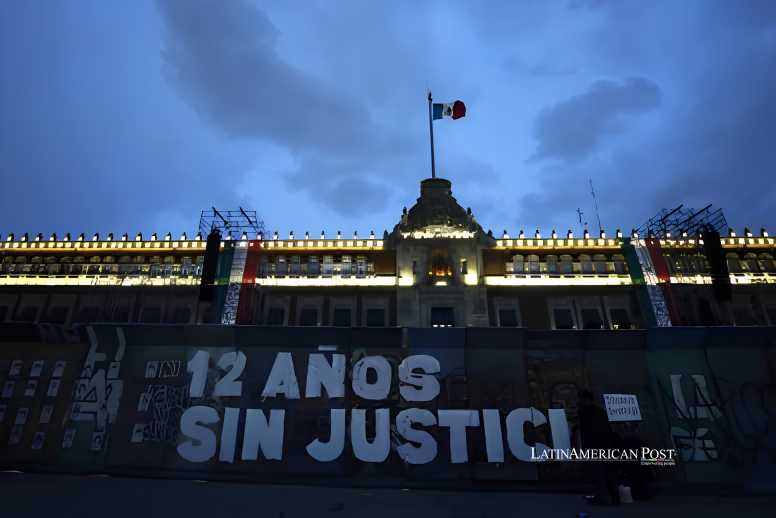
Twelve years after 43 Ayotzinapa students disappeared, reused cellphones are leading Mexican investigators toward funeral homes and a police station. Newly examined records connect people and places, but families still await the proof that turns another lead into an answer.
The Phones Changed Hands
Eight days after the attacks in Iguala, a student’s cellphone was being used by a funeral businessman. That is the sequence Mexican prosecutors now say they have reconstructed, finding a possible trail through an everyday object that survived its owner’s death.
The phone belonged to Julio César Mondragón Fuentes, killed during the September 2014 attacks. He was not one of the 43 students who disappeared. Investigators say a businessman identified as Rodolfo used his device on October 4, a connection that helped direct searches toward funeral facilities.
At Monday’s briefing, prosecutor Mauricio Pazarán described a fresh examination of telephone records from 2014 and 2015. It identified 17 people who had not previously been investigated and reconstructed contacts among Guerreros Unidos members, police, public employees and civilians. “Today we know who communicated with whom, how many times and when,” Pazarán said in remarks reported by EFE. Investigators say Rodolfo’s family also operated Iguala’s forensic medical service, Semefo, and had interests in the municipal cemetery.
That overlap gives the phone trail its significance. The inquiry reaches businesses and institutions handling bodies and burial records, not just people suspected of carrying weapons. Prosecutors are examining whether Guerreros Unidos used that network to make evidence disappear.
The records establish connections that investigators can test against testimony. They do not show that a student accompanied a phone after someone else acquired it. Following a device requires reconstructing each change of hands.
Inside the Paper Trai
At Funeraria El Ángel, investigators reported finding a bone fragment inside a drawer and an unregistered crematorium. They also recovered a firearm and paperwork governing the movement and burial of bodies, including burial authorizations signed and stamped but otherwise blank.
A blank authorization leaves the central facts unwritten even as it carries the appearance of official approval. The discovery raises a concrete question for investigators: whether procedures meant to document a death instead helped conceal what happened to someone.
Further searches at the funeral home and Semefo produced 23 reported findings, encompassing hundreds of bone fragments, dental prostheses, and biological remains. The Argentine Forensic Anthropology Team is participating in the analysis. Authorities said seven people connected to this investigative line are facing proceedings.
Twenty-three findings do not mean 23 victims. Hundreds of fragments do not establish hundreds of bodies. The reporting announces no identification linking this material to the missing students. For families, that distinction separates a potentially important discovery from confirmation of a son’s death.
The original official explanation placed all 43 students at a garbage dump in Cocula, where authorities said their bodies were burned. Independent international experts challenged that account. The funeral-home hypothesis requires its own evidence; the existence of a crematorium cannot settle what happened there in September 2014. The new leads matter because they offer specific places, people and records to investigate, rather than simply another account of the same night.
The second priority is Iguala’s municipal police detention facility, known as Barandilla. Investigators are testing whether approximately 17 students passed through it before being taken elsewhere. That would concern roughly 40% of the disappeared group, not a complete account of all 43. Seven statements support that inquiry: four from municipal officers, two from Guerreros Unidos members, and one from a survivor. Investigators also traced Israel Caballero Sánchez’s phone to subsequent use by the wife of a former public employee.
Authorities say these elements contradict José Ulises Bernabé’s account that only six detainees entered that night, none of them students. Mexico has requested his extradition from the United States. Establishing who entered the station could narrow the next question: who took custody of them afterward.
Millions of Pages, Missing Answers
The broader case now involves 168 people facing proceedings, including 130 in prison, according to the investigative unit. About 77% are therefore incarcerated, but that ratio measures detention, not convictions. Authorities report 30 arrests since October 2024 and criminal proceedings involving 17 military personnel. The military cases keep federal responsibility within the investigation even as the latest leads focus on municipal offices and private businesses. These inquiries add to, rather than replace, existing proceedings.
The files contain approximately five million pages, nearly 90% of them digitized. That translates to about 4.5 million pages converted, with roughly half a million remaining. Digital access can make dispersed records easier to compare; the telephone reanalysis shows why revisiting existing material matters. Investigators also report work at 1,931 search sites since 2019. Neither pages processed nor places searched establishes what percentage of the case is solved. The relevant change is whether separate traces can be connected into an account supported by evidence.
Officials have opened discussions with the UN human rights office about independent experts while rejecting a return by the earlier Interdisciplinary Group of Independent Experts. The Argentine team’s continuing forensic role is separate from that proposed arrangement.
For the families, another anniversary has passed without a complete account of where the students went. A reused phone can identify a person to question. A blank burial form can identify a procedure to investigate. Neither can yet tell a parent where to find a son.