Mexico’s Meth Expertise Takes Root Deep in Nigeria’s Hidden Forests
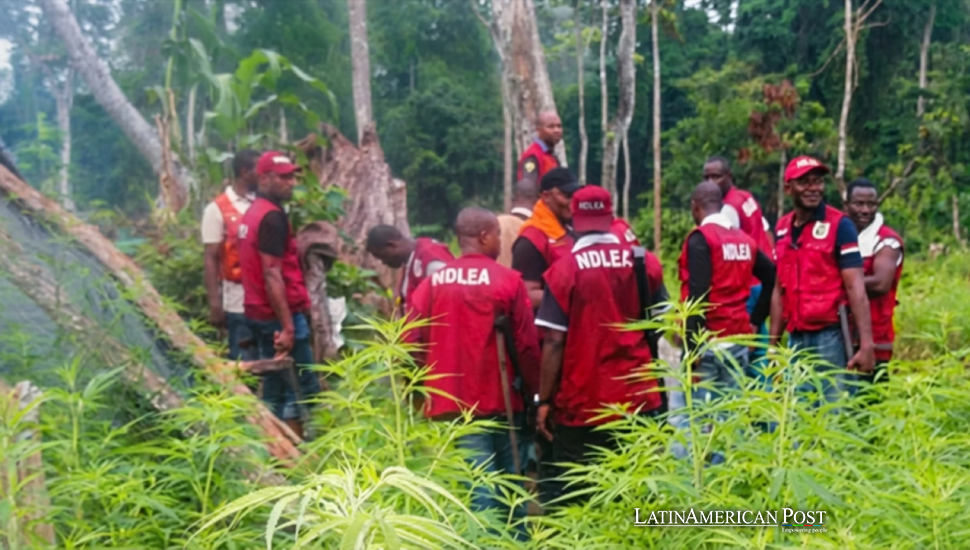
A courtroom moved into a Nigerian forest, where Mexican meth specialists allegedly joined local partners, revealing how cartels are turning West Africa from a transit corridor into a manufacturing base for synthetic drugs bound for nearby communities, Europe, and Asia.
A Courtroom Beneath the Canopy
The judge arrived dressed for federal court. Lawyers observed Nigerian legal ritual. Yet beyond their formal clothes stood unfinished walls, propane cylinders, caustic soda, and open vats breathing a bitter chemical smell into the forest air.
Justice Musa Kakaki had not come merely to hear descriptions of an alleged methamphetamine laboratory. The court had come to see it.
Three Mexican nationals and seven Nigerians, handcuffed and guarded, were brought through the site as Kakaki examined machinery and chemicals prosecutors say supported a vast operation. One drum held liquid methamphetamine as it crystallized. Nearby, crude meth gave off another powerful odor.
The hearing, roughly two hours from Lagos, turned an abstract criminal case into the physical geography of globalization: imported expertise, local labor, loosely monitored chemicals, forest concealment, and access to international shipping.
According to BBC reporting by Simi Jolaoso, Nigeria’s National Drug Law Enforcement Agency said the May raid was the largest meth bust in the country’s history. Agents reported finding more than two tons of drugs, valued at about $360 million, and called it a sophisticated Nigerian-Mexican production syndicate.
The following month, agents found another laboratory in the neighboring state of Oyo. Five suspects were arrested, including a Mexican described as a methamphetamine expert. Two forest laboratories in quick succession suggested more than an isolated crew. They suggested infrastructure.
Mexico’s role here is not the export of national culture, but the movement of criminal technology perfected over decades. Meth does not require an Andean coca field or poppies in a particular climate. It requires chemicals, equipment, knowledge, and somewhere authorities are unlikely to look.
The Chemistry of Globalization
That portability changes the drug map. Cocaine and heroin remain tied to agricultural landscapes and long routes from cultivation to processing. Meth can be manufactured closer to consumers, helping criminal groups shorten supply lines, reduce risk and replace seized laboratories.
James Griego, who leads counter-narcotics operations for U.S. Africa Command, told the BBC and Jolaoso that Mexican producers had refined methamphetamine to exceptional purity and potency. He said 14 Mexican-operated laboratories had been raided in Africa since 2023, including five in 2026. Four were in Nigeria.
U.S. intelligence has linked some African laboratories to the Sinaloa Cartel and the Jalisco New Generation Cartel. West Africa is not new territory for them. Griego said such groups have operated there since the 1990s. What appears to be changing is the depth of investment. Transit is becoming production.
That distinction matters. A trafficking corridor can move poison elsewhere while collecting corruption at home. A manufacturing base needs workers, protection, storage, chemical suppliers, transporters and local buyers. It settles into ordinary economies, especially where unemployment makes dangerous work look like work nonetheless.
Femi Babafemi, an NDLEA spokesperson interviewed by the BBC, and Jolaoso identified Nigeria’s forests, large youth population, and cheap labor as attractions. Those are not criminal defects. They are structural vulnerabilities. Vast territory complicates surveillance. Economic exclusion expands recruitment. Weak oversight of chemical imports gives clandestine industry room.
Africa’s geography adds commercial logic. West African production can reach Europe through Atlantic routes and Asia through maritime networks. The BBC report noted that European meth use rose 47 percent between 2014 and 2024, while seizures in East and Southeast Asia reached a record in 2024. Nigeria is strategically placed.
A Production Hub With a Human Cost
The most revealing phrase may be “corporate production hub,” Babafemi’s description of how pressured cartels view West Africa. It captures their managerial logic. When one route becomes expensive, another opens. When enforcement tightens, production migrates. Borders become variables on a balance sheet.
The intensified U.S. campaign against Latin American cartels since President Donald Trump returned to office in 2025 may be one factor behind diversification. Yet pressure alone does not explain it. Sinaloa and Jalisco New Generation were global beforehand. Africa offers scalable sites, growing markets and proximity to several continents.
Nigeria also risks becoming a customer of the industry it is fighting. A 2018 survey found that 14.4 percent of Nigerian adults had used an illicit drug, more than twice the global average estimated by the United Nations Office on Drugs and Crime. Meth has spread across East and southern Africa, including South Africa, where it is called tik.
That is the human edge. Methamphetamine’s euphoric rush can leave cardiovascular damage, malnutrition, severe depression, exhaustion and punishing cravings. A hidden laboratory can reshape a nearby town, the family whose son takes a night job, the clinic unable to treat dependency and the police unit offered life-changing money.
Nigeria’s decision to bring the courtroom into the forest was symbolic in the best sense. It forced the state to confront the machinery where it stood, not as evidence sealed in bags, but as an industrial system built inside Nigerian territory.
Babafemi told the BBC and Jolaoso that the threat has made authorities more vigilant and proactive. The raids show capacity, and the courtroom visit shows resolve. But dismantling laboratories is only the first layer. The deeper contest is whether criminal globalization can turn economic vulnerability into permanent infrastructure.
In that forest, Mexico and Nigeria were not simply connected by suspects in handcuffs. They were joined by a darker lesson: illicit markets travel fastest where expertise, desperation and geography can be made to cooperate.
This article is adapted from the BBC report, “How Mexican drug cartels have outsourced meth labs to Nigeria,” written by Simi Jolaoso.
Also Read: Venezuela Returns to Dialogue After Ruin, Revolt, and Repeated Betrayals