Chile Turns Fashion Waste Into a Reckoning for Cheap Clothes
Chile’s used-clothing economy has created jobs, bargains, and regional trade. Still, there is a hidden bill in the Atacama Desert, where unsold garments are burned or dumped as a new recycling push races against law and neglect.
The Price Tag Hidden in the Sand
If you have ever dropped old clothes into a recycling bin in the UK or North America, there is a chance those garments did not begin a noble second life at all. They may have crossed oceans, passed through a free-trade zone in northern Chile, failed to find a buyer, and ended up in the desert.
That possibility gives this story its sting. It is not just about textile waste. It is about the mythology of ethical disposal crashing into the dry earth of the Atacama. As Jane Chambers reports for the BBC, Chile has become one of the world’s biggest importers of used clothing, taking in 123,000 tons every year. Much of that trade moves through Iquique, where the Zona Franca del Iquique, or Zofri, allows businesses to import, store, and sell goods without paying customs duties or VAT. Created in 1975 to stimulate economic and social development in northern Chile, the zone did what such models often do: it failed. It generated commerce, employment, and movement. But it also produced an afterlife no one really wanted to own.
The used clothing arrives from the United States, Canada, Europe, and Asia, compressed into shipping containers and fed into a system that sorts, resells, and redistributes across Chile and the rest of Latin America. At one level, it is easy to see why the business took hold. Felipe González of Zofri tells the BBC that around 50 clothing import firms help the local economy and create work for women in the region. He says the jobs are accessible because they do not require high levels of formal qualification. That matters in northern Chile, where economic opportunity is never an abstract question.
There is also a more intimate social truth in the notes. The worst quality clothes still circulate in the human economy for a while. They end up at La Quebradilla, an open-air market near Alto Hospicio, where rows of tents display piles of second-hand garments on plastic sheets. T-shirts, jeans, and dresses sell for 500 Chilean pesos. Tourists and locals come looking for bargains. This is the visible, almost cheerful face of the trade. Cheap clothes, informal commerce, women working, families buying what they can afford.
But beneath that scene lies the question every waste economy eventually faces: what happens to what cannot still be sold?

A Free Zone With No Exit
That is where the story stops looking like a recycling story and starts looking like a policy failure.
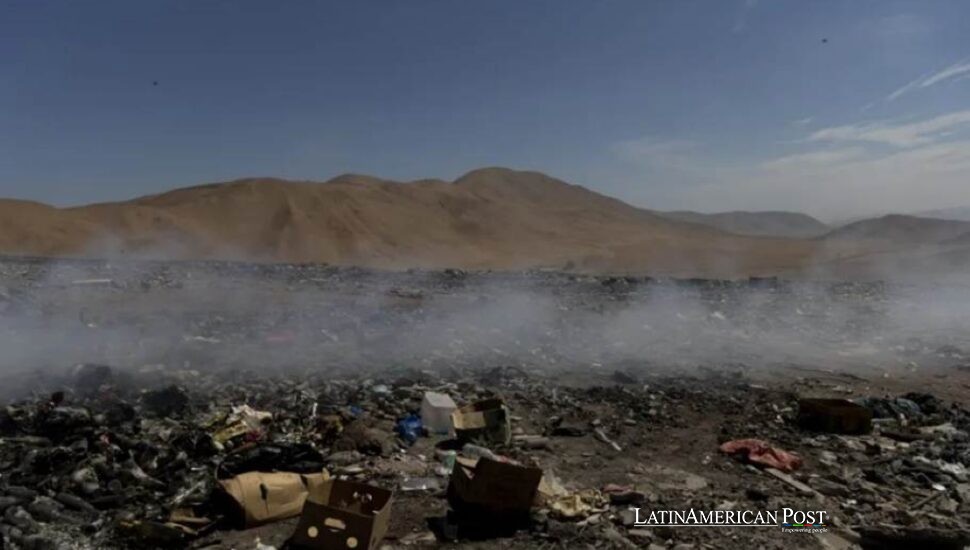
According to the BBC’s reporting, unsold clothing cannot simply be sent to the local council landfill because that site is reserved for household waste, not commercial imports. Traders are supposed to export the clothing, pay tax on its sale outside the free-trade zone, or send it to an authorized waste company. Every one of those paths costs money. So the system generates its own temptation. As Chambers reports, unscrupulous traders either burn the clothes illegally or dump them in the surrounding Atacama Desert. The largest estimates put the figure at 39,000 tonnes illegally dumped every year.
This is the moral contradiction at the center of the Chilean story. A free-trade regime designed to stimulate local development has also made room for a shadow disposal economy whose costs are absorbed by the landscape, the municipality, and the idea of public order itself. The clothes create jobs, yes. They also create a slow-moving environmental insult that local authorities seem structurally unequipped to stop.
Miguel Painenahuel from Alto Hospicio’s planning department describes the geography of the problem with painful simplicity. The town is surrounded by desert and hills, easily accessible by lorry or truck. The council uses patrol cars and cameras to monitor dumping and fine culprits. But he admits there are so many trucks dumping clothes that it is very hard to keep up, and that the town lacks the resources.
That admission says a great deal about the Latin American reality behind the issue. Across the region, local governments are often left to manage the fallout from economic models shaped at larger scales. Trade comes in under one logic. Waste stays behind under another. The municipality becomes the exhausted last line of defense. It gets cameras, patrols, and fines. It does not have enough power or money to control the stream.
The result is almost allegorical. The Atacama, famous in the global imagination for its harsh beauty, becomes a graveyard for the leftovers of global consumption. Not the glamorous leftovers, either. Not luxury. Not the cherished vintage piece. Just the garments that made one journey too many and lost all value on the way.

Can Chile Turn Waste Into Policy
Not all is despair. Ecocitex, founded in 2020, helps keep discarded clothing out of landfills in Chile by reselling garments or turning them into recycled yarn and textile stuffing. The company’s founder, Rosario Hevia, told EFE the goal is to make the most of every item and prevent waste, especially as illegal textile dumps in the Atacama Desert harm the environment.
In Iquique, Luis Martínez of CircularTec says clearly that he does not want the Atacama Desert to become famous as a tourist attraction where visitors come to see mountains of clothes. His organization promotes reuse rather than disposal, and he highlights a factory now being built near Alto Hospicio. The facility belongs to businessman Bekir Conkur, one of the region’s largest textile importers, who has worked in Chile for more than 15 years and brings in around 50 containers of clothes every month. He says he wants a solution to the problem of dumped clothing and believes the factory will help.
Its promise is practical. It will not use water or chemicals. Machines will turn clothing into fibers and then into felt, for use in mattresses, furniture, car interiors, and insulation. Conkur says the factory should be able to process 20 tonnes a day. He has invested $7m and hopes to recoup it by taking in unwanted textile stock from across Chile and eventually from other countries as well.
The recycling process sorts clothes by color, shreds them, and turns the fibers into new yarn. It also has a social impact, employing women who are incarcerated or reentering society to handle color selection. Ecocitex says processing one ton of clothing saves 4.8 tons of carbon, while Kaya Unite estimates it has kept about 880 kilograms of fabric out of landfills and cut around 1.6 tons of carbon emissions through recycled yarn production.
That is encouraging, but it is also revealing. Even the hopeful solution arrives through a blend of environmental necessity, legal pressure, and business opportunity. Conkur openly acknowledges that one reason for the investment is a law change. Last July, textiles were added to Chile’s Extended Producer Responsibility Law, which makes companies responsible for what happens to products at the end of their life. For clothing firms, that means brands, retailers, and importers will eventually have to finance and organize collection, reuse, recycling, or proper disposal rather than leaving the burden to local councils or the Environment Ministry. The government is still drafting the specific details for the sector.
That may be the real significance of this story. Chile is no longer able to pretend that textile waste is someone else’s problem; the old model worked by separating profit from disposal. The clothes were useful when they created trade, jobs, and bargains, then suddenly became invisible when they stopped moving. The new law challenges that invisibility. It says the afterlife of a product is part of the product.
Whether that shift succeeds will depend on enforcement, scale, and political seriousness. One factory, even a meaningful one, will not erase years of dumping. But it does point toward a more adult response to a problem Latin America knows well: imported value can quickly become local damage when regulation comes late, and public institutions are asked to clean up what private actors made profitable.
Chile’s desert of clothes is not just an environmental scandal. It is a warning about the false innocence of second-hand consumption. The old shirt dropped into a donation bin does not disappear. It enters a chain of labor, trade, avoidance, and neglect. Jane Chambers’ reporting for the BBC makes that chain visible. And once seen, it becomes much harder to call this recycling without also naming the sand, the smoke, and the cost.
Also Read: Cuba Sells Cigar Prestige While Shortages Empty Shelves and Workers Endure