From USDT to Gold: How Latin American Savers Are Diversifying in 2026
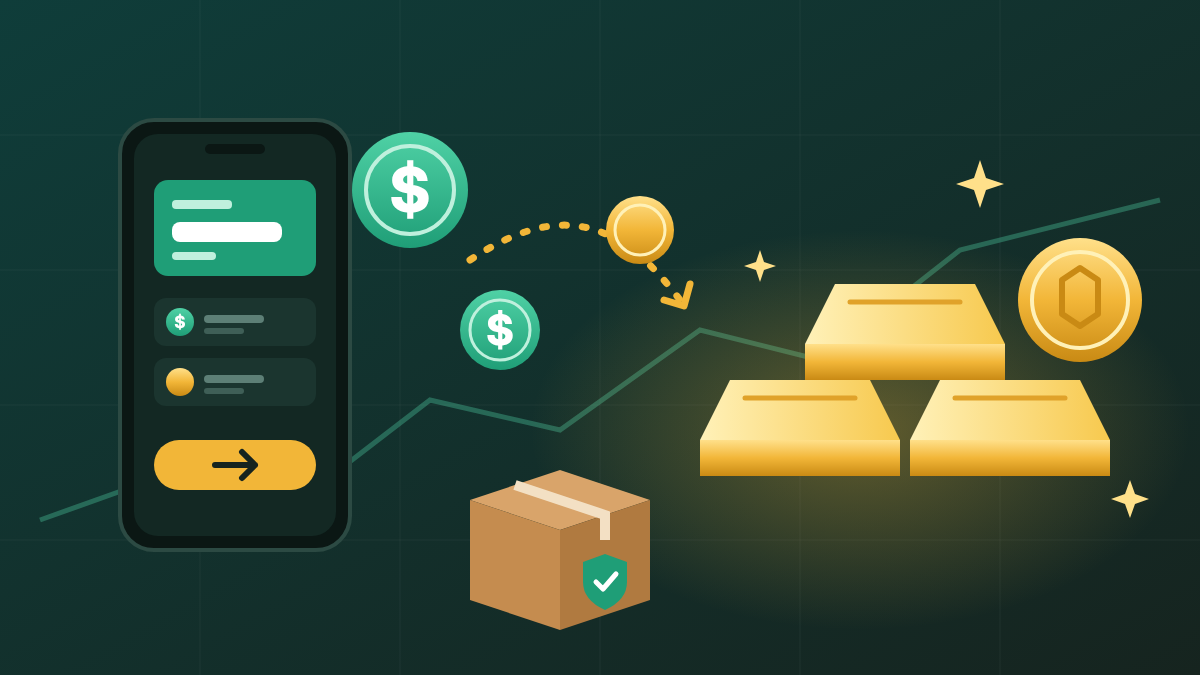
The short answer, as of October 2026: many savers in Argentina, Venezuela, Brazil, and Mexico keep part of their money in USDT, and some move a slice of it into physical gold by paying an online bullion dealer in stablecoins and having coins or small bars shipped, insured, to their door. The token protects them from the local currency; the metal spreads their risk beyond the dollar and any single issuer.
The mechanics are simple. A dealer such as Bitgolder’s gold range prices each coin from the live spot in US dollars, shows a USDT amount at checkout, and holds that total while you pay. The harder questions are premiums, networks, and customs.
Key takeaways
- Chainalysis found that stablecoins made up 17.6% of personal wallet balances in Latin America as of June 2026.
- USDT shields savings from peso or bolivar inflation, but it is still a claim on one company; gold is nobody’s liability.
- Gold tokens such as PAXG and XAUt track the metal on-chain, but turning them into bars needs a verified account.
- Import duties and taxes normally fall on the buyer, so check your country’s customs rules before ordering.
Digital dollars are already a savings habit
The Latin America chapter of the Chainalysis 2026 The Geography of Cryptocurrency report, published on 23 September 2026, puts the region’s crypto economy at $593.8 billion for the 12 months to 30 June 2026, up 9.8%. Brazil led with $252.5 billion, followed by Argentina at $88.5 billion, Mexico at $77.6 billion and Venezuela at $39.1 billion, more than double the year before.
As of June 2026, stablecoins accounted for 32.1% of the region’s cross-border value, 22.1% of domestic peer-to-peer transfers, and 17.6% of personal wallet balances. In Venezuela, merchants interviewed for the report said close to 40% of their income arrives in USDT. Monthly stablecoin value on corridors touching Mexico reached $1.8 billion in June 2026, about four times its early 2024 level. In Argentina, the 2025 edition found that stablecoins made up more than half of exchange purchases with pesos between July 2024 and June 2025.
Why a dollar saver would want gold too
For Argentines, the reason to own dollars is written in the official statistics. INDEC, the National Statistics Institute, reported that consumer prices rose 211.4% in 2023, the highest year-end figure since 1990, and 117.8% in 2024. Inflation has slowed sharply, but INDEC’s September 2026 figure, released on 13 October, still showed prices up 33.4% over twelve months.
USDT answers the peso problem, but a balance held entirely in one stablecoin depends on one issuer, one currency, and usually one exchange or app. Gold sits outside all three. For someone already saving in USDT, it is not a second peso hedge but a way to own something no company has to honor.
It is not a calm asset. Kitco quoted gold at $4,114.50 bid per troy ounce at 3:11 a.m. EDT on 21 October 2026, about 26% below the $5,589.38 record of 28 January 2026. Savers who add gold accept that its dollar value can fall for long stretches.
Physical gold or a gold token
Paxos says each PAX Gold (PAXG) token is backed by one fine troy ounce in LBMA vaults in London, held by Paxos Trust Company, which is regulated by the US Office of the Comptroller of the Currency. The gold is audited monthly, and tokens can be redeemed for Good Delivery bars or dollars.
Tether Gold (XAUt) has a regional link. Its issuer, TG Commodities, S.A. de C.V., moved its domicile from the British Virgin Islands to El Salvador with effect from 27 January 2025 and holds authorization there as a stablecoin issuer and digital assets service provider. Verified customers can redeem XAUt, subject to minimum sizes and fees, with physical delivery inside Switzerland.
For a saver in Rosario or Maracaibo, that is far from home. Tokens are easy to split and swap back into USDT, but they remain claims on a blockchain. A coin in your hand needs safe storage and costs a premium. StoneX Bullion wrote on 1 April 2026 that a reasonable premium on a government-minted gold coin is generally 3 to 10% above spot, with bars cheaper. Money Metals Exchange put a 1 oz bar at 2 to 5% on 15 June 2026. At Kitco’s $4,116.50 ask, a 4% premium works out to roughly $165 an ounce.
Picking the network before you pay
USDT exists on several blockchains, and a dealer’s payment address belongs to just one of them. Tron (TRC-20) and Ethereum (ERC-20) are the most familiar, and they are not interchangeable: tokens sent on the wrong network are usually lost, so copy the network name as carefully as the address.
Support differs by dealer. Bitgolder says it accepts stablecoins directly on Ethereum, Tron, Base, BNB Smart Chain, Polygon and Solana. BTC Gold Shop takes USDT on Tron and Ethereum. Fees change with demand, and your exchange’s withdrawal fee on each chain often matters more than the on-chain cost.
If you are weighing USDT against USDC as well, BTC Gold Shop’s stablecoin guide, dated 17 March 2026, compares how the two issuers hold reserves and what each network costs. One point is worth repeating: do not pay to bridge to a cheaper chain if the saving is smaller than the fee.
Shipping and customs into the region
Bitgolder says it ships insured, tracked, and signed for to more than 50 countries, with rest-of-world delivery in 3 to 7 business days, excluding customs clearance, and the cost is calculated at checkout. BTC Gold Shop offers free insured delivery to more than 150 countries, arriving in 5 to 10 business days internationally, and its terms state that customs duties, VAT, and import taxes are the recipient’s responsibility.
Confirm your country is covered before paying, then read your own rules, whether that means ARCA in Argentina, the Receita Federal in Brazil or ANAM in Mexico. Some countries cap courier imports by value or treat precious metals separately. Keep the invoice for customs. Tax rules on bullion and on spending crypto also vary by country.
How to move part of your USDT savings into gold, step by step
- Decide what share of your savings you want in metal and whether you want coins at home or a token.
- Check your country’s import rules and confirm the dealer ships to your address.
- Read the dealer’s operator details, returns policy, and buyback terms.
- Compare the item price with live spot to see the premium.
- Note the USDT network shown at checkout and withdraw from your exchange on that same network.
- Lock the price and send the exact amount, adding your withdrawal fee so the dealer receives the full invoice.
- Keep the transaction ID (TXID) and invoice for customs and tax records.
- Sign for the parcel, inspect the seals, and keep your first order small.
Frequently asked questions
Can I buy physical gold with USDT from Latin America?
Yes, if the dealer ships to your country. Several online bullion sellers accept USDT and send insured parcels abroad, but check the destination list first.
Why buy gold if USDT already protects me from inflation?
Because they protect against different things. USDT guards against a falling peso or bolivar, while gold reduces dependence on one issuer and on the dollar, at the cost of price swings.
Is Tether Gold (XAUt) the same as owning a gold bar?
Not quite. Each token reflects an interest in one troy ounce of vaulted gold, but redeeming it needs a verified account and minimum sizes, with delivery in Switzerland.
Which USDT network should I use to pay a gold dealer?
Use the exact network checkout names. Between supported options, compare your exchange’s withdrawal fee on each chain.
Who pays customs duties on gold shipped to Latin America?
Usually the buyer. Dealers’ terms commonly make the recipient responsible for duties and import taxes, and rates depend on your country.
The bottom line
For savers who already think in digital dollars, gold is a way to own something outside the stablecoin system without leaving it. Know your import rules, match the network, watch the premium, and start small.