Peru Builds Its Olympic Future Through a Crucial South American Games Test
Peru arrives at Santa Fe 2026 with 492 athletes, established champions and a larger ambition than medals alone. The South American Games will test whether recent breakthroughs can become a durable sports system before Lima 2027 and Los Angeles 2028.
More Than a Medal Count
For Stefano Peschiera, the bronze medal hanging from Paris 2024 carries unusual weight. It was not simply his first Olympic medal. It was Peru’s first Olympic podium appearance in 32 years, ending a drought that had lasted since shooter Juan Giha won silver at Barcelona 1992.
Now Peschiera heads into another important cycle as one of the most recognizable names in Peru’s 492-athlete delegation to the South American Games in Santa Fe, Argentina. The Games run from September 12 through September 27, with Peruvian athletes competing across 37 sports.
For Peru, however, Santa Fe is not really the destination.
It is a measuring point.
The country is looking toward the 2027 Pan American Games in Lima, when the capital will host the continental event for the second time in only eight years. More than 7,000 athletes from 41 countries and territories are expected, and many events will offer pathways toward qualification for the Los Angeles 2028 Olympics.
That makes every performance in Argentina more consequential than the medal table alone suggests.
Peru enters Santa Fe ranked seventh in the historical South American Games standings with 897 medals, including 209 golds, 288 silvers and 400 bronzes. At Asunción 2022, a delegation of 377 athletes collected 74 medals. This time, the team has grown by 115 competitors, an increase of about 30 percent.
Numbers like that create expectations.
A larger delegation does not automatically produce more medals. It can instead reveal whether a country has widened the base of competitive sport or merely expanded participation. Peru’s real benchmark should therefore be Cochabamba 2018, when it won 92 medals, not simply whether it edges past the 74 collected four years ago.
The difference matters because Peru is trying to turn occasional excellence into something more durable.
Veterans Carry the Olympic Memory
Peschiera embodies that tension better than anyone.
His bronze in the men’s dinghy competition in Marseille transformed him from an accomplished sailor into a symbol of what Peruvian athletes can achieve when preparation, international competition and individual persistence finally intersect. Before Paris, Peru had won only four Olympic medals in its history. His became the fifth.
But Santa Fe will not depend on one athlete.
Marathoner Cristhian Pacheco arrives with an extraordinary regional record. He won Pan American marathon gold at Lima 2019 and repeated the feat at Santiago 2023, demonstrating the consistency required to remain competitive across an entire Olympic cycle.
Gladys Tejeda brings another generation of distance-running experience. Their presence matters particularly because Peru will be without two prominent race walkers, Kimberly García and Mary Luz Andía. In a country where athletics has repeatedly delivered international success, those absences place additional pressure on the distance runners.
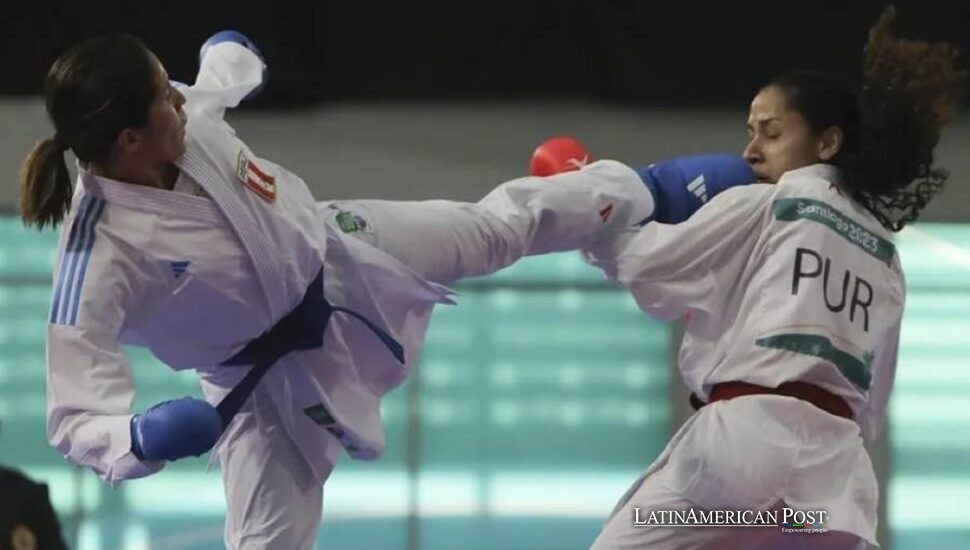
Karateka Alexandra Grande provides another bridge between generations. A World Games champion and two-time Pan American gold medalist, she has competed through multiple cycles of Peruvian sport, collecting medals at Guadalajara 2011, Toronto 2015, Lima 2019 and Santiago 2023.
She will carry the Peruvian flag alongside weightlifter David Bardalez.
Bardalez himself represents the depth Peru needs if it wants Lima 2027 to become more than a successful hosting operation. His résumé includes Pan American bronze from Lima 2019 and medals across South American and Bolivarian competition.
Then there is Nicolás Pacheco.
The skeet shooter finished sixth at Paris 2024, close enough to the Olympic podium to understand precisely how narrow the margins become at that level. Shooting also carries unusual historical significance for Peru. Edwin Vásquez won the country’s only Olympic gold medal in London in 1948. Francisco Boza and Juan Giha later added Olympic silvers.
That tradition makes Pacheco’s progress especially intriguing. Peru does not need to invent an Olympic culture from nothing. It needs to reconnect with disciplines in which it has already demonstrated world-class potential.
Lima 2027 Changes the Equation
Perhaps the most interesting athletes in Santa Fe are those competing in sports whose importance within Peru has expanded dramatically.
Surfing makes its South American Games debut, and Peru will turn to Itzel Delgado, a Pan American medalist at both Lima 2019 and Santiago 2023. Few disciplines connect more naturally with Peru’s geography. The Pacific coastline gives the country not merely facilities but a sporting environment embedded in everyday coastal culture.
Water skiing offers another medal opportunity through Natalia Cuglievan, who won Pan American gold at Toronto 2015 and Lima 2019, and Cristhiana De Osma, a world under-21 champion.
These are not household names throughout Peru. That is precisely why events like Santa Fe matter.
Major multisport competitions create visibility for disciplines that spend most of the four-year Olympic cycle outside football-dominated media attention. Success can influence sponsorship, federation funding, youth participation and even whether families view an unconventional sport as a realistic path rather than an expensive hobby.
Lima 2027 amplifies that opportunity enormously.
Hosting the Pan American Games again so soon after 2019 gives Peru something rare in Latin American sport: continuity of infrastructure. Venues built or modernized for Lima 2019 can be reused rather than abandoned, while athletes can prepare for a major continental competition without leaving their own country.
The political challenge will be resisting the familiar regional temptation to measure success through ceremonies and construction rather than athlete development.
Sports infrastructure matters only if athletes repeatedly use it.
For Peru, that means Santa Fe should be studied almost like a national audit. Which disciplines convert participation into finals? Which athletes are approaching continental podium level? Where does the country remain dependent on one exceptional veteran? Which younger competitors could realistically peak in Lima next year and Los Angeles the year after?
A medal total can answer only the first question people ask.
Whether Peru wins 75 medals, reaches the 92 of Cochabamba or surpasses both will dominate headlines. But the deeper story begins after the podium photographs.
Peschiera proved in Paris that three decades of waiting can end in a single afternoon.
Peru’s harder task is making sure the next Olympic medal does not require another generation to wait.
Also Read: Vozinha Keeps Things Clean as Chilean Leaders Colo Colo Draw a Blank