Guyana Awaits Essequibo Verdict as Latin America Weighs Borders, Oil and Peace

Guyana wants Venezuela to accept an approaching Essequibo judgment, while Caracas demands direct negotiations. The dispute reaches beyond their border, testing Latin America’s reliance on international courts, regional diplomacy and foreign investment as oil transforms the stakes for both neighbors.
Two Speeches, One Homeland
Irfaan Ali spoke of neighbors, not just boundaries. At the United Nations on Thursday, Guyana’s president asked Venezuela to accept the forthcoming International Court of Justice judgment on Essequibo. “We look forward to a new era of neighborly relations,” he said in remarks reported by EFE. A day earlier, Venezuela’s acting president, Delcy Rodríguez, defended her country’s historical rights and argued that bilateral negotiations produce more lasting agreements than outside institutions. The disagreement is therefore not simply over territory. It concerns who has the authority to say the argument is finished.
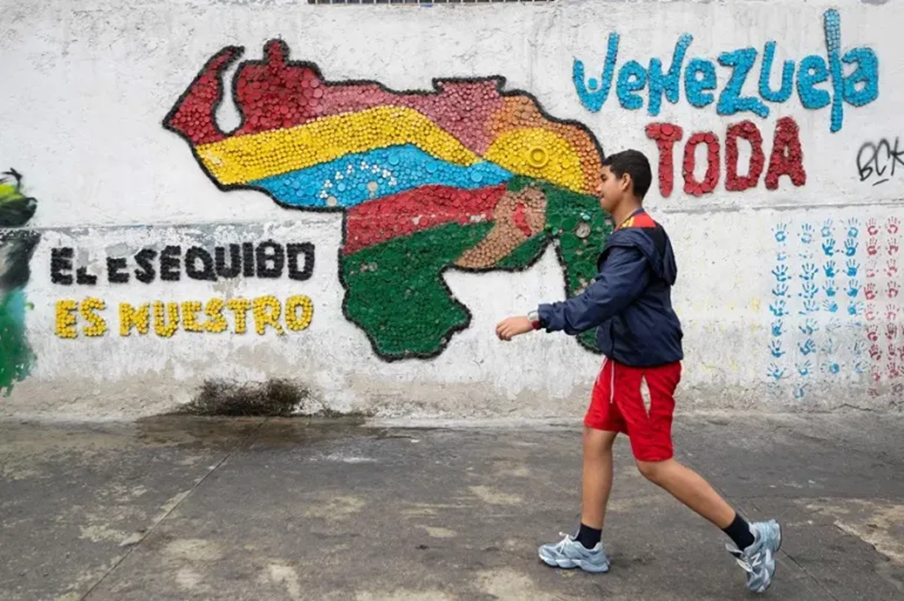
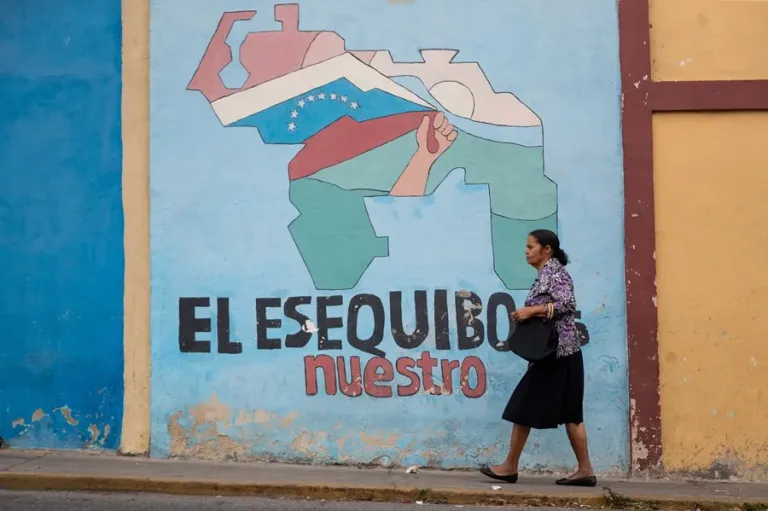
The disputed region covers nearly 160,000 square kilometers, approximately 62,000 square miles. Guyana administers it; Venezuela claims it. For residents, sovereignty reaches beyond the flags politicians display to the institutions that issue documents and provide services. This is inhabited territory, not merely acreage awaiting a decision.
The 1899 Paris arbitration placed the region within British Guiana. Venezuela declared the award invalid in 1962, alleging irregularities. The 1966 Geneva Agreement established a process for resolving that controversy. Guyana brought its case in 2018, seeking confirmation of the award and the resulting land boundary.
Colonial history complicates easy appeals to regional solidarity. Caracas describes the award as dispossession. Guyana, independent since 1966, is defending the territory of a sovereign state, not continued British rule. Latin American governments therefore confront competing national interpretations of an inherited border, rather than a straightforward dispute between a regional country and an overseas empire. Recognizing that history does not, by itself, answer the legal question now before the judges.
The court’s own record adds a distinction: Geneva and judicial settlement are not necessarily alternatives. Under the agreement, the UN secretary-general selected the court as the means of settlement. In 2020, the judges upheld their jurisdiction by twelve votes to four. That preliminary decision did not determine who would prevail on the merits.
Both countries presented arguments in May, with hearings ending May 11. Venezuela nevertheless says it will not recognize the judgment. In June, it challenged Prime Minister Mark Phillips’s prediction of a Guyanese victory. His confidence does not establish the outcome; Caracas’s rejection does not erase the jurisdictional ruling.
Oil Changes the Stakes
Oil makes the dispute more valuable without explaining its origins. ExxonMobil dates its major offshore discoveries to 2015, 53 years after Venezuela’s 1962 challenge. Reducing the controversy to a recent scramble for crude would overlook the territorial claims that preceded the drilling.
The scale of investment gives outside governments reasons to watch. Reuters reported in July that Guyana was producing more than 900,000 barrels daily. In the Stabroek venture, ExxonMobil holds 45%, Chevron 30% and China’s CNOOC 25%. American companies therefore hold three-quarters, with a Chinese company owning the remaining quarter. Those shares complicate a simple Washington-versus-Beijing explanation. Firms from both countries have commercial exposure to Guyana’s stability. The ownership percentages are not Guyana’s share of revenue, however, and commercial investment does not automatically translate into a military guarantee or a government’s diplomatic position.
Nor would the land-boundary judgment automatically resolve every offshore licensing question. Its immediate subject is the validity of the 1899 award and the related land frontier. Ownership of a coast can influence maritime claims, but land adjudication and offshore delimitation are not identical legal tasks.
For Latin America, the economic risk extends beyond an interrupted shipment. Uncertainty can affect decisions about financing, insurance and construction. If money is delayed or redirected toward security, businesses waiting for contracts and communities expecting public investment can feel the consequences without being anywhere near a confrontation.
A Verdict Needs Neighbors
Regional diplomacy already offers an example of dialogue alongside litigation. In its March 2024 communiqué, the Caribbean Community backed Guyana’s sovereignty while welcoming the two countries’ January meeting in Brasília. It treated practical cooperation and the court proceedings as activities that could continue together.
Brazil’s role supplies a regional channel that does not depend on Washington. For South American governments concerned with diplomatic autonomy, that distinction has practical consequences: preventing an incident does not necessarily require resolving sovereignty first or asking either neighbor to abandon its legal position.
For smaller Caribbean states, the issue also reaches beyond oil. CARICOM’s same communiqué supported judicial settlement of claims involving Belize. Taken together, those positions reflect an institutional interest in boundaries settled through legal processes rather than whatever leverage an individual country can assemble.
But legal authority and implementation remain separate. ICJ judgments bind the parties; the court cannot itself patrol a frontier. Regional governments could help sustain communication and discourage escalation after a decision without becoming judges of the underlying case.
That work would begin with a difficult reality: Caracas has already announced nonrecognition, while Georgetown has presented the court as the route to finality. Continued talks could address practical coexistence without either government describing them as a new negotiation over ownership.
For families living in the disputed region, the meaningful distinction is between a judgment announced abroad and greater predictability at home. A court can decide a legal question. The governments’ conduct afterward will determine whether that decision also changes how securely people can plan their lives.
Also Read: Colombia Puts Former FARC Chiefs to Work Searching for the War’s Missing