Amazon Nations Turn Emergency Declaration Into a Blueprint for Survival

Indigenous nations across the Amazon have issued more than another warning. Their new Pan-Amazon mandate demands self-government, secure territories, free cross-border movement, and an end to extraction, reframing forest protection as a struggle over power, sovereignty, and collective survival itself.
A Forest Declares Its Own Emergency
In Quito, the Amazon was described not as a distant reservoir of carbon or a green backdrop for international climate promises, but as a living territory under siege.
Indigenous peoples and nations from across the basin unveiled their mandate Monday after the twelfth Pan-Amazon Social Forum, or FOSPA, held in Ecuador the previous week. The document declares the Amazon in a state of emergency and sets out a program built around self-determination, stronger Indigenous governments and control over ancestral territories.
The diagnosis is severe. Legal and illegal mining, oil extraction, agribusiness, narcotrafficking, road expansion, hydroelectric projects and deforestation are advancing together, the declaration says. Climate change compounds those pressures, while what the signatories call “false solutions” risk reproducing extraction under greener language. Together, they are pushing the forest toward a point of no return.
That phrase usually describes ecological collapse. FOSPA gives it a political meaning. A point of no return can also arrive when communities lose enough land, language and authority that territorial life can no longer be rebuilt on its own terms.
“Our territory is not merchandise,” Andoa leader Daniel Dagua told EFE. “It is a territory of respect, sacred, where we have our education, health and sovereignty.”
Governments and corporations commonly value the Amazon by what can be removed from it or calculated through it. Indigenous nations value it as the place where institutions, memory, and daily life already exist. Land is not simply an asset awaiting regulation. It is the basis of a society.
The emergency declaration therefore asks for more than protection from drilling rigs or chainsaws. It demands recognition of Indigenous governments, economies and knowledge systems, along with restoration when territories have been damaged.
Borders Drawn Through Living Nations
One of the mandate’s most consequential demands concerns movement.
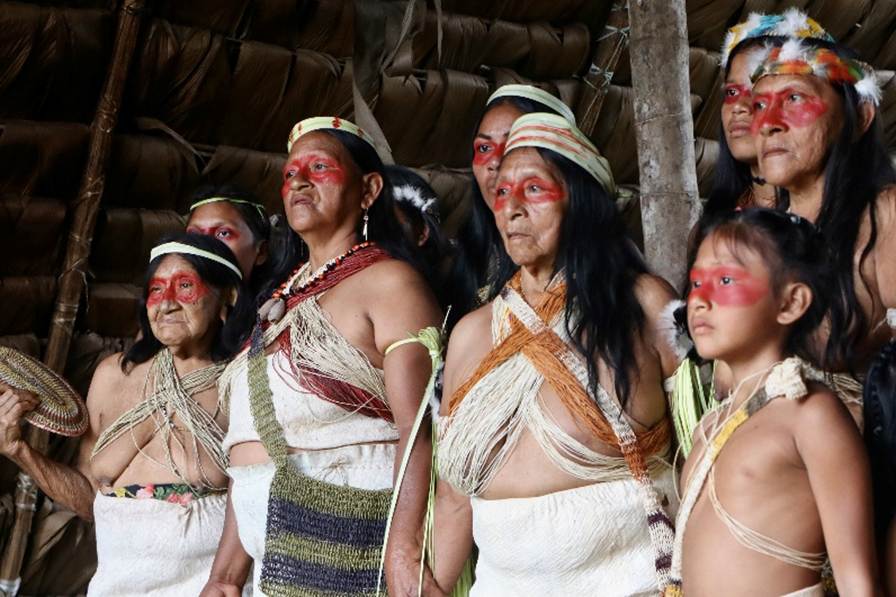
Many Amazonian peoples existed long before the republics that divided the basin. State borders turned relatives, trading routes, and ceremonial landscapes into international crossings. A river that once connected communities could become a customs line.
FOSPA argues that self-determination must therefore be transnational. The participating nations demand passage across state frontiers and coordination mechanisms, including Indigenous guards and community systems of territorial monitoring and defense.
This challenges a basic habit of Latin American states, which have often treated Indigenous territory as internal space to administer rather than as political geography with its own authority. The mandate asks governments to recognize that a nation can be divided by borders without ceasing to be one nation.
The forum demanded effective land titles, clear boundaries and legal security, as well as action against invasions and dispossession. It called for suspending concessions and extractive activities that threaten Indigenous lands.
“We will not allow one more step for extractivism or the state to subdue us,” Waorani vice president Ene Namquimo told EFE, warning that communities would monitor compliance.
Land titling may sound technical, but in the Amazon it determines who can say no. Without enforceable boundaries, consultation can become theater. A community may be invited to speak after a project has already been planned, financed and politically approved.
The declaration insists that free, prior and informed consent must not become a tool for legitimizing decisions, dividing communities or manipulating them into accepting new extractive frontiers. It also demands enforcement of favorable national and Inter-American rulings, since rights recognized on paper are often weakened through delay.
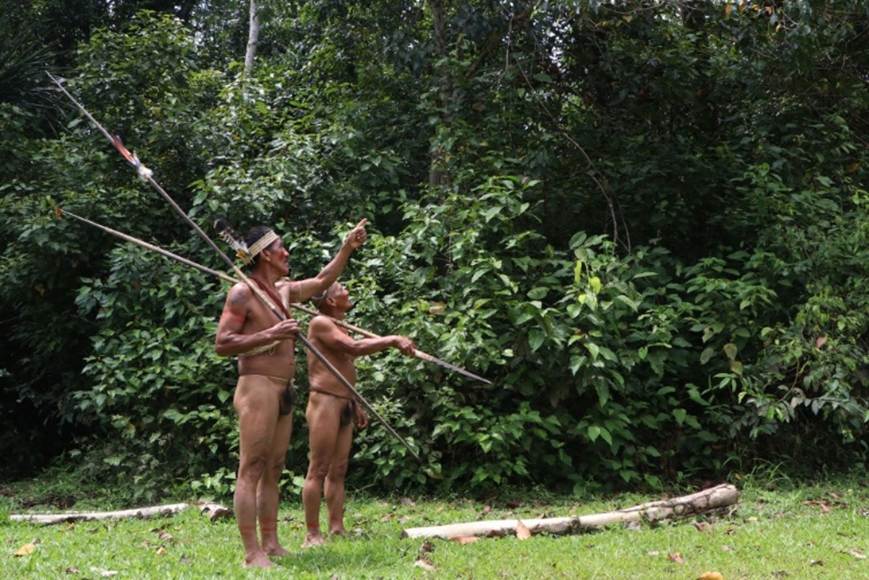
Protection for Indigenous peoples living in isolation or initial contact is treated as urgent. For them, an illegal road, mining camp, or oil operation can bring dispossession, disease, violence, and irreversible contact.
Conservation Without Colonial Control
The forum’s critique extends beyond conventional extractive industries. Participants rejected protected areas imposed over their territories without their authority, as well as the criminalization of leaders, communicators, and defenders of nature.
That position unsettles the assumption that conservation is automatically just. A forest can be protected on a government map while the people who cared for it are restricted, displaced or treated as intruders. FOSPA rejects that model, in which outside institutions claim guardianship while Indigenous residents lose decision-making power.
The same logic shapes its call for a just transition. The declaration proposes an Amazon free from fossil-fuel exploitation and extractivism, but it does not ask communities to absorb the costs of a transition designed elsewhere. It demands direct financing for territorial economies and effective participation by Indigenous women.
Climate money often moves through governments, large organizations, and intermediaries before reaching communities. The mandate seeks to reverse that route. Those defending the forest should not be the final recipients of someone else’s plan. They should help determine the plan and control the resources.
Education is part of that struggle. The forum called on states to strengthen Indigenous schooling, intergenerational transmission of knowledge and protection against violations of collective intellectual property. When elders cannot pass on languages, medicinal knowledge or territorial memory, environmental loss accelerates in ways satellites cannot measure.
Participants also agreed to create a Pan-Amazon mechanism through the Coordinator of Indigenous Organizations of the Amazon River Basin, known as COICA, to protect leaders and territorial defenders. The next gathering will be held in Colombia.
The mandate leaving Quito is ambitious because the danger is cumulative. It connects a mine, a road, a border checkpoint, a manipulated consultation, and a threatened leader as parts of the same system.
Its argument is simple, but not modest: the Amazon cannot be saved while its peoples are governed as obstacles inside their own home.
Also Read: Venezuela Floods Expose How Rain Finds the Same Forgotten Streets