Fidel Castro at One Hundred While Cuba Bargains with Tomorrow
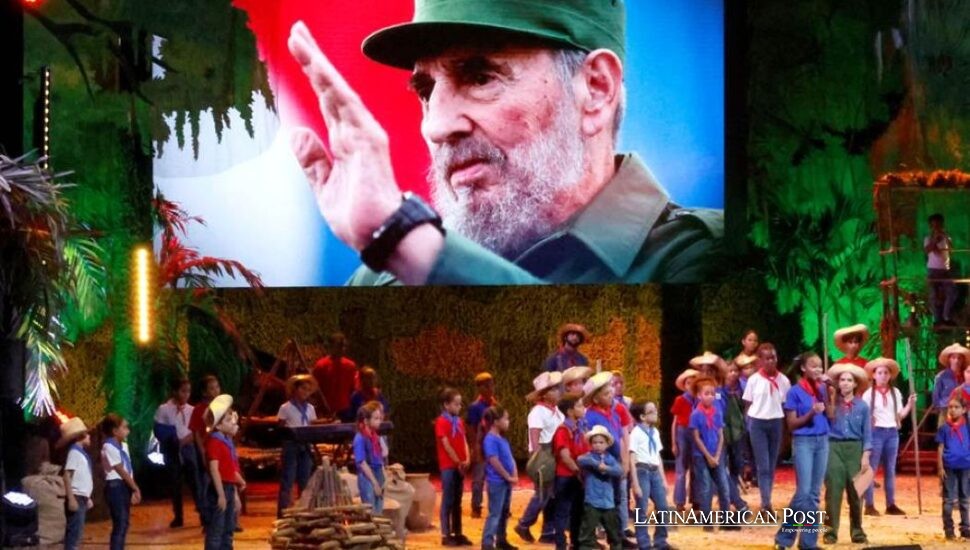
Fidel Castro’s centenary arrived with songs, statues and old revolutionary vows, but Cuba’s deepest crisis gave the celebration another meaning: the government was not merely honoring a dead leader. It was borrowing his authority to justify a difficult economic reinvention.
The Revolution Stages Its Memory
Inside Havana’s Karl Marx Theater, childhood voices carried the story of an aging revolution. La Colmenita, Cuba’s children’s theater company, moved through Fidel Castro’s life in images and songs while the political hierarchy watched. Raúl Castro was there, retired from office but still described officially as the “leader at the front of the Cuban Revolution.” President Miguel Díaz-Canel sat nearby, along with senior Communist Party officials, Fidel’s widow, Dalia Soto del Valle, and other members of the Castro family.
The arrangement brought institutional authority, revolutionary lineage, and family memory into one room. In a country where the Communist Party is the only legal party, this was more than a birthday tribute. It demonstrated that the current government still claims legitimacy through the founding generation.
Díaz-Canel said Fidel had dedicated his life to “all just causes” and would live forever as a rebel, warrior and defender of humanity, according to EFE. The language lifted Castro beyond the disputed record of a president who governed for almost half a century. It placed him inside a moral universe where revolution remains synonymous with independence, justice and national dignity.
Time can soften biography into symbol. Contradictions recede. A leader once immersed in daily decisions returns as an answer to questions he never faced in their present form.
The ceremony also closed the first international colloquium titled “Fidel: Legacy and Future,” attended by more than 1,000 Cuban and foreign delegates. Those two words contained the government’s problem. Cuba cannot remain frozen in the system Castro built, yet its leaders still need his name to explain why change does not mean surrender.
Reform Wrapped in Revolutionary Cloth
Díaz-Canel linked Fidel’s legacy directly to 176 economic and social reforms approved in June. The measures seek to liberalize and decentralize an economy trapped in a profound crisis for more than six years. The government did not present reform as a correction of Castro’s model. It presented reform as the latest defense of what Castro entrusted to the nation.
This is how revolutionary systems try to change without admitting rupture. Policies can bend while sacred language remains intact. Decentralization becomes continuity. Liberalization becomes protection of socialism. Fidel serves as a bridge across the contradiction, allowing the government to adopt practices associated with retreat while insisting that the destination remains unchanged.
The strategy carries risk. A historical figure can lend authority to reform, but he can also create an impossible standard. Alex Castro, one of Fidel’s sons, told EFE that his father always possessed the wisdom to confront difficulty and kept an answer in mind. The remark was affectionate, yet amid crisis it sharpened the comparison between the founder’s legendary certainty and the limited choices confronting his successors.
At a Plaza de la Revolución exhibition, roughly 30 portraits presented Fidel at different moments in the same monumental space. Photographer Roberto Chile, who followed him for about 25 years, told EFE that Castro was exceptionally photogenic. His bearing, history, and physical presence helped him command the camera.
That helps explain Castro’s political afterlife. A photograph removes exhaustion and the tedious machinery of governing. It preserves posture and fixes confidence. Displayed in the Plaza, the portraits do not merely record a man who once stood there. They make him permanently available to a state still searching for his certainty.
Díaz-Canel also blamed Cuba’s hardship on Washington, accusing the United States of tightening an immoral imperial siege. The language places current pain inside the revolution’s oldest dramatic structure: a small sovereign nation resisting a powerful enemy. Under that logic, reform becomes wartime adaptation, while political unity becomes a condition of survival rather than a matter open to competition.
The Afterlife Travels Abroad
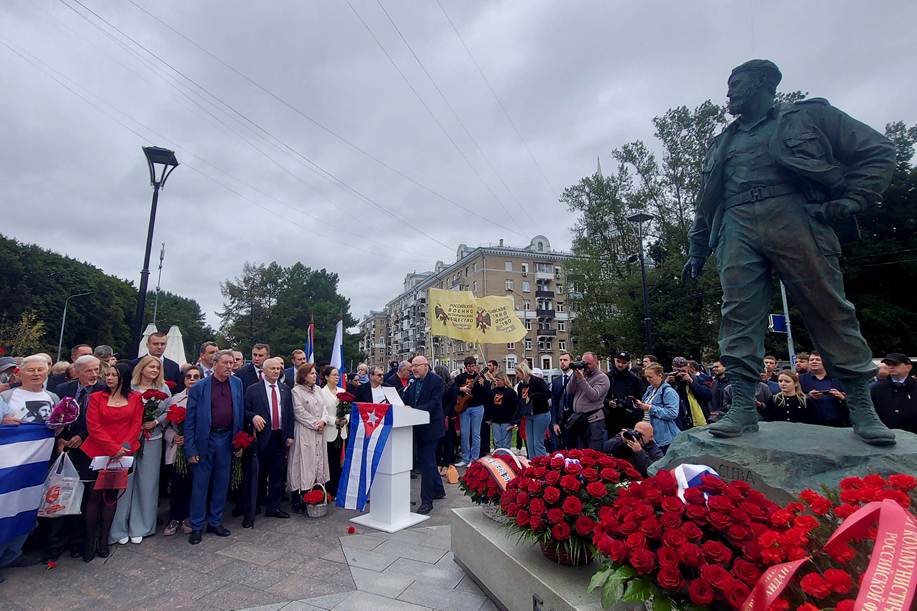
In Moscow, hundreds gathered with Cuban flags, red flowers and nostalgia for the Soviet era. Russian Communist leader Yevgueni Ziugánov, wearing a red jacket with the hammer and sickle, called Fidel a model for defeating history’s most evil forces. His remarks also carried an electoral tone before September’s parliamentary vote.
Fidel’s memory was serving Russian politics as much as Cuban history. Deputy Foreign Minister Sergei Ryabkov presented him as an early prophet of a multipolar world and linked his legacy to Moscow’s alliance with Havana. Vladimir Putin called Castro a symbol of freedom, justice and patriotism in messages to Raúl Castro and Díaz-Canel.
China emphasized another inheritance. Xi Jinping praised Fidel’s role in building relations Beijing now presents as a model of socialist cooperation. Brazil’s Luiz Inácio Lula da Silva offered something more personal, thanking Castro for encouraging his political journey through a message delivered by theologian Frei Betto. The same dead leader performed a different task in each country: geopolitical rebel, socialist statesman, mentor of the Latin American left.
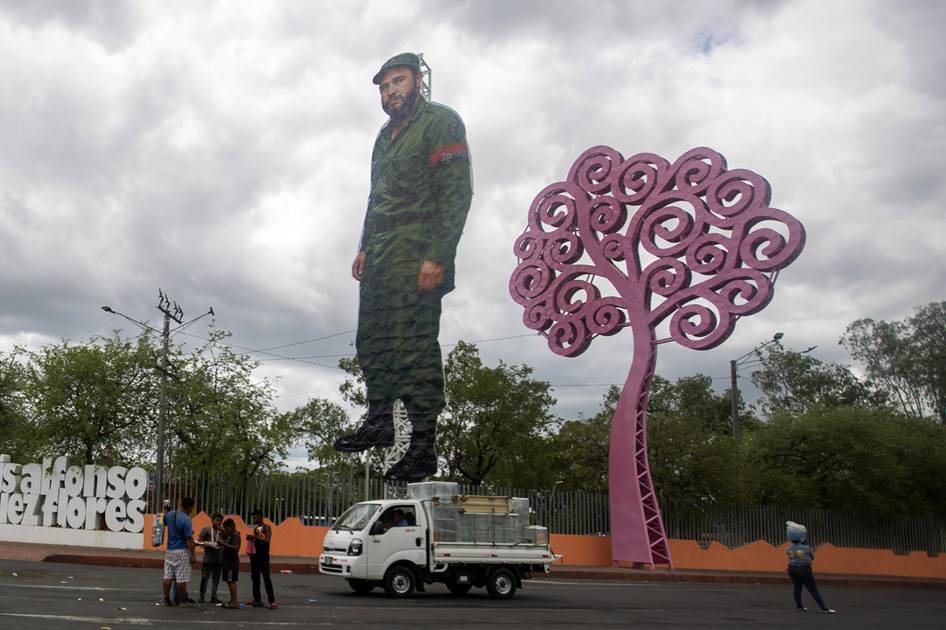
Managua offered the starkest version. Public employees, soldiers, police officers, and Sandinista youth gathered before a new 13-meter metal monument near government buildings and the National Assembly. Nicaragua’s co-president Rosario Murillo declared that Fidel lived in “our peoples,” while branding critics of the sculpture traitors and cowards.
There, remembrance became a test of loyalty. The monument did not simply preserve an alliance between Cuba and Nicaragua. It marked who belonged inside the revolutionary story and who could be cast outside it.
The irony is sharp. Fidel opposed statues of himself while alive, yet his image now rises in allied capitals. Whatever restraint he intended has not governed his afterlife. Governments have turned the man who rejected monuments into monumental political language.
At one hundred, Fidel Castro remains useful because the future is uncertain. Cuba’s leaders invoke him to authorize reform, allies invoke him to legitimize their struggles, and relatives and photographers restore the confidence of his presence. The centenary did not settle his legacy. It revealed the work that legacy is still being asked to perform.
In the Karl Marx Theater, children sang the past forward. Outside, Cuba continued bargaining with tomorrow.
Also Read: Peru Recruits FBI as Organized Crime Reinvents Its Survival Strategy