Argentina Faces a Chilling Economic Reckoning as Perito Moreno Loses Its Footing
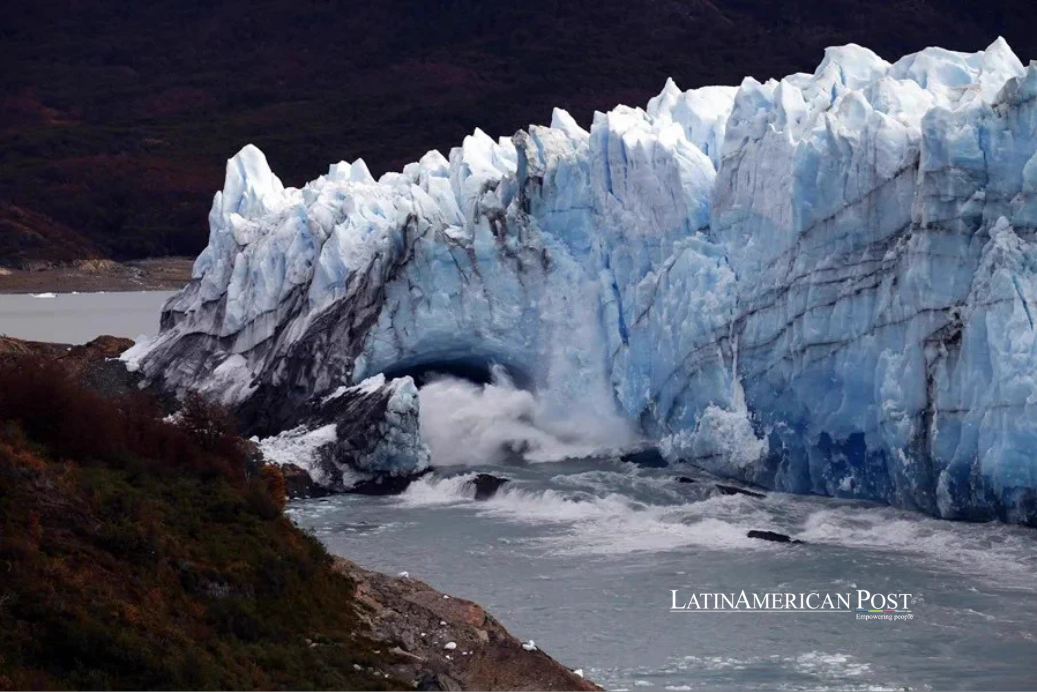
Argentina’s Perito Moreno glacier is retreating, shaking a tourism economy built on seemingly dependable ice. As the country loosens glacier protections, the changing landscape exposes a harder economic question: who pays when natural wealth stops behaving like a permanent asset?
The Glacier Loses Its Grip
A visitor can leave Perito Moreno with a photograph of falling ice. Someone earning a living from the glacier must think about what remains after the spectacle. The same landscape can be a holiday memory and the foundation of a household budget.
The figures are alarming, but one needs clarification. EFE described a retreat of 910 meters in 100 days. Glaciarium’s detailed monitoring account, however, identifies 910 meters as the distance from the Magallanes Peninsula in June 2026, up from 420 meters in February. That means roughly 490 meters of retreat in the measured sector, not uniformly across the front. The gap more than doubled. It also exceeded the 750-meter separation recorded in 1899. That historical comparison concerns distance, not evidence that the two retreats happened at the same speed.
Drone monitoring recorded 0.65 square kilometers of surface area lost between February 24 and June 4, following another 0.81 during the southern summer. Together, those losses total 1.46 square kilometers. This is a shrinking footprint, not a measurement of ice volume or drinking water lost.
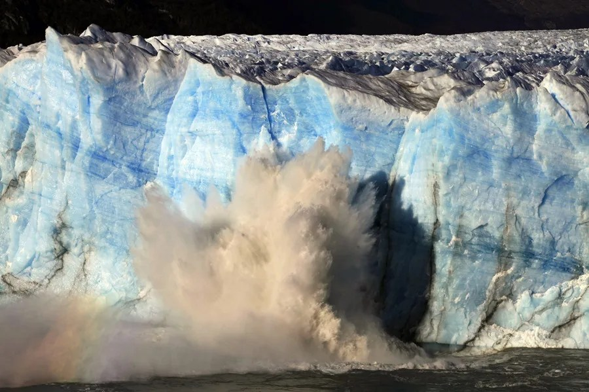
Between 1999 and 2013, the glacier’s front shifted by less than 50 meters. That history encouraged confidence, but it never guaranteed immunity. A glacier held in place by underwater terrain can appear resistant to warming until the conditions supporting that resistance begin to fail.
Luciano Bernacchi, a Glaciarium director, told EFE that the glacier was losing contact with a submerged accumulation of rocks that had provided support. He described surrounding water roughly 160 meters deep, compared with about 60 meters above the formation. The ice was losing a natural brace.
Research in Communications Earth & Environment found frontal surface lowering accelerated from 0.34 meters annually during 2000–2019 to 5.5 meters during 2019–2024, approximately sixteenfold. That is vertical thinning, distinct from horizontal retreat. The lake’s shape helps explain how climatic pressure can trigger disproportionate changes once stabilizing support weakens.
A Town Built Around Ice
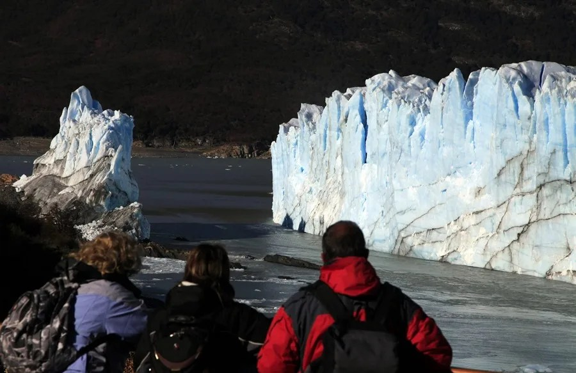
For El Calafate, the significance reaches beyond a changing view. Almost 90 percent of visitors to the gateway town eventually visit Perito Moreno. An estimated 500,000 to 700,000 people visit the glacier annually. Those figures describe an economy with considerable exposure to one natural attraction.
They do not mean the glacier generates 90 percent of local income. But they suggest that businesses apparently separate from the ice can share the same underlying vulnerability. A restaurant need not overlook the glacier to depend on the traveler who came to see it.
The research also records almost 800,000 national park tickets sold in 2023, compared with 663,674 in 2022. That increase approached 21 percent. Yet park admissions and glacier visitors are different measures; comparing them as though they tracked the same population could create a false impression of tourism decline.
Nor does retreat automatically empty hotel rooms. A changing glacier can remain spectacular. The economic danger is treating continued popularity as proof that the attraction, its accessibility and the infrastructure supporting it will remain equally dependable.
For a hotel owner, another room represents a bet on future seasons. For a guide, experience remains valuable even when routes require adjustment. Public investment should help these livelihoods adapt through reliable monitoring and carefully planned access, rather than leave small businesses to absorb physical changes they cannot control.
Tourism cannot be managed sensibly as a countdown to disappearance. The available measurements provide no defensible expiration date. They do provide reason to stop selling yesterday’s stability as tomorrow’s guarantee.
Protection on Thinner Ice
The political contrast is difficult to miss. In April 2026, Congress approved President Javier Milei’s glacier law reform, expanding provincial authority over identifying protected glacial and periglacial environments. The government is simultaneously offering substantial tax incentives for investment in natural resource extraction.
Nothing in these glacier measurements establishes that mining caused Perito Moreno’s retreat. Nor does the reform hand this national park to provincial mining authorities: the law retains the National Parks Administration’s jurisdiction over federally protected parks. The dispute is about national priorities, not an invented local excavation.
Environmental groups have challenged the reform through protests and litigation, arguing that it weakens water protection. The economic question behind that objection is concrete: when authorities seeking investment also determine which environments qualify for protection, scientific classification becomes a point of financial pressure.
Provincial decision makers may understand local terrain better than distant officials. Proximity alone, however, does not eliminate conflicts between immediate investment and environmental obligations extending beyond a project’s lifespan. Technical findings need independence precisely when a favorable designation carries commercial value.
The lesson for Argentina is not that every mine threatens every glacier. It is that climate vulnerability changes the calculation of acceptable additional risk. Protecting a water reserve or a tourism landscape is not refusing development; it is recognizing assets that extraction statistics do not fully price.
Perito Moreno’s former stability was a physical condition, not a national entitlement. Argentina can rewrite its rules within a political season. The families whose livelihoods depend on this landscape need decisions built for longer horizons. A brochure can be redesigned. A marketing campaign cannot restore a glacier’s lost foothold.