Paysandú Serves Up Faith and Chajá as Pope Leo XIV Comes Calling
Paysandú is preparing for Pope Leo XIV’s November 7 Mass with riverfront pride, Argentine pilgrims and a celebrated dessert, turning a brief papal stop into a test of hospitality, regional identity and tourism ambition in Uruguay’s unusually secular public landscape.
A Bridge to the Spotlight
Posters bearing Pope Leo XIV’s image hang around Paysandú. Shops sell keepsakes, and even the city’s signature dessert now comes in commemorative packaging. For a place roughly 230 miles from Montevideo, preparations for Saturday’s papal Mass carry an ambition larger than filling a park: getting visitors to remember where they have been.
Tens of thousands are expected at Parque París Londres on November 7, a day after Leo arrives in Uruguay’s capital. Thousands will cross the international bridge from Colón, Argentina. The Uruguay River, which marks a national boundary, will help define a gathering whose religious loyalties extend across it.
“I would say it is the most significant visit in the department’s history,” Nicolás Olivera, head of the departmental government, told EFE. He said he looks forward to outsiders discovering the place residents inhabit beyond the television pictures.
Paysandú already possesses a formidable historical identity. Its nickname, La Heroica, recalls the 1864-65 siege, when defenders led by Leandro Gómez resisted Brazilian forces and Uruguayan rebels under Venancio Flores. This was both a domestic struggle and a foreign intervention, reminding visitors how regional powers shaped Uruguay’s conflicts.
Gómez was executed after the city fell in January 1865. The defense is still interpreted in a public museum in Plaza Constitución, placing the remembered struggle in the city’s everyday geography.
That memory complicates any portrait of Paysandú as merely a picturesque stopover. The city’s pride predates the papal posters. Welcoming neighbors across the bridge now gives a border once entangled in war a different public meaning.
Faith Beyond the Capital
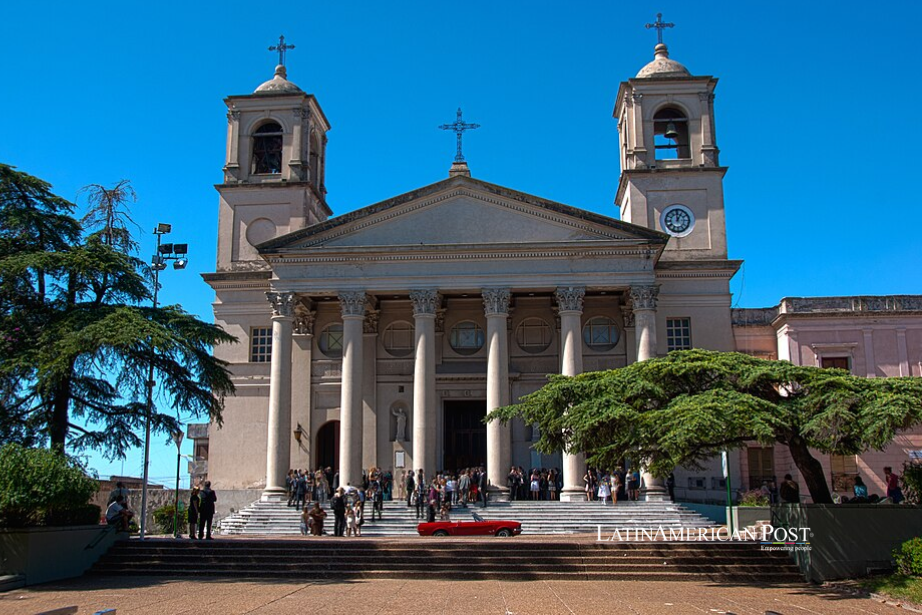
At the basilica of Nuestra Señora del Rosario, parish priest Miguel Suárez described the visit to EFE as “a great joy.” He sees strong local religiosity and expects an enthusiastic reception. His account describes a community of believers; it does not require every resident to share their devotion.
That distinction matters in Uruguay. The constitution protects religious freedom while declaring that the state supports no religion. A papal welcome therefore unfolds within a civic culture where Catholicism has a public presence without holding an official monopoly on national identity.
Paysandú offers its own illustration. Its annual beer festival takes place during Semana de Turismo, Uruguay’s official designation for the period corresponding to Holy Week. Religious observance, holidays and commercial celebration occupy the same calendar through different understandings of what the week means.
The pope’s arrival can similarly draw worshippers, curious spectators and residents, proud that their city has been chosen. Crowd size will measure the scale of the occasion, rather than provide a reliable census of religious commitment. Argentine pilgrims also make this a regional congregation, beyond the boundaries of any local parish.
For Catholics outside Montevideo, the location matters. The first Mass of this Latin American journey will take place in their part of the country. For a few hours, the familiar hierarchy between capital and provincial city will be rearranged.
More Than a Souvenir
Olivera told EFE that hotels, restaurants, and the welcome offered by residents must match the occasion. The economic opportunity is real, but attendance estimates don’t translate directly into overnight stays. A pilgrim arriving from nearby Colón may hear Mass, buy lunch, and return across the bridge that afternoon.
Leo’s published schedule allows just three hours and 35 minutes between landing and departure in Paysandú. The brevity sharpens the contrast between the visitor’s timetable and the preparation an entire city must make.
That geography makes hospitality consequential. A smoothly managed day could encourage a later weekend visit; congestion or an indifferent reception could leave little appetite to return. Businesses must serve a sudden concentration of customers while making the city feel worth exploring after the main attraction leaves.
Chajá has an advantage here. Orlando Castellano created the dessert in 1927, and it combines meringue, sponge cake, and cream. Its contrasting textures give Paysandú something visitors can recognize through taste. A special papal edition puts the event on the packaging while keeping the city’s own creation inside.
A 2023 TasteAtlas ranking placed Chajá among the world’s top 30 cakes. This placement gives confectioners a marketing tool to reach an audience beyond the city and Uruguay. The more durable asset is a recipe approaching its centenary, with an identity that does not depend on the pope’s itinerary.
Beyond the city, Guaviyú’s freshwater thermal baths and Almirón’s saline waters offer reasons to extend a trip. The Montes del Queguay and Meseta de Artigas expand the department’s possibilities. Turning those attractions into additional nights requires visitors to discover a destination larger than Saturday’s gathering.
For families making the journey to worship, the essential outcome will be hearing the Pope together. Tourism gains depend on respecting that purpose while making room for further exploration afterward.
Olivera also spoke to EFE about the pride involved in preparing to receive strangers. That benefit is harder to enter into a balance sheet, but it belongs to the story. When the papal aircraft leaves, Paysandú will still have its river, its history and its kitchens. The lasting opportunity is persuading some of Saturday’s guests to come back.